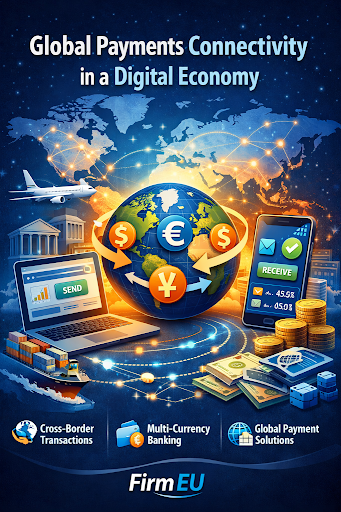
In recent years, the way money moves across borders has changed profoundly. Transactions that once took days and manual reconciliation now happen in near-real time, thanks to digital infrastructure and modern financial technology platforms. Businesses that operate in today’s digital economy depend on more than just physical bank branches or traditional wire transfers; they require systems that connect them to customers, partners, and suppliers around the world in ways that are reliable, compliant, and efficient.
Nonetheless, achieving truly seamless connectivity is not a trivial task. Companies face regulatory boundaries, varying currency practices, fragmented payment rails, and disparate banking systems. Even though innovations have transformed local commerce, the leap to international markets adds layers of complexity that many businesses still struggle to navigate.
In markets where e-commerce, remote work, and cloud-based services are rapidly growing, global payments infrastructure has become more than just a convenience — it’s a necessity for survival and competitiveness.
Why Global Payments Matter Today
Traditionally, businesses that sold internationally had to set up banking relationships in every country where they had customers. That meant opening accounts, verifying compliance documents, handling different languages, and managing multiple currencies through local banks. A company in Germany selling to India or Brazil needed separate banking partners, each adhering to their own rules and timelines. Transactions could take several days, and errors were common.
Now, digital platforms and payment networks are stepping into that gap. They help reduce friction and automate many of these tasks so that companies can transact across borders more smoothly. For example, networks like the European Payments Alliance are working to bring uniformity to how payments move across multiple nations, creating a more harmonised experience for banks and merchants alike.
Innovations in payment technology are especially critical for businesses that deal in multiple territories with different financial regulations and infrastructure. Whether it’s a consumer ordering goods online from halfway across the world or a company transferring funds to an overseas supplier, the speed and reliability of cross-border financial flows are crucial.
The Challenge of Cross-Border Transactions
Despite progress, moving money internationally still involves hurdles. The term Cross-Border Payments refers to transactions in which the sender and recipient are located in different countries. On the surface, this may sound simple — just send money where it needs to go. However, each country has its own regulations, bank fees, compliance requirements, and settlement procedures. Different regions may use distinct clearing systems or standards, which can slow transfers and add costs.
For instance, payment standards such as SEPA in the European Union strive to make euro-denominated transfers as easy as domestic ones across member nations. However, outside such harmonised areas, settlement times can still vary widely, and fees often remain high.
These challenges affect businesses and consumers alike. A freelancer in India waiting on payment from a client in the UK may face delays. An online retailer shipping to customers in Latin America might pay significant fees to transfer revenue back to its home base. Without efficient international payment rails, companies take risks on fluctuating exchange rates, compliance penalties, and customer dissatisfaction due to slow settlement times.
As the volume of global transactions continues to rise, thanks in part to digital commerce and remote work trends, the demand for faster, transparent, and more manageable systems increases.
What Modern Global Payment Connectivity Looks Like
Today’s digital economy thrives on platforms that help businesses navigate these complexities. Modern systems remove the manual layers of the past and replace them with automated processes, risk checks, compliance screening, and connectivity to global financial networks. Many of these platforms offer dashboards, APIs, and reporting tools that make it clear where funds are at any moment, what fees are attached, and how long settlements will take.
Important components of this ecosystem include:
- Multi-rail connectivity, allowing payments over multiple networks depending on cost, speed, and compliance.
- Real-time settlement options, so funds are accessible quickly without waiting days for clearing.
- Integrated compliance screening, which ensures that international laws, anti-money-laundering rules, and sanctions requirements are met automatically.
- Currency conversion services, which help businesses deal with fluctuating exchange rates and reduce exposure to currency risk.
One key enabler of this landscape is companies that connect businesses to financial institutions and infrastructure worldwide. Firm EU, for example, bridges the gap between businesses and verified financial partners that align with their specific payment and banking needs. Rather than requiring organizations to build these connections one by one, Firm EU connects companies to banks, payment providers, and service partners that can support international transactions efficiently. This approach makes it easier for companies to maintain financial operations across borders.
The result is a system where a business based in Europe can transact with customers in Asia, Africa, or the Americas without the traditional layers of overhead and manual intervention.
The Role of Multi-Currency Banking and Partnerships
An essential piece of the puzzle is how companies manage currency. In an international context, funds are often received and held in various currencies. Businesses must convert them, manage exposure to rate fluctuations, and make payments in the local currency of partners and vendors.
This is where a Multi-Currency Banking Partner plays an important role. Instead of juggling dozens of bank accounts in different countries, businesses can hold and manage funds in multiple currencies through a single partner. This setup simplifies reconciliation, reduces fees, and gives firms more control over when and how currency conversion occurs.
Multi-currency capabilities are especially valuable for companies that sell globally. If a retailer receives payments in euros, pounds, dollars, and yen, having a partner that supports these currencies in one platform saves time and reduces administrative burden.
It’s not just about holding different currencies — it’s also about operational flexibility. For instance, firms with team members, suppliers, or service providers in multiple regions benefit significantly when they can pay them in their local currency without incurring heavy conversion fees or unnecessary delays.
Integrated Solutions That Support Scale
When businesses first start selling outside their home market, they often rely on payment gateways and local banking relationships that handle small volumes. But as they scale, that approach can break down. Questions arise like: “How can we centralise our funds?” or “Which partner can help us move money securely without manual reconciliation?” or “What systems ensure compliance across different legal jurisdictions?”
A Global payment solution answers these questions by combining connectivity, settlement, compliance, and reporting into one ecosystem. It becomes less about managing dozens of individual connections and more about having a high-level platform that orchestrates payments based on the company’s specific needs.
These solutions may include:
- Cross-border settlement infrastructure
- Multi-currency account capabilities
- Transparent fee and exchange reporting
- Automated compliance and risk checks
- Centralised dashboards for finance teams
Platforms built for global connectivity allow finance teams to see where their money is, what regulatory requirements apply, and how to optimise cash flows across regions.
For small and medium enterprises, this kind of capability used to be limited to large corporations with the resources to build complex banking networks. Today, technology players and financial infrastructure partners have democratized access, making it possible for businesses of all sizes to run international operations more smoothly.
Regulatory Frameworks and Compliance in the Digital Era
No discussion of international payments would be complete without acknowledging the importance of regulation. Every country imposes rules meant to protect consumers, prevent fraud, and comply with local legal standards. These regulations intersect with everything from anti-money-laundering (AML) checks to foreign exchange controls.
While many digital platforms simplify these layers, they also rely on compliant partners, robust data-sharing agreements, and updated internal monitoring. This is especially true when dealing with varied regulatory regimes, such as those in Europe compared to Asia or Latin America.
For example, initiatives in the European Union aim to standardise electronic payments across member countries, making transfers with euro-denominated accounts nearly as simple as domestic payments within each state. These types of frameworks reduce friction and lower costs for businesses so they can send and receive funds without worrying about substantial regulatory obstacles.
Similarly, collaborations between payment providers and technology platforms often include embedded compliance checks that flag suspicious activity, ensure correct documentation, and monitor risk in real time.
What the Future Holds
As digital commerce continues to grow, connectivity for global payments will become even more vital. Business models that rely on subscription monetisation, app marketplaces, online services, and cross-border trade need payment infrastructure that keeps pace with customer expectations and regulatory environments.
Emerging technologies like digital currencies, blockchain-based settlement, and central bank digital currencies (CBDCs) are also contributing to change. These innovations promise faster settlement times, increased transparency, and reduced dependence on traditional banking networks.
However, the real breakthrough will come when these emerging tools integrate seamlessly with existing payment rails and regulatory frameworks. The end goal for many businesses is to have a system where someone in Tokyo can pay a vendor in Brazil as easily and reliably as someone in New York pays a local merchant — all without manual intervention or unnecessary fees.
Connectivity, compliance, and clear visibility of funds will be the foundations of that future.
Conclusion
Global payments connectivity represents a fundamental shift in how businesses operate in the digital economy. What was once a maze of fragmented systems and slow settlement times has become a network of interconnected platforms, compliant partners, and automated infrastructure. This transformation allows organisations to trade across continents, serve customers in diverse markets, and manage multi-currency operations with greater clarity and control.
Companies that build on these systems now position themselves to compete on a global scale without being hindered by outdated payment practices. At the same time, the emerging financial landscape continues to evolve, driven by improvements in technology and the ongoing efforts of financial innovators.
Whether a startup is looking to sell its products internationally or an established business wants a more efficient way to handle its treasury operations, the digital economy’s global payment networks make it possible to think bigger and act faster.
Firm EU plays a part in this story by making sure that companies have access to the right partners and infrastructure needed to compete confidently in a world that no longer stops at borders.