Confused about Etsy fees? Discover how much Etsy takes from each sale, including listing fee, transaction fee, and payment processing fee.
Selling on Etsy sounds simple—list a product, make a sale, get paid. But before you set your prices, you need to understand Etsy fees. Many new sellers underestimate costs and end up with lower profits than expected.
Etsy charges more than just one basic fee. You’ll pay listing fees, transaction fees, and payment processing fees. In some cases, there are also optional advertising costs. These charges may seem small at first, but they add up quickly.
So, how much does Etsy actually take from each sale? The answer depends on your product price, shipping cost, and whether you use Etsy Ads. Because of this, two sellers can earn very different profits from the same $50 sale.
In this guide, we’ll break down every Etsy fee in simple terms. By the end, you’ll know exactly what to expect—and how to price your products to protect your margins.
Etsy Fees Breakdown
Selling on Etsy involves several fees that help keep the platform running. Here is a clear breakdown of the Etsy fees you will encounter as a seller.
Listing Fee
Every time you post a product, Etsy charges a flat fee of $0.20. This fee puts your item on the market for four months or until it sells.
If your item does not sell within four months, the listing expires. You must pay another $0.20 to renew it for another four months.
Transaction Fee
When you make a sale, Etsy takes a 6.5% commission on the total amount. This percentage applies to the item price, shipping costs, and any gift-wrapping fees you charge.
This fee is only charged after a buyer completes a purchase. It ensures the platform benefits directly from your success.
Payment Processing Fee
Etsy charges a fee to handle the money transfer from the buyer to your bank. In the United States, this is usually 3% plus $0.25 per transaction.
These rates vary depending on which country your bank is located in. This cost covers the security and technology needed to process credit cards and digital wallets.
Offsite Ads Fee
Etsy pays to show your products on other websites like Google, Facebook, and Instagram. You only pay a fee if a customer clicks one of those ads and buys from your shop within 30 days.
If you made less than $10,000 in the past year, the fee is 15% of the sale, and you can opt out. If you made more than that, the fee drops to 12%, but participation becomes mandatory.
Etsy Ads Fee
Unlike offsite ads, Etsy Ads show your products to shoppers specifically searching on the Etsy website. You choose a daily budget for how much you want to spend on these promotions.
You pay for these ads based on clicks rather than sales. This means you are charged every time someone clicks your ad, even if they do not buy the item.
Currency Conversion Fee
If you list your items in a different currency than your bank account uses, Etsy must convert the money. This service costs an additional 2.5% fee on the total sale amount.
To avoid this extra cost, you should make sure your shop currency matches the currency of your local bank.
Regulatory Operating Fee
Sellers in certain countries like the UK, France, and Canada must pay a small extra percentage. This fee helps Etsy cover the cost of following local digital laws and taxes.
The rate is usually very low, often ranging from 0.29% to 2.27%. This fee applies to the total amount the buyer pays, including shipping.
| United Kingdom | 0.32% |
| France | 0.47% |
| Italy | 0.32% |
| India | 0.29% |
| Spain | 0.72% |
| Türkiye | 2.27% |
| Vietnam | 1.24% |
| Canada | 1.15% |
Subscription Fee
Most Etsy sellers start with a free Standard account, but you can choose to pay for Etsy Plus. This optional subscription costs $10 per month.
The plan gives you extra tools, such as credits for listings and ads. It also provides advanced ways to customize how your shop looks to customers.
What is the $29 Fee on Etsy?
In early 2024, Etsy introduced a new fee for some people opening their first store. This is known as the Etsy Shop Setup Fee. While the amount can vary, many new sellers are seeing a one-time charge of $29.
The $29 fee is a one-time payment required to open a new shop on Etsy. Etsy does not charge this to every single person who signs up, but it is becoming more common.
You pay this fee during the initial setup process before your shop goes live. It is separate from the $0.20 listing fee and only needs to be paid once.
Etsy created this fee to help keep the marketplace safe from scammers and bots. By adding a small cost to start, they make it harder for fake accounts to flood the site.
The money also helps pay for more advanced security checks during the signup process. This ensures that every new seller is a real person who is serious about their business.
When you start an Etsy shop, Etsy will ask you to confirm the payment. They may place a temporary hold on your credit card for the amount before officially charging you.
This fee is non-refundable, even if you decide to close your shop later. It is listed as a “Setup Fee” in your shop’s payment account history.
How Much Does Etsy Take from a $100 Sale?
When you sell a $100 item on Etsy in the United States, you can expect the platform to take roughly $10.15 in basic mandatory fees. This calculation assumes you are not using optional services like ads and that the $100 includes any shipping costs you charged the buyer.
The first deduction is the $0.20 listing fee, which you pay as soon as the item sells to renew the listing for the next customer. Next, Etsy takes a 6.5% transaction fee, which equals $6.50 for a $100 order. This fee covers the cost of using the marketplace and is calculated based on the total amount the buyer paid you.
The final mandatory cost is the payment processing fee, which covers the secure transfer of money to your bank. In the U.S., this rate is 3% plus $0.25, which adds up to $3.25 on a $100 sale. After all these standard fees are removed, you would be left with $89.85 before you account for item cost and shipping cost.
How to Calculate Etsy Fees?
To calculate your Etsy fees, you must add up the listing fee, the transaction fee, and the payment processing fee. This can be difficult because some of these Etsy fees are fixed while others change based on a percentage of your total sale.
The easiest way to calculate Etsy fees is to use the Etsy fee calculator by Sidekick Tools. It’s free, accurate, and does all the calculation work for you in just a few seconds. You only need to enter your item’s price and shipping cost to see a clear breakdown of your expected profit.
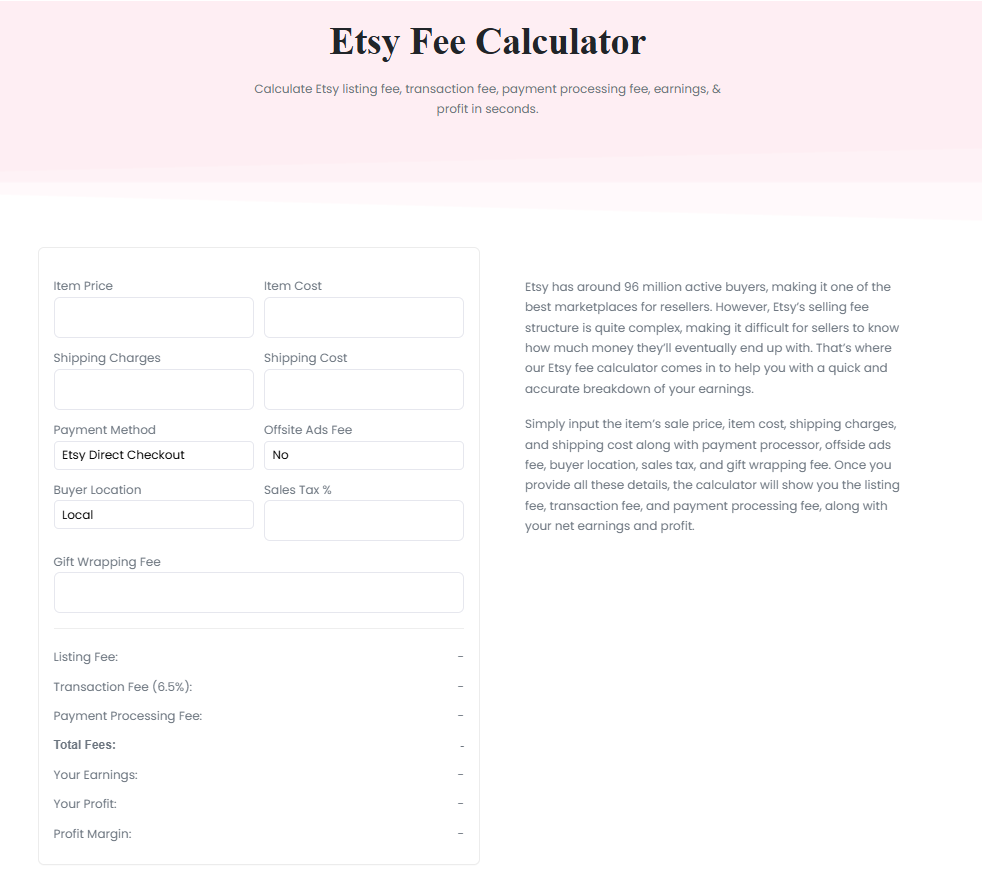
Using Etsy fee calculator will help you avoid mistakes that could hurt your reselling business earnings. It is a reliable resource that allows you to test different prices before you commit to a listing. This ensures you always know exactly how much money will end up in your bank account after Etsy takes its share.
Who Pays for Shipping on Etsy?
On Etsy, the buyer usually pays for shipping, but the seller is responsible for making sure the item gets to the door. Most sellers set up their shops so that the shipping cost is added to the price of the item at checkout.
How the Buyer Pays
When a shopper looks at your item on Etsy, he sees a shipping price that you have chosen. If he decides to buy the item, Etsy adds that shipping amount to the total cost of the order.
The buyer pays this full amount directly to you through the Etsy platform. You then use that money to purchase a shipping label and send the package to the customer.
The Free Shipping Guarantee
Many sellers choose to offer free shipping to attract more customers and show up higher in search results. When you offer free shipping, the buyer does not see an extra delivery charge at the end.
Etsy encourages sellers to offer this for orders over $35 for shoppers in the United States. To avoid losing money, most sellers simply add the cost of shipping into the price of the item itself.
Buying Shipping Labels
While the buyer pays the cost, you are the one who physically buys the label from a carrier like USPS or FedEx. You can buy these labels directly through your Etsy dashboard at a discounted rate.
The money for the label is usually taken out of your Etsy shop balance. This makes it easy to manage your expenses and print your labels without leaving your house.
International Shipping Costs
Shipping items to other countries is often much more expensive than shipping them nearby. You can set different shipping prices for different parts of the world so you do not undercharge.
Buyers expect to pay more for international delivery, and they are also responsible for any extra customs fees. It is a good idea to clearly state in your shop policies that these extra taxes are the buyer’s responsibility.