Extrusion is the most common method used for the industrial processing and transformation of thermoplastic polymers, but it is also used for other kinds of materials. For this purpose, special machines called extruders are used.
This technology is not only used in the plastics industry, but also in the ceramics, pharmaceutical, and food sectors.
Extruders come in different shapes and sizes. Depending on the application, single-screw extruders, twin-screw extruders, or co-extruders can be used.
Among these, one of the most commonly used types is the single screw extruder machine, which is used to mix and shape a plastic product until it achieves the required form.
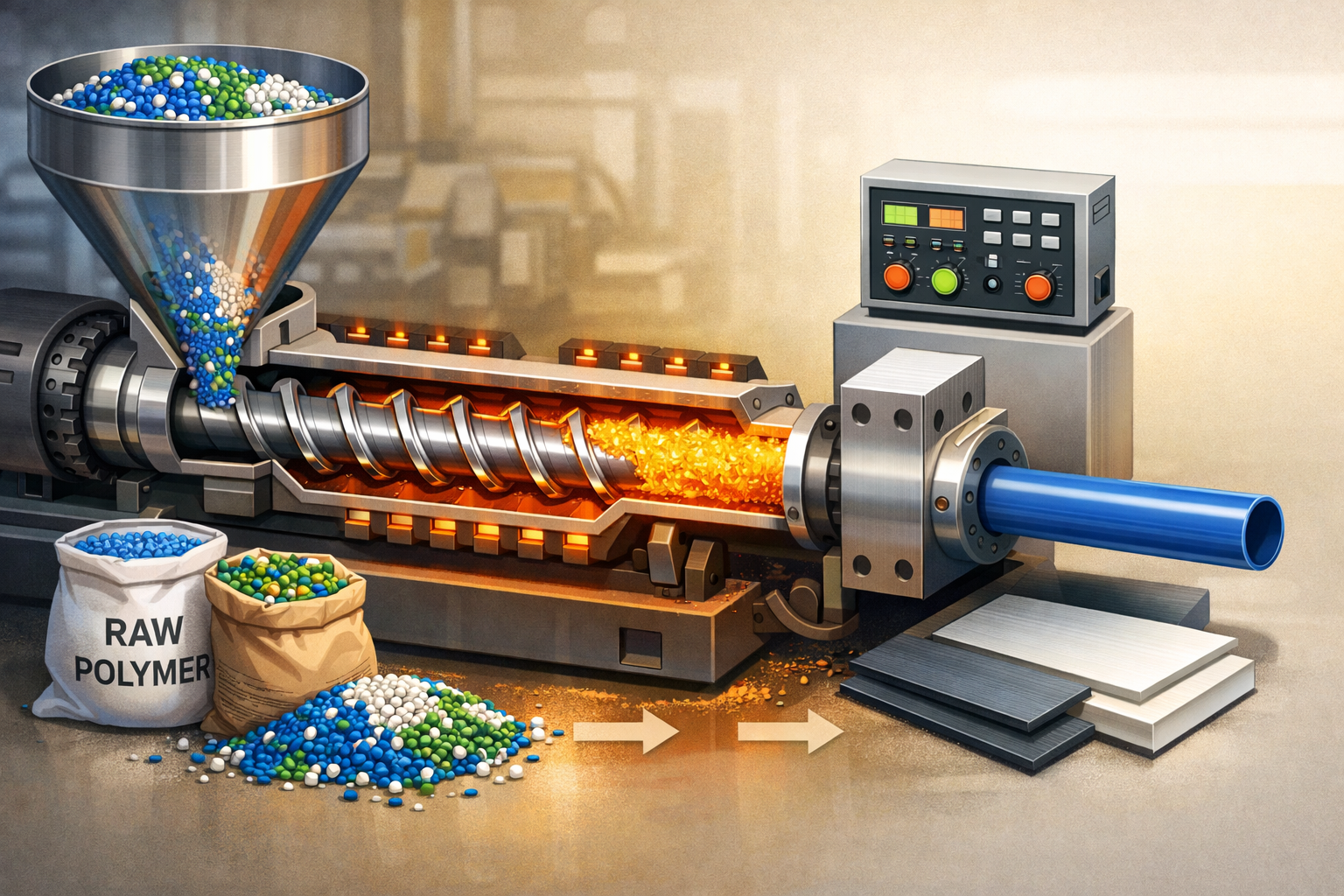
The term “single-screw” means that the machine uses a single screw that is inserted into a heated cylinder. The screw, which is designed after specific tests, is a key element in the extrusion process because it allows the raw material to be melted, mixed, and transported. It can have a fixed or variable diameter (i.e., with an increasing diameter along the screw).
What does a single-screw extruder machine consist of?
A single-screw extruder is a highly technological machine and its main components can be summarized as follows:
- high-efficiency motor
- loading hopper: this is the container in which the material to be processed is placed;
- material feeding system;
- heated cylinder and extrusion screw: this is the “heart” of the entire process; here the material is heated in a controlled way to prevent degradation or other faults; the screw is used to mix and push the product forward;
- extrusion die: this is the component that gives the material the required shape;
- cooling system: necessary to solidify the product before moving on to the next stages.
Downstream of the extruder, there may be other machines, such as cooling, packaging, winding, or other finishing systems.
What plastics can be processed by a single-screw extruder?
A single-screw extruder can be used to process a wide range of plastic materials. These include: PVC (Polyvinyl Chloride), HDPE (High-Density Polyethylene), LDPE (Low-Density Polyethylene), PP (Polypropylene), ABS (Acrylonitrile Butadiene Styrene), PMMA (Polymethyl Methacrylate), PC (Polycarbonate), TPE (Thermoplastic Elastomers).
Other materials that can be processed include filled compounds (i.e., with “fillers” that improve certain properties), recycled compounds, polymer blends (mixtures of two or more different polymers), etc.
Extruders can be customized according to the different formulation of the material. This is a fundamental point since each material has its own characteristics (viscosity, melting temperature, heat sensitivity, possible presence of fillers or additives, etc.).
A single-screw extruder is an ideal choice for the production of many products, including electrical cables, water pipes, gas pipes, irrigation systems, window and door profiles, cable ducts, baseboards, roller shutters, furniture components, and much more.
Single-screw or twin-screw extruder?
Extruders can also have two screws (twin-screw machines). The main difference is that twin-screw extruders offer a very wide range of functions, both in terms of the raw materials that can be processed and the operating conditions. Twin-screw extruders also stand out for their excellent blending ability, which makes them suitable for processing more “difficult” materials. They are therefore incredibly versatile. Naturally, the choice depends on the type of processing.
In many cases, a single-screw machine may be an appropriate choice because it offers a good balance between performance and low operating costs. On the other hand, for processes that require intense and uniform mixing, twin-screw extruders are a very suitable option, even if they can be expensive and complex to maintain.
How much does a single-screw extruder cost?
The price of a single-screw system is extremely variable as it is influenced by many technical and production factors, including the presence of additional equipment (cutters, stackers, calibration systems, etc.).
In general, prices range from average prices for compact and standard configurations to much higher prices for customized machinery designed for specialized production or high production volumes.