Introduction
Accounting has been the support system of business. Since the first can be found on clay plates nowadays the most modern and advanced methods of accounting software are based on the cloud computers, the approach to entering the financial data has changed tremendously. Manual vs. electronic accounting systems play a role in businesses by recording transactions, quantifying performance, complying with laws, and making business decisions.
Accounting has ceased to be in handbooks to digital accounting systems that are automated over the years. The change is the technological advancement of accounting work that has caused a revolution in the way organizations keep process and report financial information.
The article compares manual accounting systems with electronic accounting systems and evaluates the techniques of these systems, their strengths, weaknesses, and general effectiveness in efficiency, accuracy, scalability, internal controls and real-time reporting. It also shows how technology has transformed the accounting activities and had a bearing on the way business is conducted all over the world.
Manual Accounting Systems
Meaning and Structure
Manual accounting system is a traditional system that the financial transactions are recorded through physical books of account. The journals, ledgers and subsidiary books are written by hand and transactions are written in them. The calculations are also done manually and financial statements are drawn up without using computerized software.
The main elements of a manual accounting system are:
- Documents of sources (invoices, receipts, vouchers)
- Journal (book of original entry).
- Ledger (book of final entry)
- Trial balance
- Financial reports (income statement, balance sheet, cash flow statement)
All transactions are based on the principle of double-entry, i.e. any debit is to be accompanied by a credit. Periodically, accountants have to ensure that they make entries in journals to ledger books and balance accounts.
Manual System Characteristics
The manual systems are defined by:
- Physical record-keeping
- Handwritten entries
- Manual calculations
- Limited automation
- Paper-based storage
These systems were very popular prior to the advent of computerized accounting packages and can be still found in small business with minimal transactions.
Benefits of Manual Accounting Systems
Although technology has improved, manual system has some advantages:
- Low Initial Cost: Manual systems do not entail any costly software, hardware, and IT infrastructure.
- Simplicity: Small enterprises having limited number of transactions do not require any special technical expertise to keep records.
- Minimized Cyber security Threats: Records are not kept digitally and therefore the risks of hacking or data breach are reduced.
- The lack of Electricity or Internet dependency.
It is possible to keep manual records even without power supply or the internet connection.
Weaknesses of Manual Accounting Systems
But there are major drawbacks of using manual accounting system:
- Time-Consuming: Manual recording and posting is very time consuming and consumes a lot of effort.
- Higher Risk of Errors: There are mathematical errors, errors in posting and omissions.
- Difficulty in Corrections: Mistakes necessitate correction of records, which may complicate records.
- Limited Scalability: Records management can be hectic as the number of business transactions on the business rise.
- Delayed Reporting: Financial reports are made periodically and cannot be made automatically.
- Weak Internal Controls: Surveillance and duty separation are more difficult to make effective.
Electronic Accounting Systems
Meaning and Structure
Computerized accounting is also referred to as an electronic accounting system, where a computer program is used to record, process, store and report the financial data. Data is typed into a computer system and automatically generates journals, ledgers and financial statements.
Examples of accounting software are:
- QuickBooks
- Sage 50
- Xero
- SAP
These systems are automated, provide instant reports, and in many cases will be integrated with other business systems like inventory management and payroll.
Electronic Systems Characteristics
The electronic accounting systems are defined as being characterized by:
- Automated data processing
- Real-time updates
- Digital storage
- Cloud accessibility
- Built-in internal controls
- Interaction with other applications.
Small, medium and large enterprises have adopted them as they are very efficient and accurate.
Benefits of Electronic Accounting Systems
- Increased Efficiency: Information is captured in a short period of time and repetitive functions are automated.
- Improved Accuracy: Human error is minimized by software by automatic computations and validation checks.
- Real-Time Reporting: Reports and financial statements can be produced immediately.
- Scalability: Systems are able to cope with the growing transaction levels as businesses expand.
- Enhanced Internal Controls: Such characteristics as user access controls, audit trails and password protection enhance accountability.
- Data Backup and Security: Systems based on cloud are automatic and encrypted.
- Integration Capabilities: Accounting software is linked with banking systems, e-commerce and payroll systems.
Electronic Accounting System Limitations
- High Initial Cost: Software, hardware and training are costly.
- Technical Dependence: Operations may be affected by system failures or power outage.
- Cybersecurity Risks: Electronic systems could be susceptible to hacking and data attacks.
- Training Requirements: The employees should be trained to utilize accounting software.
Comparative Analysis: Manual and Electronic Systems
The direct comparison of manual vs. electronic accounting systems makes it clear that the accounting practice has changed.
Efficiency
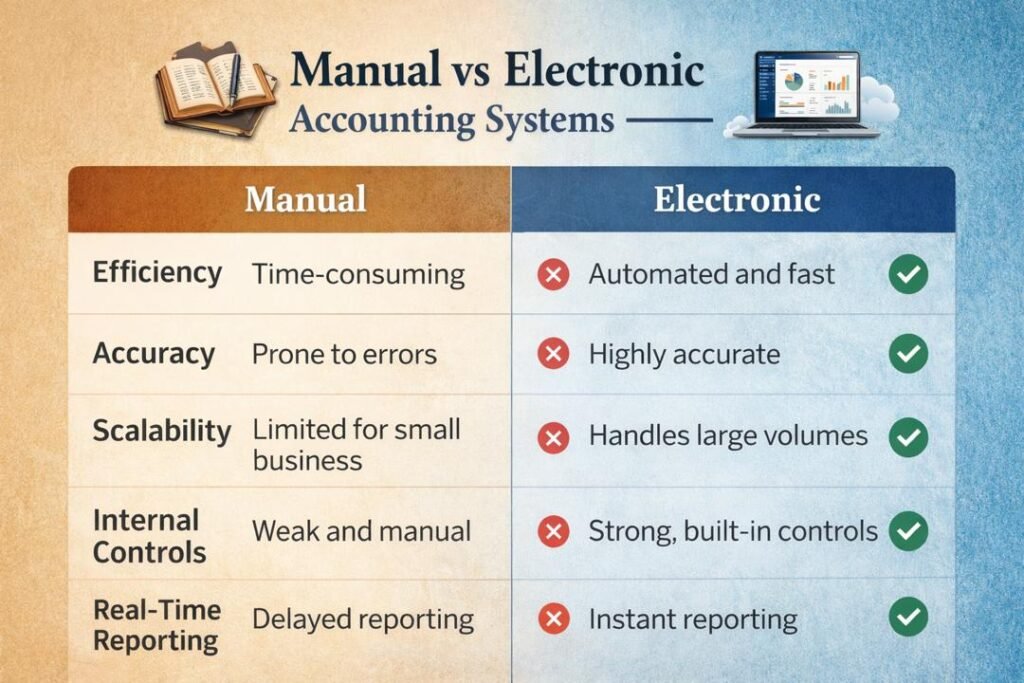
Manual systems have the disadvantage of recording transactions individually, summing up by hand and creating periodic report. This is a time-consuming and tedious process.
These are automated using electronic systems hence saving a lot of time in bookkeeping. Reports are created at the touch of a few clicks. The electronic systems are much more effective.
Accuracy
Paper accounting is reliant on human error. Financial statements may be misrepresented by even a small mistake in arithmetic.
Electronic systems automatically calculate totals, identify inconsistencies and eliminate duplications of entries. E-Systems are more accurate.
Scalability
Small businesses with low transactions are appropriate in manual systems. But, with the increase in the volume of transactions, the record-keeping becomes cumbersome and unmanageable.
Thousands of transactions can be carried out by electronic systems without affecting its performance. As the businesses expand, they can upgrade software plans.
The electronic systems are more scalable.
Internal Controls
Paper-based systems are based on physical supervision and documentation. Duty segregation can be implemented but more difficult.
Electronic systems: built-in controls:
- Role-based access
- Password protection
- Audit trails
- Automated Practitioner Approval.
These characteristics make the accounts more responsible and minimize the risk of fraud.
EDSs provide improved internal controls.
Real-Time Reporting
Manual systems need end of period processing to come up with financial statements. There is no instant availability of information.
Electronic systems also allow real-time financial information, which means that the managers can track the performance on a day to day basis or even on an hourly basis.
In summary Electronic systems allow real time reporting.
The Accounting Practice Technological Evolution
The change in the use of manual books to computerized processes indicates the general digitalization of business. The development of information technology was accompanied by accounting development.
Historical Development
- The initial records of trade were written down.
- Accounting structure was made formal in the double-entry system.
- The system of mechanical calculators enhanced the speed of calculation.
- It was during the late 20th century that computers revolutionized the concept of bookkeeping.
- Cloud computing made it possible to access remotely and collaborate in real-time.
This development shows how accounting practices have evolved in terms of technology, which has turned accounting into a strategic management process instead of a clerical job.
Effect on Business activities
Electronic accounting systems have had far reaching impacts:
- Improved Decision-Making: Strategic planning about financial data is available to managers.
- Enhanced Transparency: Stakeholders are provided with the appropriate and timely financial reporting.
- Regulatory Compliance: Computerized systems make sure that the accounting standards and tax regulations are followed.
- Cost Reduction: Automation minimizes employee expenses and wastes.
- Global Accessibility: This is because under cloud systems, financial data is brought together smoothly because of multinational operations.
Difficulties in the Change of Manual to Electronic System
Although there are many advantages to the use of electronic systems, the move to manual accounting may be challenging:
- Resistance to change
- Cost of implementation
- Data migration issues
- Need for staff training
- Threat of technical discontinuity.
It is necessary to plan the implementation properly, choose the right software, and educate employees to receive the maximum.
Trends in Accounting Systems in Future
The accounting technological revolution still moves on. Emerging trends include:
- Financial data Artificial Intelligence (AI)
- Automation of bookkeeping operations.
- Secure transaction blockchain technology.
- Collaboration applications on the cloud.
- Connection to data analytics systems.
Accounting is more and more becoming technology oriented where the accountant has a more role of financial analysis and advisory besides just data entry.
Conclusion
Manual vs. electronic accounting systems are two different phases of the evolution of financial records keeping. Manual systems, being low-cost and simple, are time consuming, error prone, and not very scalable. Electronic accounting systems on the contrary are efficient, accurate, offer greater internal controls, scalable, and real-time reporting.
The technological revolution on accounting practices has made accounting to be more dynamic, automated, and strategic in organizations besides being a paper-based record keeping. The result of this evolution is the enhancement of the business operations, management of finances and organizations being able to compete in a digital economy.
With the further evolution of technologies, accounting systems will be even more integrated, smart and data-driven. Companies that adopt e-accounting systems are in a position to grow, work more efficiently, and survive in the ever-digitized world.
Get more well researched information about manual vs. electronic accounting systems here.