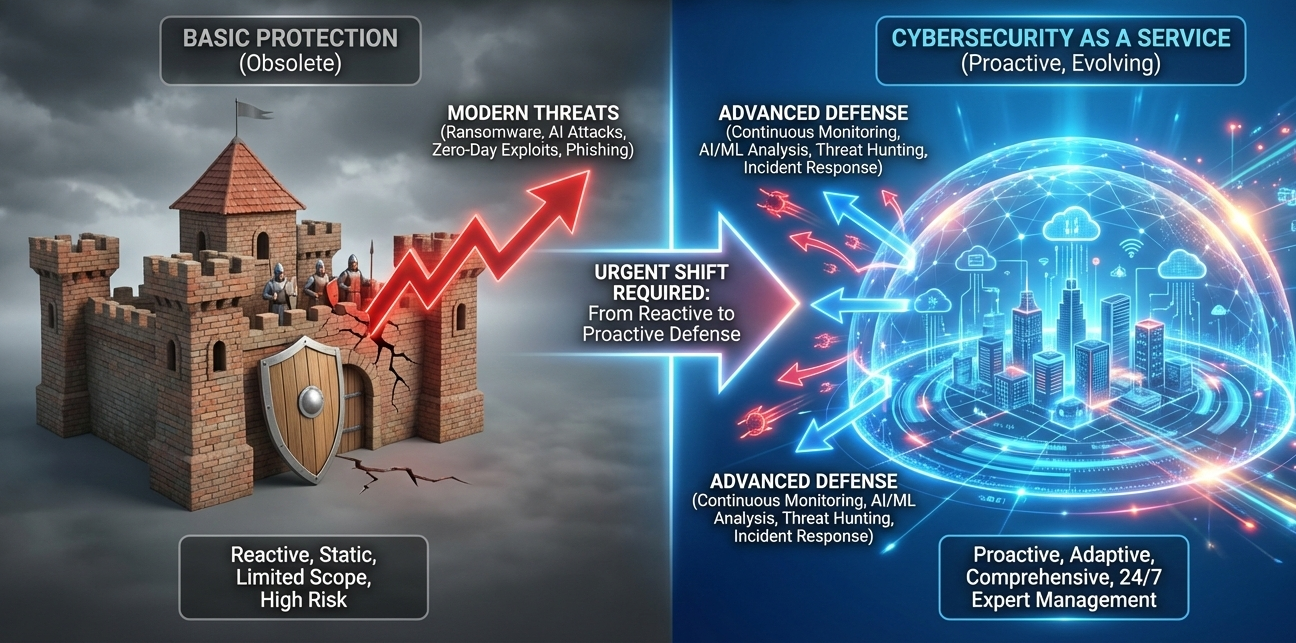
There has never been a more digitally connected business environment as seen today. The cloud environments, remote working forces, mobile devices and integrations with third parties have increased operational capabilities- however, they have increased the attack surface. Cyber threats are not singular situations that are executed by amateur hackers. They are automatized, structured, and more advanced processes that are meant to utilize weak areas in real time.
The old fashioned antivirus and standalone firewalls used to be effective to prevent simple malware and attempts of unauthorized access. Nowadays such measures are not sufficient. Businesses need layered strategies that are all-encompassing and predict threats in advance before they harm. This is where service based cybersecurity is necessary.
Growing numbers of organizations are finding reliable IT Company & Tech Solutions in managed service Providers (MSPs) that offer active security frameworks. Meanwhile, the demand on the higher level of Cybersecurity for Businesses and Remote IT Support for Businesses is on the rise. These services are indicative of a transition to active protection, as opposed to reactive one.
The Changing Threat Landscape
There are cyber threats that are growing in magnitude and complexity. The contemporary forms of attack are ransomware, phishing, credential harvesting, and supply chain intrusion, and advanced persistent threats. Hackers use automation and artificial intelligence to search networks to seek vulnerabilities.
Some of the risks encountered by businesses currently include:
- The multi-stage ransomware attacks.
- Insider threats
- Zero-day vulnerabilities
- Business email compromise
- Exploits of cloud misconfiguration.
Conventional security devices are configured to identify malware that has been identified. Nevertheless, attacks in the present day often employ unfamiliar code or legitimate credentials, circumventing antiquated defences.
The threat environment demands the use of tools that identify behaviour anomalies, rather than familiar viruses.
Basic Antivirus and Firewalls weaknesses
The antivirus software mostly depends on signature-based detection. Although it is effective in blocking most forms of malware, it does not perform well with fileless attacks and zero-day exploits.
Firewalls are a barrier to both inbound and outbound traffic on internal networks. They regulate incoming and outgoing data depending on set rules. Nevertheless, firewalls are not able to recognize the malicious activity that does not originate outside of the network or uses valid user credentials.
The following restrictions pose blind spots:
- Lateral movement undetected.
- Absence of live threat intelligence.
- The existence of very low protection against insider threats.
- Lack of visibility of cloud environment.
The current distributed digital infrastructure was not designed with basic protection.
Endpoint Detection and Response (EDR)
EDR is a major improvement as compared to conventional antivirus. Instead of just being concerned with prevention, EDR constantly scans endpoints i.e. laptops, servers and mobile devices of suspicious activity.
Key Capabilities of EDR
- Real time behavioural observation.
- Threat containment is automated.
- Forensic investigation equipment.
- Uninterrupted endpoint visibility.
In the event of malicious activity, EDR will be able to put isolated devices in place to avoid the further propagation. This offense defence lowers both the damage and recovery expenses.
EDR gives a more detailed view of the system behavior and, therefore, allows identifying and addressing an issue quicker.
Managed Detection and Response (MDR)
Even though EDR tools do produce valuable data, they need professional analysts to make sense of alerts and act appropriately. MDR is a fusion of high tech and human intelligence.
What MDR Offers:
- 24/7 security monitoring
- Threat hunting
- Incident response support
- The constant defense optimization.
MDR teams evaluate alerts, recognize trends and upscale actual threats. This human intervention decreases the amount of false positives and provides prompt intervention.
In a number of organizations, construction of internal security operations center is prohibitive. MDR provides high endurance enterprise protection without the burden.
Threat Intelligence: Think Like an Attacker Innovate
Threat intelligence is the process of gathering and assessing information regarding new cyber threats. This intelligence can guide the businesses to know the tactics of the attackers and how to expect vulnerabilities.
Through threat intelligence ingested into the security frameworks, organizations are able to:
- Proactively patch vulnerabilities.
- Modify access rules and firewall.
- Enforce policies of strength.
- Track questionable IP addresses.
Active intelligence makes cybersecurity more proactive rather than reactive.
Zero-Trust Architecture
Conventional network models presuppose that the users within the network perimeter can be considered trustworthy. This is no longer true in remote and cloud environments.
Zero-trust architecture is based on a simple principle never trust, always verify
Basic Building Blocks of Zero Trust:
- Multi-factor authentication
- Access controls of least privilege.
- Identity verification is incessant.
- Network micro-segmentation.
Zero-trust models restrict the effect of compromised credentials. Although attackers may access, it becomes much harder once they have access because of lateral movement.
Conformance Management and Regulatory Protection
There are numerous data protection regulations in many industries. Strict security regulations have to be observed in healthcare, finance, and retail sectors.
Nonconformity can also lead to fines and loss of reputation.
As a service, cybersecurity incorporates monitoring of compliance into routine. MSPs assist with:
- Risk assessments
- Policy documentation
- Security audits
- Regulatory reporting
The integration of cybersecurity and compliance regimes helps business to minimize the risk of fines and legal issues.
The MSPs and the role in Layered Security
Managed service providers offer multi-layered defence solutions, which integrate tools, expertise and continuous supervision.
Layered Security Approach
- Perimeter protection
- Endpoint monitoring
- Network traffic analysis
- Identity management
- Threat intelligence in real time.
There is redundancy provided by layered structures. In the event that one defence fails, another one intercepts the threat.
Transparency and accountability of MSPs are also guaranteed because of centralized dashboards.
Proactive and Reactive Security
Reactive security is a reaction to the incidents that happen. Proactive security is the anticipation of a threat and prevention of its occurrence when substantial damage has not been caused.
The cybersecurity as a service underline:
- Continuous monitoring
- Automated alerting
- Rapid containment
- Vulnerability management in advance.
This transition minimizes downtimes, loss of operations and data loss.
Scalability and Cost Efficiency
Developing internal cybersecurity staff involves recruiting experts, spending money on surveillance devices, and infrastructure maintenance.
Subscriptions Cybersecurity as a Service is predictable through subscription. Protection can be scaled-up by businesses as they grow.
Enterprise quality protection is available to small and mid-sized organizations without requiring huge capital spending.
Supporting Distributed Workplaces
Working remotely has widened the network boundaries past office walls. Home networks and mobile devices allow employees to access data in a company.
MSPs offer distributed workforces protection with secure remote access frameworks, encrypted connections, and endpoint monitoring.
Constant monitoring will make remote environments adherent and secure.
Lessening Exposure to risk and Regulatory fines
Full-scale cybersecurity decreases the chances of breaches, as well as the extent of harm in case of breach. Quick response and detection reduce down-time and loss of data.
Compliance management will keep the business out of expensive fines. Proactive frameworks will show due diligence and data custodianship.
The cybersecurity service simplifies working towards security consistency and operational durability.
Conclusion
Simple antivirus and fire wall applications are not enough to counter recent cyber threats. The changing digital environment requires multi-layered, proactive solutions that combine sophisticated detection and identification tools, human skills, and ongoing surveillance.
MSPs provide end-to-end cybersecurity frameworks with the help of EDR, MDR, threat intelligence, zero-trust architecture, and compliance management. The services help lower the risk exposure, enhance resilience, and protect organizations against regulatory fines.
Cybersecurity does not require a single investment. It is a continual effort to defend digital assets in a more and more complex environment.