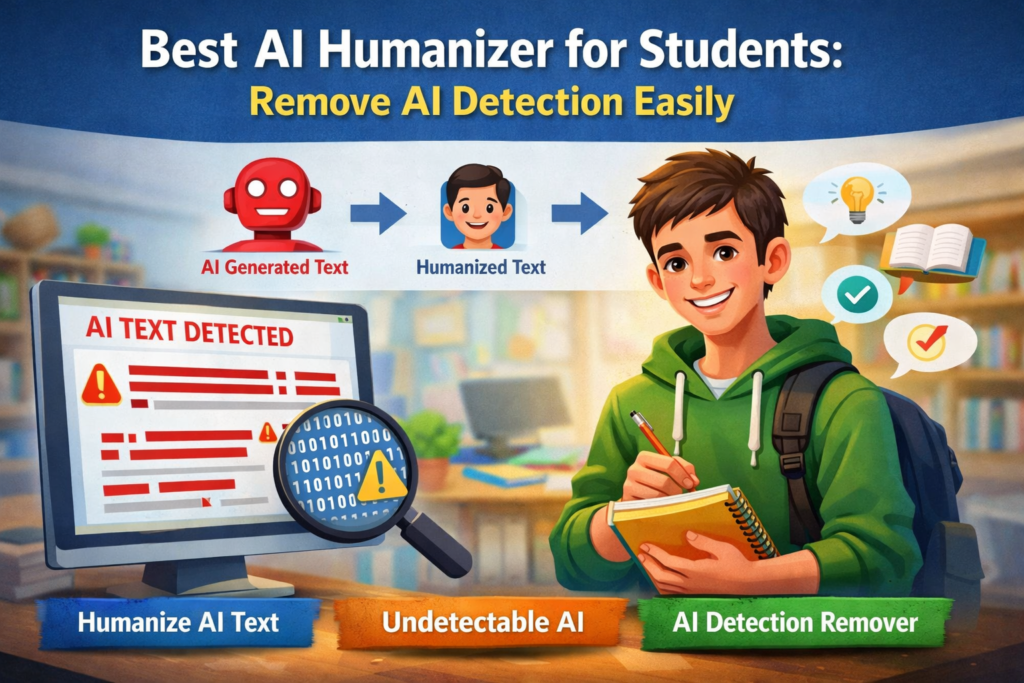
Artificial intelligence has changed how students research, write, and organize their academic work. From brainstorming essay topics to summarizing long readings, AI tools save time and energy. However, with the rise of AI-generated content, schools and universities are increasingly using detection systems to identify machine-written text. This creates a new challenge for students who rely on AI assistance but still want their work to feel authentic and personal.
As someone who has worked closely with digital content optimization and online visibility strategies for years, I understand how important natural language is. Whether it is a blog post or a college essay, writing must sound human. That is why many learners are searching for the best AI humanizer to refine their drafts and remove robotic patterns.
In this guide, we will explore how AI humanizers work, why students need them, and how to humanize AI text effectively without compromising quality or integrity.
Why Students Are Concerned About AI Detection
Educational institutions now use advanced detection systems to identify patterns typical of AI writing. These tools analyze:
- Sentence structure consistency
- Repetition of phrases
- Predictable word choices
- Lack of personal tone or variation
Even if the content is factually correct, it may still be flagged if it sounds too polished or mechanically structured.
Students often use AI for legitimate reasons such as:
- Overcoming writer’s block
- Improving grammar
- Organizing ideas
- Summarizing complex research
The issue arises when the final output feels synthetic. This is where an ai detection remover becomes useful. It helps reshape the text so that it reflects a natural flow, varied sentence length, and a more authentic voice.
What Is an AI Humanizer and How Does It Work?
An AI humanizer is a tool designed to transform AI-generated content into text that reads as if it were written by a real person. Instead of simply replacing words with synonyms, high-quality humanizers adjust tone, rhythm, and structure.
Here is what a good tool typically does:
- Breaks predictable sentence patterns
- Adds subtle variations in phrasing
- Introduces conversational elements
- Improves readability
- Adjusts vocabulary to match a student’s level
When you humanize chatbot text, the goal is not to trick anyone. The purpose is to refine the draft so it sounds natural, personalized, and aligned with academic expectations.
A well-built AI humanizer for students focuses on clarity and authenticity rather than just bypassing detection systems.
Why Humanized Writing Matters in Academic Settings
Professors value original thinking and a clear personal voice. Even when AI assists in drafting, your submission should reflect your perspective and understanding.
Humanized writing:
- Demonstrates comprehension of the topic
- Sounds less formulaic
- Engages readers more effectively
- Reduces the likelihood of detection flags
When students make a text undetectable, it is not about hiding misconduct. Instead, it often involves polishing a draft so it mirrors how they naturally communicate.
For example, AI might produce a sentence like:
“Artificial intelligence has significantly transformed academic productivity across multiple educational domains.”
A humanized version might read:
“AI tools have changed how students manage their schoolwork, making research and writing faster than ever.”
The second sentence feels more relatable and less rigid. That difference matters.
Key Features to Look for in the Best AI Humanizer
Not all tools are equal. Some simply swap words, while others genuinely enhance readability.
When choosing an ai humanizer for students, consider these features:
- Natural tone adjustment
- Context awareness
- Grammar correction
- Plagiarism-free rewriting
- Customization based on academic level
- Quick processing time
A strong ai detection remover should not distort meaning. Instead, it should preserve your ideas while improving expression.
Avoid tools that:
- Overcomplicate simple sentences
- Insert unnecessary jargon
- Produce awkward phrasing
- Change the original intent of your argument
The best platforms refine rather than rewrite your voice entirely.
How to Humanize AI Text Effectively
Even with a powerful AI humanizer, students should follow smart editing practices. Technology works best when combined with human review.
Here are practical steps to humanize a text successfully:
- Read the draft out loud
If a sentence feels unnatural when spoken, it likely needs revision. - Add personal insights
Insert examples, experiences, or small observations to make the content unique. - Vary sentence length
AI often generates sentences of similar size. Mixing short and long sentences creates rhythm. - Simplify complex wording
Academic writing does not need to sound robotic. Clarity always wins. - Adjust transitions
Replace predictable connectors with more natural ones.
When you humanize chatbot text carefully, you improve both authenticity and readability.
Ethical Considerations Students Should Keep in Mind
It is important to use AI responsibly. Educational institutions have guidelines about acceptable assistance. Before using any ai detection remover, review your school’s policies.
Responsible use includes:
- Using AI for brainstorming rather than full essay generation
- Editing and understanding the final draft
- Citing sources properly
- Ensuring the work reflects your own knowledge
An AI humanizer should enhance your writing process, not replace critical thinking. Remember that your education depends on genuine learning, not just polished submissions.
Benefits of Using an AI Humanizer for Students
When used wisely, an AI humanizer for students offers several advantages.
First, it saves time. Instead of rewriting entire drafts manually, students can refine text quickly.
Second, it boosts confidence. Submitting work that sounds natural reduces anxiety about detection tools.
Third, it improves writing skills. By comparing original AI output with humanized versions, students learn how tone and structure affect readability.
Here are some clear benefits:
- Cleaner and more engaging language
- Reduced robotic phrasing
- Improved academic tone
- Lower risk of automated flags
- Better flow between ideas
The goal is to create undetectable ai content that still feels authentic and aligned with academic standards.
Common Mistakes to Avoid When Trying to Make AI Text Undectable
Many students rush the process and rely solely on automation. This can backfire.
Avoid these common mistakes:
- Copying and pasting without reviewing
- Overusing rewriting tools multiple times
- Ignoring grammar inconsistencies
- Submitting text without personal edits
- Choosing low-quality platforms
To make a text undetectable effectively, you must combine technology with thoughtful revision. A tool can assist, but final responsibility remains with you.
Quality always matters more than speed.
Practical Tips for Blending AI Assistance with Personal Voice
Blending AI help with personal input creates stronger academic work.
Consider this simple approach:
- Use AI for outlining
- Expand sections in your own words
- Run the draft through an ai humanizer
- Edit manually for clarity
- Double-check citations and formatting
This workflow ensures your essay maintains originality while benefiting from technological support.
Students who humanize a text strategically often find that their writing becomes clearer and more structured over time. The process itself becomes a learning experience rather than just a shortcut.
Choosing the Right Tool for Long-Term Academic Success
Selecting the best AI humanizer is not only about avoiding detection. It is about improving communication skills and producing high-quality academic work.
When evaluating tools, ask yourself:
- Does it maintain my original meaning?
- Does it improve readability?
- Does the final text sound like something I would naturally say?
- Does it respect academic integrity?
A reliable AI humanizer for students should feel like an editing partner, not a content spinner.
Also remember that detection systems continue to evolve. Relying solely on technical tricks is not sustainable. Instead, focus on understanding how natural language works. Tools can assist, but your personal voice remains the most powerful asset.
Final Thoughts on Smarter Academic Writing
AI tools are not going away. They will continue to shape how students learn, research, and write. The key is using them wisely and responsibly.
An effective AI humanizer helps transform structured AI drafts into engaging, authentic writing. When you humanize chatbot text thoughtfully, you improve clarity and reduce robotic patterns. When used properly, an ai detection remover supports better communication rather than encouraging shortcuts.
Students who learn how to humanize a text gain more than just undetectable AI submissions. They develop stronger editing skills, deeper understanding of tone, and greater confidence in their academic voice.
In the end, technology should enhance learning, not replace it. By combining smart tools with genuine effort, students can create work that feels natural, thoughtful, and truly their own.