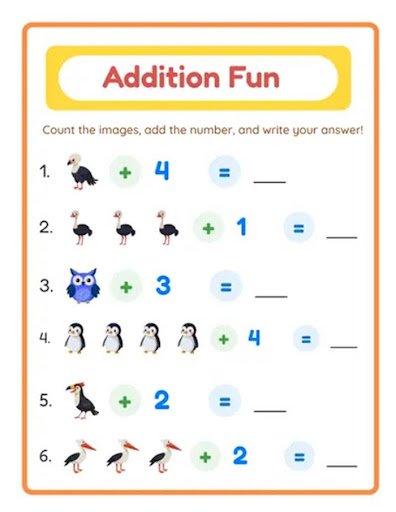
Strengthening mental math skills is essential for developing quick thinking and confidence with numbers. Addition worksheets are a powerful tool that helps learners practice systematically and build a strong foundation. These worksheets allow students to repeatedly engage with addition problems, reinforcing memory and improving calculation speed. Regular practice with structured exercises can significantly enhance mental agility and mathematical fluency.
The goal of using Addition worksheets is not just to complete problems but to foster a sense of confidence and enjoyment in math. By gradually increasing difficulty, learners can see tangible improvements, making the learning process rewarding. Mental math skills extend beyond the classroom, helping with everyday tasks and decision-making. A consistent approach to practicing addition can make challenging problems manageable and boost overall numeracy skills.
Choosing the Right Worksheets
Selecting appropriate addition worksheets is the first step in successful mental math practice. Beginners benefit from worksheets with clear, large numbers and simple layouts. Overly complex designs can distract or frustrate learners, reducing their focus on the math itself. It is important to choose worksheets that gradually increase in difficulty to keep learners engaged without overwhelming them.
Worksheets with a mix of problem types can encourage deeper understanding. For example, a combination of single-digit, double-digit, and word problems can create variety and maintain interest. Even occasionally incorporating Subtraction worksheets alongside addition exercises can strengthen overall mental arithmetic. Selecting the right materials sets the stage for productive practice and long-term skill growth.
Starting with Single-Digit Problems
Single-digit addition is the foundation of mental math and should be mastered first. Worksheets focusing on numbers 0 through 9 help learners memorize basic sums. Repetition at this stage ensures that calculations become automatic, freeing mental energy for more complex problems. Students gain confidence as they correctly solve problems quickly.
Simple exercises also allow learners to identify patterns in numbers, such as pairs that sum to 10. Mastery of single-digit addition builds a strong base for transitioning to larger numbers. The key is consistent practice and reinforcing correct answers without pressure. Single-digit worksheets serve as stepping stones to more challenging exercises.
Moving to Double-Digit Addition
After mastering single-digit sums, learners can progress to double-digit addition. Worksheets with double-digit problems introduce the concept of carrying over numbers. This step strengthens mental computation skills and encourages logical thinking. Regular practice helps students solve these problems without relying on paper or calculators.
Double-digit worksheets can also include both vertical and horizontal formats to simulate different problem types. Practice should begin with simple problems and gradually increase in complexity. By steadily advancing, learners avoid frustration and develop confidence in handling larger sums mentally. Repetition remains key for long-term retention.
Incorporating Word Problems
Word problems connect addition skills to real-life scenarios. Worksheets that combine narrative questions with addition encourage comprehension alongside calculation. Learners must read carefully, identify relevant numbers, and apply addition strategies. This process develops critical thinking and problem-solving skills.
Word problems also make math more meaningful and practical. Students see the real-world applications of mental math, which reinforces motivation. Worksheets should vary in difficulty and context to challenge learners while keeping exercises enjoyable. This integration of reading and math strengthens both cognitive and numerical skills.
Using Timed Exercises
Timed addition worksheets improve speed and accuracy in mental math. Setting a timer creates a sense of urgency that encourages learners to think quickly. These exercises help identify areas of weakness while promoting mental agility. Over time, students naturally become faster without sacrificing accuracy.
Teachers and parents can gradually reduce the allotted time as learners improve. Timed exercises also make practice more engaging and competitive, fostering a goal-oriented mindset. These worksheets are particularly effective when combined with tracking progress, allowing learners to see tangible improvements in their speed and efficiency.
Pattern Recognition
Recognizing patterns is an essential skill in mental math. Worksheets that highlight number patterns, such as sums of 10 or doubles (5 + 5, 6 + 6), enhance memory and problem-solving speed. Identifying these patterns allows learners to make quick calculations without performing every addition step individually.
Pattern recognition strengthens both analytical and visual thinking. Worksheets can include exercises that encourage spotting trends in numbers or predicting sums. The more learners practice, the more naturally these patterns become part of their mental computation toolkit. This approach makes mental math less intimidating and more intuitive.
Breaking Numbers Apart
Breaking numbers into smaller parts simplifies addition and improves mental efficiency. Worksheets can encourage splitting numbers into tens and units or using friendly numbers to simplify calculations. For example, adding 27 + 35 can be approached as 20 + 30 and 7 + 5, then combining the sums.
This strategy reduces cognitive load and builds confidence in handling larger numbers mentally. Learners gradually internalize methods to deconstruct numbers, enabling faster and more accurate calculations. Worksheets should present a variety of problems to practice this technique, ensuring flexibility in mental math approaches.
Using Visual Aids
Visual aids enhance comprehension and retention in addition practice. Worksheets with number lines, blocks, or diagrams help learners visualize sums. Visual representation supports mental strategies by providing reference points for calculations. This method is particularly effective for younger learners who benefit from concrete illustrations.
Incorporating colors, shapes, or grids can also make worksheets more engaging. Visual aids transform abstract numbers into tangible concepts, reinforcing memory and making learning enjoyable. They serve as helpful scaffolds while learners develop the ability to perform mental addition independently.
Encouraging Daily Practice
Consistency is a key to strengthening mental math skills. Daily practice with addition worksheets ensures that concepts remain fresh and computation becomes automatic. Even short, focused sessions of 10–15 minutes contribute to steady improvement over time. Habitual practice reinforces neural pathways associated with calculation.
Daily worksheets also help learners set personal goals and monitor their progress. Establishing a routine makes math a regular part of learning rather than an occasional challenge. This consistent exposure develops confidence and allows learners to tackle more complex problems with ease.
Tracking Progress
Tracking progress motivates learners and helps identify areas for improvement. Worksheets can include sections for recording scores, completion times, or accuracy percentages. Reviewing these records provides insight into strengths and weaknesses in mental addition.
Progress tracking also encourages self-reflection and goal setting. Learners can celebrate achievements and focus on skills that need reinforcement. Over time, consistent tracking leads to measurable growth and boosts confidence in both classroom and everyday math tasks.
Professional Worksheets Generator
LessonCraftStudio offers a Professional Worksheets Generator designed to create customized addition and subtraction worksheets quickly. Educators and parents can select difficulty levels, problem types, and layouts to meet the learner’s needs. It saves time while ensuring worksheets are clear, structured, and visually engaging for students of all ages.
With this generator, users can produce printable worksheets that support daily practice and mental math improvement. LessonCraftStudio also provides options to include visual aids, timed exercises, and word problems. These features allow learners to enjoy varied and effective practice, making math both educational and fun.
Making It Fun
Incorporating games and interactive elements makes addition practice enjoyable. Worksheets can include puzzles, color-by-number exercises, or small rewards for completed sections. Fun elements reduce stress and encourage a positive attitude toward mental math.
When learners associate practice with enjoyment, they are more likely to stay motivated and engage consistently. Creative worksheets also allow for collaboration and friendly competition, adding a social dimension to learning. This approach ensures that strengthening mental math is both effective and enjoyable for all learners.