Abstract
The editing symbols have traditionally been at the heart of the newspaper production process, as they enable effective communication among editors, proofreaders, and writers. Before the widespread use of digital editing software, newsroom processes relied on standardised proofreading marks to fix grammar, structure, formatting, and factual errors in printed texts. The abstract ideas of the editing symbols still remain relevant to the editorial procedures and the quality control mechanisms, even in the contemporary digital world. This paper will discuss the common editing symbols, their evolution in history, and how they are used in a newsroom setting. Based on the qualitative approach to analysis, which is developed on the basis of journalism studies and editorial theory, the article discusses the effectiveness of editing symbols in terms of the workflow, stylistic consistency, and accuracy at the stage of copy-editing and proofreading. The results of the study suggest that the standardization of editing notation can decrease the ambiguities in editorial communication, improve production schedules, and foster professional responsibility in news houses. This paper finds that the learning of editing symbols is imperative to journalism students, editors and media practitioners regardless of changes in technology in news production.
Keywords: Editing, copy editing, proofreading marks, newsroom operations and editorial communication, newspaper production, news editing procedures, news production effectiveness.
1.0 Introduction
Editing is a preliminary phase in journalism that is used to refine raw reporting into definite, correct, and publishable news content. In the conventional newsrooms, the editing symbols were used as a universal language by which the editors could communicate corrections and instructions without necessarily rewriting complete manuscripts. These standard marks enabled various actors of editing to work effectively with the application of rigid publication schedules.
Traditionally, the newspapers used to depend on handwritten corrections on the printed copy so that the editors could indicate the presence of grammatical errors, corrections in the format of a text, deletions, insertions, and stylistic modifications. These practices were a very important part of professional newsroom operation and culture.
In addition to historical relevance, editing symbols still influence the editorial thought in the present day as they strengthen clarity, precision and accountability. This paper explores newspaper editing processes, their role, importance, and relevance in the modern journalism practice.
2.0 Literature Review
Accuracy, clarity and credibility are highlighted as the main editorial objectives of discussion of the newsroom editing among scholars. Harrower (2010) says that editing serves as the quality control system of journalism, whereby published materials are held to professional and ethical standards. On the same note, Brooks, Kennedy, Moen, and Ranly (2014) assert that standardized editorial practices had developed mainly to minimize confusion among the newsroom staff members who were operating under time pressure.
The initial studies regarding the evidence of proofreading systems point out the development of editing marks together with the printing. According to Bivins (2008), the symbols of proofreading were standardized in the nineteenth century when the newspapers were experiencing industrial growth and the editorial departments had to be very efficient in the communication process.
Research also shows that cognitive efficiency is facilitated by editing symbols. The editors reduced the chances of misunderstanding and sped up the process of corrections by using brief visual elements instead of extensive written descriptions (Einsohn and Schwartz, 2019). This visual shortcut was particularly useful in high-turnover newsroom situations.
The recent literature accepts the fact that, even though digital tools, track changes, and collaborative editing software have supplanted handwritten marks, a lot of contemporary editorial conventions are still based on old-fashioned proofreading notation (Rich, 2016).
3.0 Conceptual Review: Journalism Editing Symbols
3.1 The symbols of editing defined
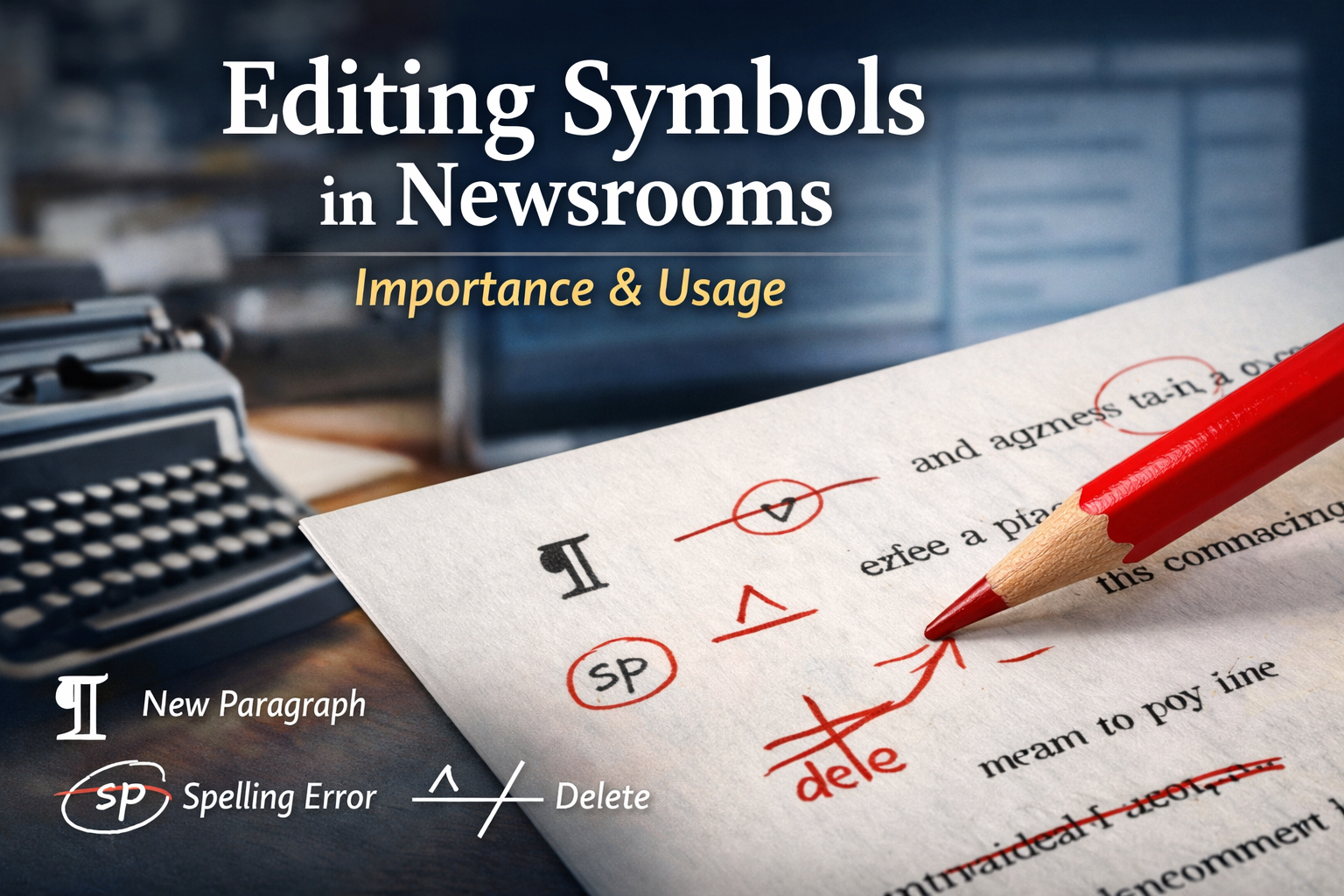
Editing symbols are standard marks that can be used by editors and proofreaders to designate corrections or instructions on the copy they have written. These marks convey certain editorial actions without necessarily recapitulating.
They typically address:
- Corrections in grammar and punctuation
- Word deletion or insertion
- Spelling adjustments
- Formatting alignment
- Capitalization changes
- Paragraph restructuring
3.2 Types of Universal Editing Signs
a. Deletion Marks
Point out words that are unnecessary and/or wrong. The editors tend to cross out the text but leave a deletion mark in the margins.
b. Insertion Marks
Caret symbols (^) indicate the position where other words or punctuations are to be included.
c. Transposition Marks
Applied to phrases or words that need to be reordered.
d. Paragraph Marks
Indicate the points of new paragraphs to improve reading and logical organization.
e. Spacing and Alignment Marks
Make sure that it is typographically consistent, especially during production of print layouts.
4.0 Theoretical Framework
This paper relies mostly on the Gatekeeping Theory and Communication Efficiency Theory.
4.1 Gatekeeping Theory
gatekeeping theory, which is a process of information that gets filtered and refined by editors prior to publication (White, 1950). Editing symbols are practical elements of this gatekeeping mechanism in that it helps editors to control narratives without necessarily distorting the writer’s structure.
4.2 Theory of Communication Efficiency
The theory explains the approach to translating information into an electronic format and then transferring it by spoken, written, or digital communication.
The theory of the efficiency of communication holds that the commonality of systems of symbols is beneficial to collaborative productivity. Editing symbols are a professional lingo that minimizes interpretive ambiguity among the participants of the newsroom.
These theories combined give us a reason as to why standardized editing notation became an essential part of print journalism.
5.0 Methodology
In this article, a qualitative analysis methodology is used, and it is grounded on:
- Document Analysis – Review of journalism books and editorial manuals on proofreading practices.
- Comparative Review – Comparison of the traditional print editing process and the modern digital editing systems.
- Conceptual Analysis – Analysis of the symbol of editing as a communication tool in the organizational workflow.
The secondary academic sources and journalism scholarship were examined to find out the common themes on editorial efficiency and newsroom alignment.
6.0 Findings and Discussion
6.1 Editing Symbols Enhance Editorial Communication
Results indicate that editing symbols would considerably lower the occurrence of miscommunication between editors and writers. Instead of preparing long notes, the editors use short marks, which have a universal meaning in newsroom culture.
6.2 Under Deadline Pressure Workflow Efficiency
Newspapers are exposed to time limitations. The advantage of editing symbols is that they can be reviewed by many editors, enabling the production cycles to go faster with the same quality standards.
6.3 Standardization of Consistency and Style
House style rules are enforced with the assistance of standard symbols. Through capitalization, punctuation and formatting corrections, editors make sure that there are uniformities between sections.
6.4 Training and Professional Development
Traditionally, the education of journalists demanded that students learn to proofread marks. This training enhanced attention to detail and editorial judgment.
7.0 Digital Newsroom Implications
Even though physical markup has been superseded by digital editing software, the rationale of editing symbols still exists. The comment tools, revision tracking, and markup suggestions are also features which imitate the traditional functions of proofreading in electronic form.
At least, an idea of the editing symbols fosters digital ability to edit since:
- Editors are aware of the principles of structural correction.
- Authors are more sensitive to editorial comments.
- The news organizations provide continuity between the traditional and modern workflow.
8.0 Conclusion
Editing symbols are not simply historical newsroom artifacts; they constitute a lengthy system of communication that informed the practices of professional journalism. These symbols helped to make newspaper production more reliable and credible as they facilitated effective collaboration, helped to maintain consistency, and assisted in editorial gatekeeping.
Although journalism is shifting to digital platforms, the theoretical principles of the editing symbols are still of primary importance in the editorial work. The students and practitioners of journalism who are aware of these systems will have a better understanding of how a newsroom works and how the editorial decision-making process works.
Future studies may consider how artificial intelligence-enhanced editing aids can implement or alter established proofreading norms without compromising editorial quality.
References
Bivins, T. H. (2008). Mixed media: Moral distinctions in advertising, public relations, and journalism. Lawrence Erlbaum Associates.
Brooks, B. S., Kennedy, G., Moen, D. R., & Ranly, D. (2014). News reporting and writing (12th ed.). Bedford/St. Martin’s.
Einsohn, A., & Schwartz, M. (2019). The copyeditor’s handbook (4th ed.). University of California Press.
Harrower, T. (2010). Inside reporting: A practical guide to the craft of journalism. McGraw-Hill.
Rich, C. (2016). Writing and reporting news: A coaching method (8th ed.). Cengage Learning.
White, D. M. (1950). The gatekeeper: A case study in the selection of news. Journalism Quarterly, 27(4), 383–390.