
Modern design, computer graphics and engineering are built around geometric modeling. It connects the abstract mathematical concepts and concrete visual images. And be it in the production of complex 3D objects to animate, the visualization of architectural models, or the simulation of engineering models, geometric modeling can enable the designer and engineer to take complex formulas and coordinate data and express them in forms that can be displayed, handled and evaluated.
In this article, the abstract mathematical concepts are converted to visual reality, decomposition of the basic aspects of geometric modeling point, curve, surface and solid. Readers interested in academics or profession can follow the accuracy and ingenuity which the geometric modeling provides by knowing the tools and techniques involved in the computations.
Introduction: Points and Coordinate Systems
The simplest element of geometry is the point, which is at the centre of geometric modeling. The position of a point in space is determined by the use of the coordinate (usually 2D or 3D) (x, y) or (x, y, z). These coordinate systems are used as the framework on which more complex structures are based.
Individual points are hard to regard seriously, but they are the quintessence of all geometry. Designers can produce lines, curves as well as surfaces by defining several points in the space. These points can be stored, manipulated and visualized accurately in computational tools which are the cornerstone of digital modeling.
Learning Abstract Mathematical Equations
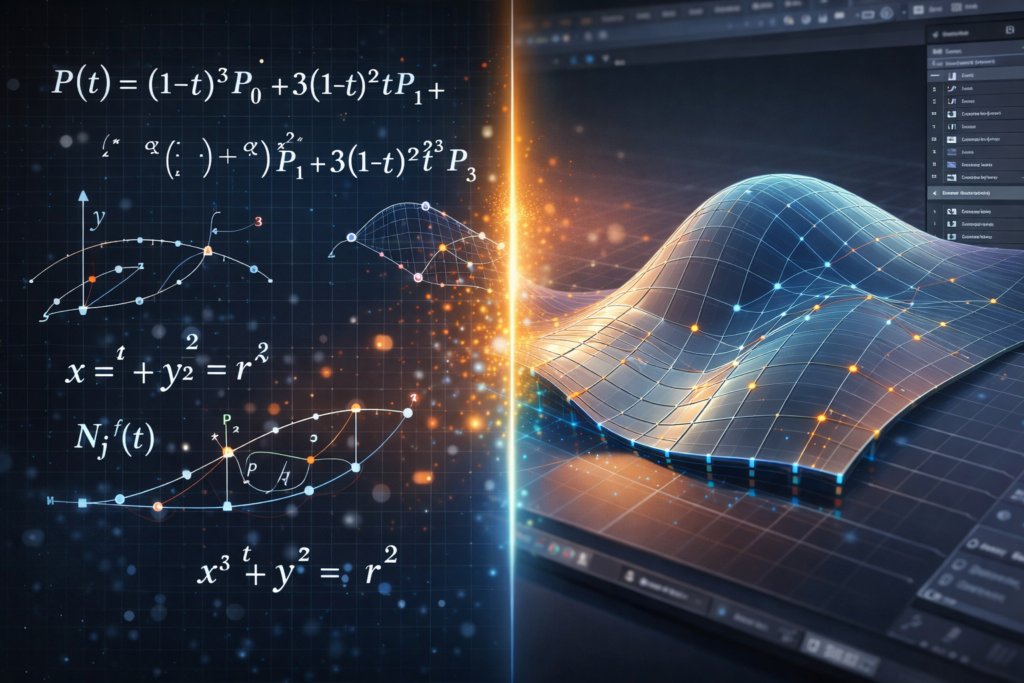
A significant number of geometric structures are based on abstract mathematical equations. These equations provide the systematization of relationships between points, lines and curves. As an example, the 2D space equation of a circle; x 2 +y 2 =r 2x 2 +y 2 =r 2 =r 2 defines all the points that are a fixed distance rrr away from a center point.
More complicated equations are used to define curves in 3D modeling such as Bezier curves or B-splines. These curves enable the designers to create flowing forms that are smooth and efficient in that a set of points are manipulated mathematically. The mathematical formulation of such equations makes it possible to interpret abstract equations on the display in visible curves.
Building Curves: How to Move Between Points and Paths
The first level of complexity suggested by individual points is curves. They relate spaces to make tracks, lines and forms.
Parametric Curves
Another common modeling technique in geometry is a parametric curve, in which a point on the curve is represented by a single parameter ttt. An example is the Bezier curves which are determined by control points and the curve is determined as a weighted sum of control points. The shape can be changed dynamically by designers through the control points, which gives accuracy and flexibility.
Spline Curves
Another significant one is spline curves, e.g. B-splines and NURBS (Non-Uniform Rational B-Splines). These curves enable the designers to build complex, flowing forms by mathematical equations to continue and remain smooth. Splines find special use in the automotive, aerospace and animation industries where smooth surfaces are required.
With several curves, designers have the capability of tracing the lines of more complex shapes, which will eventually make surfaces.
Surfaces and Curvilinear: Surfaces to Planes
Two-dimensional manifolds are surfaces that are characterized by the relationship between curves and space points. They add color and shape to visual models by creating the linkage between linear and volumetric solids.
Surface Types
- Ruled Surfaces: They are the curves obtained through the movement of a straight line between two curves.
- Lofted Surfaces: This type of surface is created by the interpolation of a number of curves.
- Swept Surfaces: Curves that are generated by tracing a profile curve along a curve.
Mathematical Representation
Surfaces are frequently expressed in a similar way as curves, that is, parametrically, with two parameters, uuu and vvv. This representation enables the modeling software to perform calculations on any points of the surface, and to render the points as well as calculate derivatives such as the curvature.
Visualization
These surfaces are then turned into meshes of polygons (typically triangles or quadrilaterals) which represent the original continuous surface, using computational tools. Mesh visualization enables designers to see, edit, and visualize surfaces in real time, and has made the abstract formulation of maths real.
Solid Modeling: Surface to Volumes
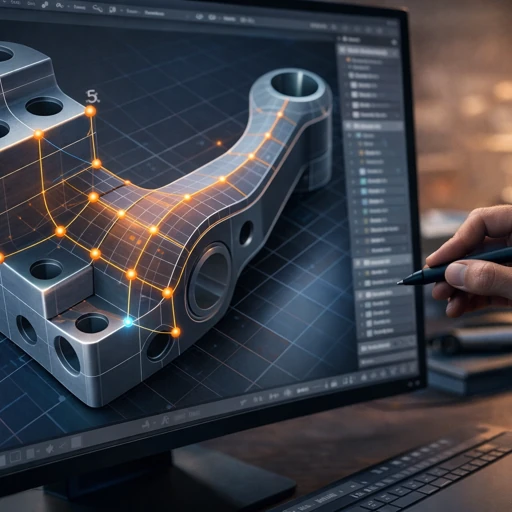
Solid modeling is the last process in geometrical modeling, the surfaces of which surround a volume forming three-dimensional objects. Solids are the most realistic and manipulable models of design, simulation, and manufacturing.
Techniques of Solid Construction
- Constructive Solid Geometry (CSG): Solids are constructed of Boolean operations (union, intersection, difference) of primitive shapes such as cubes, spheres, and cylinders.
- Boundary Representation (B-Rep): The definition of solids is based on the bounding surfaces, edges and vertices. This is best with complex objects that have curved surfaces.
- Voxel-Based Modeling: Objects can be defined as a set of volumetric pixels (voxels) which have been used in medical imaging and 3D printing.
Computational Visualization
The contemporary computer software is capable of displaying solid designs in photo realistic images via ray tracing, shading, and texture mapping. This image display allows designers to test the form, simulate the material properties, and pre-test the objects on the real world production.
Computerized Tools in Geometric Modeling
There is a number of software tools that help to transform abstract equations into visual models:
- CAD Software (Computer-Aided design): SolidWorks, AutoCAD, and CATIA are programs that offer the interface of creating points, curves, surfaces, and solids directly translating mathematical models into visual objects.
- 3D Modeling Software: Both Blender and Maya are utilized heavily in animation and game design, and convert complicated geometry into a realistic image.
- Mathematical Computing Tools: MATLAB and Mathematica enables the designers to test equations and visualize mathematical surfaces and volumes and then export them into modeling software.
They are based on the powerful mathematical algorithms, methods of computational geometries in order to provide precision and accuracy and to provide flexibility of creativity.
Geometric Modeling Applications
Geometric modeling has wide ranging uses in a variety of industries:
- Engineering and Architecture: 3D models should be precise in order to come up with designs of structures, machinery and products.
- Animation and Visual Effects: Geometric models offer lifelike characters, props and settings.
- Medical Imaging: Diagnostic: 3D reconstruction of scans is used in the diagnoses of medical conditions, surgical planning and prosthetic design.
- Manufacturing: The molds are made with solid models, 3D-printed models, and CNC-machined models.
These industries use these mathematical equations in their abstract form, transformed into visual forms, to enjoy the advantages of theory and visualization, enabling easy solution and innovation.
Problems and Concerns
Although improvements have been made, there is a challenge of geometric modeling:
- Complexity: High-level models can be millions of points, curves and surfaces with large demands in terms of computational resources.
- Accuracy vs. Performance: Designers have a trade to make between geometric accuracy and performance, particularly in the real-time rendering such as gaming.
- Interpretation of Equations: Abstract equations have to be translated into implementable models and to do it, a background in mathematics, programming, and design principles are needed.
These are not technical issues but also creative ones, and that is where the interdisciplinary approach of geometric modeling manifests itself.
Conclusion: Intangible Design to Abstraction
Geometric modeling turns the otherwise unseen world of mathematics into physical things that can be manipulated. Beginning with points and coordinate systems and traversing curves and surfaces, leading ultimately to the solid models, this could be seen as an example of how computational tools can make the gap between theory and reality.
In knowing the principles of points, curves, surfaces, and solids, professionals and scholars can not only see the mathematics of design, but also use it to generate some of the most creative solutions in engineering, architecture, animation, and so on. Geometric modeling is a monument to the fact that abstract mathematical ideas may have visual and functional impact on the real world.