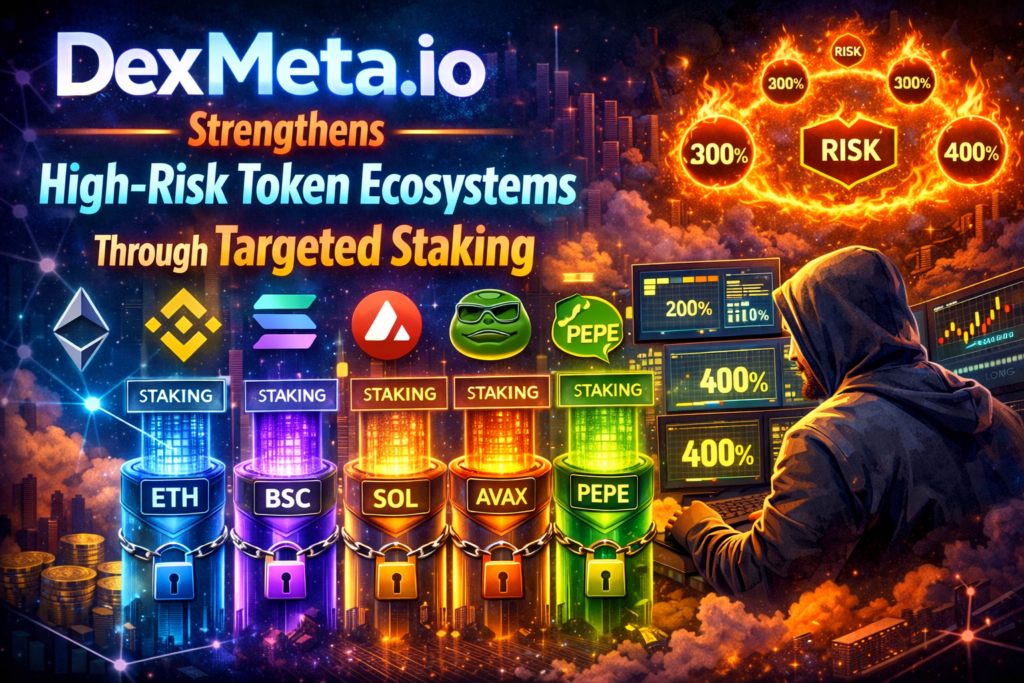
In the rapidly evolving world of decentralized finance, liquidity is often the deciding factor between a token that scales and one that collapses under volatility. DexMeta.io has introduced a staking model specifically designed to address the structural weaknesses of high-risk tokens, including micro-caps, emerging DeFi assets, and speculative community-driven projects. By enabling staking on an individual token basis, DexMeta aims to reduce circulating sell pressure, retain liquidity within ecosystems, and create strong incentive mechanisms that encourage long-term participation rather than short-term speculation.
High-risk tokens frequently experience dramatic launch cycles—rapid price increases followed by aggressive profit-taking. This volatility can quickly drain liquidity pools and destabilize markets. DexMeta’s staking framework seeks to interrupt this cycle by offering token holders meaningful yield opportunities in exchange for locking or committing their assets within the platform’s staking infrastructure.
A Non-Custodial Staking Infrastructure
DexMeta operates as a decentralized, non-custodial platform where transactions are executed directly on-chain. This means users maintain full control of their wallets and assets while participating in staking programs. Rather than transferring tokens into centralized custody, participants interact with smart contracts that manage staking logic transparently on the blockchain.
This design reinforces trust and transparency, particularly in high-risk markets where users are cautious about custodial risk. On-chain execution allows staking participation, total locked supply, and reward distribution activity to remain verifiable. For emerging tokens, this visibility can enhance credibility by showing genuine community commitment rather than artificially inflated metrics.
The non-custodial structure also ensures that DexMeta functions as infrastructure rather than as a centralized intermediary, aligning its staking services with broader decentralized finance principles.
Token-by-Token Staking: A Flexible Growth Mechanism
Unlike platforms that focus on staking a single native token, DexMeta supports staking at the individual project level. This token-specific model gives each ecosystem the ability to implement customized reward structures that match its development goals and liquidity needs.
For early-stage projects, staking serves as a growth lever. By offering competitive interest rates, tokens can incentivize holders to remain committed during volatile phases. This reduces the amount of immediately tradable supply entering liquidity pools, helping stabilize price fluctuations and dampen extreme sell-offs.
Projects can structure rewards in ways that align with roadmap milestones—encouraging participation during product launches, partnership announcements, or ecosystem expansions. This adaptability transforms staking from a passive yield feature into an active scaling tool.
Retaining Liquidity in High-Volatility Markets
Liquidity retention is one of the most critical challenges facing high-risk tokens. When speculation dominates a token’s holder base, rapid inflows are often followed by equally rapid exits. Without mechanisms to anchor capital, liquidity pools thin out, slippage increases, and price volatility intensifies.
DexMeta’s staking model directly addresses this issue by incentivizing token holders to lock or commit their assets for yield. As more tokens enter staking pools, circulating supply decreases, reducing immediate sell-side pressure. This can create a more stable trading environment, where price movements reflect broader demand rather than panic-driven liquidity gaps.
In addition, strong staking participation can signal confidence to new investors and liquidity providers. A token with a substantial percentage of supply staked demonstrates community commitment, which can enhance market perception and attract further participation.
High Interest Opportunities and Risk Premium
High-yield staking opportunities are a defining feature of speculative token ecosystems. DexMeta’s model reflects this reality by enabling projects to offer elevated annual percentage yields designed to bootstrap early adoption. These higher returns serve as compensation for the elevated risks associated with emerging tokens.
However, high interest rates inherently reflect a risk premium. Token price volatility, emission schedules, and liquidity depth all influence the true return profile of staking participation. In many cases, staking rewards may offset short-term price fluctuations—but they cannot eliminate underlying market risk.
For users, this dynamic presents both opportunity and responsibility. High returns can accelerate capital growth if token performance remains strong, but careful evaluation of token fundamentals and reward sustainability remains essential.
Supporting Rapid Project Scaling
Beyond liquidity retention, staking plays a central role in enabling rapid project expansion. When holders stake tokens, they transition from passive traders to longer-term participants. This increased engagement can strengthen community cohesion and extend attention cycles beyond the initial hype phase.
Stable liquidity and committed holders provide projects with breathing room to execute development roadmaps. Instead of constantly battling sell pressure, teams can focus on product launches, integrations, and ecosystem growth. Staking metrics such as total value locked and participation rates can also serve as indicators of project health when seeking partnerships or additional liquidity sources.
By embedding staking functionality within its broader decentralized trading infrastructure, DexMeta creates a reinforcing loop: trading generates visibility, staking retains capital, and retained capital supports further growth.
A Strategic Evolution in DeFi Infrastructure
DexMeta.io’s staking model reflects a broader evolution in decentralized finance, where platforms are no longer limited to simple token swaps. Instead, they are becoming integrated ecosystems that combine trading, liquidity management, and yield generation within a unified interface.
For high-risk tokens operating in competitive, multi-chain environments, liquidity retention can determine survival. By enabling token-by-token staking with high interest incentives, DexMeta positions itself as a liquidity anchor for speculative assets seeking stability and scalability.
While risks remain inherent in volatile markets, DexMeta’s approach underscores a key principle of modern DeFi: sustainable growth requires more than attention—it requires mechanisms that encourage capital to stay.