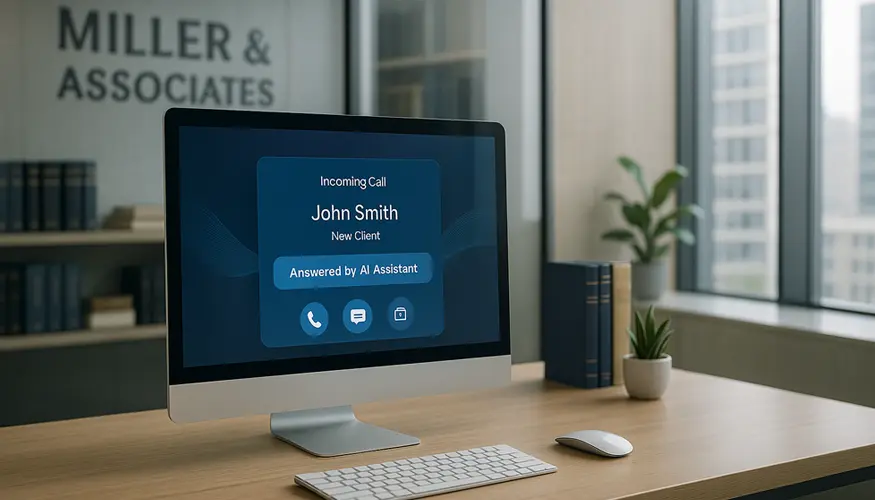
Most people don’t call a law firm unless they’re in legal jeopardy. They want help, and they want it now. When a call goes unanswered, or an email sits too long, they don’t wait. They contact the next firm.
For law firms, those missed moments turn into lost cases and wasted marketing spend. The first interaction often decides whether a potential client stays or moves on.
This post will walk through how an AI receptionist for law firms helps respond faster, handle initial intake more consistently, and protect opportunities that might otherwise be missed.
Why Law Firms Are Turning to AI Receptionists
When someone calls a law firm, they usually need help right away. If no one answers, they don’t wait. They call another firm. The first response often decides who gets the case.
Missed calls mean lost matters, wasted ad spend, and fewer chances to earn trust early. An AI receptionist helps by answering calls immediately, capturing basic details, and routing the call while staff are busy.
Common challenges for small and multi-location firms
Reception teams handle a lot at once. During busy hours or after hours, calls get missed. For firms with more than one office, intake can vary depending on who answers the phone.
Attorneys then step in to handle basic calls, taking time away from client work. AI receptionists help maintain consistent intake without adding staff.
Top AI Receptionist Platforms for Law Firms
Not every AI receptionist fits the way law firms work. Some handle only calls, while others handle intake, scheduling, and follow-up.
Below, we evaluate a few platforms based on how well they handle legal intake, integrate with existing systems, and handle calls outside regular business hours.
1. Nextiva XBert AI Receptionist
Nextiva XBert AI Receptionist is part of Nextiva’s phone system, so calls and AI work together in one place. When someone calls the firm, the AI answers first and collects basic information about their legal issue.
XBert AI routes calls based on your rules, rather than sending everything to voicemail. This helps maintain consistent intake, even during busy hours or after hours. Firms that want fewer tools and fewer missed calls often prefer this setup.
Key features
- Answers calls and gathers intake details
- Routes calls by issue or urgency
- Connects with CRMs and legal tools
- Books appointments on your calendar
- Stores call notes and transcripts
Pricing: Starts at $99 per month for 100 interactions, then $0.99 per interaction after.
2. Smith.ai
Smith.ai mixes AI answering with live receptionists. Calls can be screened by AI and passed to a human when needed. Many firms use it to filter out low-priority calls and focus on serious inquiries. It also helps with booking consultations and follow-ups. This is a good fit if you want AI support while keeping people involved.
Key features
- AI and live receptionist coverage
- Call screening and lead sorting
- Appointment scheduling
- CRM connections
- Follow-up and reminder calls
Pricing: Plans usually start around $95 per month, depending on usage.
3. Ruby Receptionists
Ruby Receptionists focuses on having a real person answer every call. Calls are handled by trained receptionists who follow your instructions. The goal is to sound warm, professional, and attentive.
Ruby is well-suited for firms that value a personal touch over automation. It helps cover calls without hiring in-house staff.
Key features
- Live receptionists for all calls
- Firm-specific greetings
- Call forwarding to staff
- Message delivery by email or text
- Basic intake support
Pricing: Plans generally start around $240 per month, based on minutes used.
Comparison of AI Receptionist Platforms for Law Firms
| Feature | Nextiva | Smith.ai | Ruby Receptionists |
| Primary approach | AI-based phone system | AI with human backup | Fully human receptionists |
| Starting price | $99/month (100 interactions) | ~$285/month (30 calls) | ~$299/month (50 minutes) |
| Legal intake support | Custom intake flows | Script-based intake | Human-led intake |
| Integrations | CRM, calendar, email, legal tools | CRM, calendar, Zapier | Calendar, email, limited CRM |
| AI capabilities | Conversational AI | Rule-based AI | Minimal automation |
| 24/7 coverage | Yes (AI) | Yes (AI + human) | Yes (human) |
| Scalability | Pay-per-use | Call-based tiers | Minute-based tiers |
| Best fit for | Firms wanting automation + visibility | Firms wanting screening | Firms prioritizing live answering |
In practice, the right choice depends on how much automation and visibility a firm wants. Nextiva suits firms seeking AI-driven intake and centralized reporting. Smith.ai works well for firms that prefer AI with human support. Ruby fits firms that value live answering over automation.
Benefits of an AI Receptionist for Small and Growing Firms
An AI receptionist helps firms answer every call, even during busy hours or after hours. It keeps intake moving without hiring more people or stretching staff thin. The result is more captured opportunities and fewer missed inquiries.
- Answers calls right away
- Books consultations and gathers basic details
Create a consistent intake experience
As firms grow, intake can start to feel uneven. An AI receptionist uses the same approach for every call, so clients always know what to expect. Faster replies and clearer next steps also lead to stronger first impressions.
- Consistent intake across teams or offices
- Clear handoff when a human steps in
Addressing Ethics, Privacy, and Compliance
For law firms, confidentiality comes first. An AI receptionist should meet the same security standards as other legal tools, including encrypted data and restricted access.
Firms also need clear control over how long call records are stored and who can view them. Understanding where data is hosted and how vendors handle security helps reduce risk.
Staying compliant with legal and ethical rules
An AI receptionist should never give legal advice. It should clearly identify itself as an automated system, gather basic intake details, and hand off to a human when legal questions arise.
Call flows can also be set up to respect jurisdictional rules by confirming location and routing out-of-scope matters appropriately. With the right setup, automation can support compliance rather than complicate it.
Key Features to Look for in an AI Receptionist for Law Firms
A general chatbot is not enough for legal intake. Law firms need AI that follows legal workflows and collects the right information without overstepping.
Look for:
- Intake questions by practice area
- Easy script editing without coding
- Different paths for new clients, existing clients, and vendors
1. Integrations that simplify work
An AI receptionist should reduce manual work, not add more tools. Intake details should flow directly into your existing systems so nothing gets lost.
Look for:
- CRM or practice management integration
- Call notes and transcripts saved automatically
- Fewer systems to manage day to day
2. Multiple ways clients can reach you
Clients don’t all call the same way. Some prefer phone calls, others text or chat, and some may need language support.
Look for:
- Support for phone, text, and web chat
- Handling for accents and mobile calls
- A single record of the conversation across channels
Firms that want fewer vendors and better visibility often choose platforms that combine calling, AI intake, and reporting in one place.
Implementation Checklist for Your Firm
Before setting up an AI receptionist, decide how calls should be handled. Here’s what you can take note of:
1. Align the AI with your firm’s tone and rules
Once your intake flow is clear, configure the AI to reflect your firm’s communication style. Set clear rules for when a call should move to a human and when it should not.
This usually means defining:
- When to transfer to staff or an attorney
- How urgent calls are handled
- What the AI should politely decline
2. Roll out gradually and track results
Start small and make adjustments before expanding firm-wide. Train staff so handoffs feel natural and consistent.
Track a short list of metrics:
- Call answer rate
- Response time
- Consultations booked
Next Steps for Law Firm Owners
Modernizing client intake is about making sure every inquiry is answered quickly, so your team can step in when judgment and experience matter most. Faster responses protect opportunities you’ve already paid to generate and create a better first impression for new clients.
Platforms like Nextiva XBert AI stand out by combining legal-focused intake, calling, and reporting into a single system. This makes it easier to manage intake consistently across teams or offices without adding staff or juggling multiple tools.
The next step is simple. Map your ideal intake flow, identify where automation will deliver the most value, and run a short pilot. Choosing a stable, all-in-one platform sets your firm up to scale intake smoothly while keeping attorneys focused on billable work.