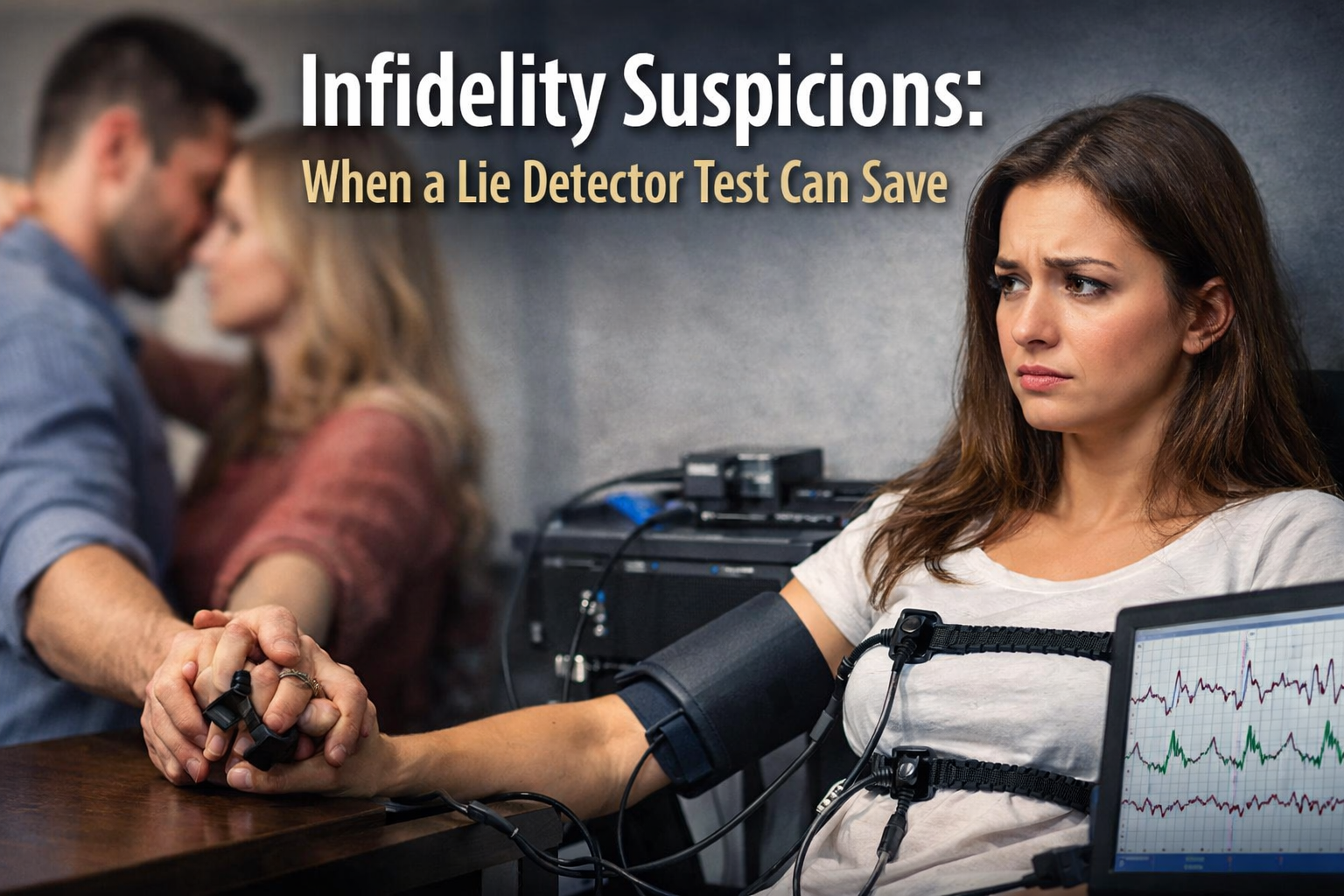
Infidelity Suspicions: When a Lie Detector Test Provides the Answers Conversations Cannot
Living with suspicion is exhausting. The late-night phone checks, the mental replays of inconsistent stories, the constant second-guessing of your own instincts. Whether your partner is actually unfaithful or you’re struggling with anxiety-driven distrust, the uncertainty itself becomes the problem – eroding your mental health, your self-esteem, and the relationship itself.
A 2024 survey by the American Association for Marriage and Family Therapy found that 41% of marriages experience at least one instance of emotional or physical infidelity. But among couples who split over suspected cheating, nearly half later admitted the suspicion was never confirmed – the relationship collapsed under the weight of doubt, not proof.
The Signs That Trigger Suspicion
Infidelity rarely announces itself. Instead, it shows through patterns of behavioral change that accumulate over time:
- Digital secrecy. New passwords, angled screens, phone always face-down, cleared browser history, apps moved or deleted.
- Schedule gaps. Unexplained overtime, new “work events,” sudden need for solo trips or nights out with previously unmentioned friends.
- Emotional distance. Less physical intimacy, fewer meaningful conversations, irritability when you try to connect.
- Appearance changes. Sudden interest in fitness, new wardrobe, or grooming habits that seem directed outward rather than shared with you.
- Financial inconsistencies. Unfamiliar transactions, cash withdrawals without explanation, a separate account you weren’t told about.
- Gut feeling. Sometimes there’s no specific evidence – just an intuitive sense that something has shifted.
Important caveat: every one of these signs can have a perfectly innocent explanation. Stress, depression, career changes, and personal growth can all produce similar behavioral shifts. This is precisely why suspicion is so maddening – the signs are ambiguous by nature.
Why Direct Confrontation Rarely Works
The most common advice is to “just ask.” But direct confrontation has a poor track record when it comes to uncovering infidelity:
| What You Say | What They Say | What Actually Happens |
|---|---|---|
| “Are you seeing someone else?” | “Of course not! How could you think that?” | Denial + guilt trip. You feel worse for asking. |
| “I saw a message on your phone.” | “It’s just a coworker. You’re reading into it.” | Minimization. Evidence gets deleted. You can’t verify. |
| “I need the truth or I’m leaving.” | “Fine, leave then. I can’t live with your paranoia.” | Deflection. The issue becomes your “trust issues” instead of their behavior. |
Research consistently shows that people who are being deceptive rarely confess when confronted – they escalate their denial. And for the innocent partner, being falsely accused feels like an attack, which also leads to defensiveness. Either way, the conversation ends without clarity.
How a Polygraph Test Breaks the Cycle
A polygraph examination cuts through the circular dynamic of accusation and denial. Here’s what makes it different from any conversation:
- Objectivity. The test measures physiological responses – not words, not tone, not body language you might misread. The data doesn’t argue or make excuses.
- Specificity. Questions are narrowly focused: “Have you had sexual contact with anyone outside this relationship in the past 12 months?” There’s no room for ambiguity or creative reinterpretation.
- Finality. With 90–98% accuracy, the result provides a level of certainty that no conversation can match. Either the concern is validated or it’s laid to rest.
- Mutual benefit. If the accused partner is innocent, the test proves it conclusively. If they’ve been unfaithful, the truth comes out – and both partners can make informed decisions about the future.
What the Process Looks Like for Couples
A relationship-focused polygraph examination follows the same professional protocol as any other test, with additional sensitivity to the emotional context:
- Initial consultation (free). You speak with the examiner privately about your concerns. They help determine whether a polygraph is appropriate and what questions would be most useful.
- Question formulation. Questions are carefully crafted to be specific, unambiguous, and answerable with yes or no.
- Testing session (1.5–3 hours). The partner being tested takes the examination voluntarily. All questions are reviewed before the test – no surprises.
- Results delivery. The examiner provides findings. Some couples choose to receive results together; others prefer to hear them privately first.
The test is always voluntary. No one can be forced to participate, and the person being tested can stop at any time.
After the Results: What Happens Next
- If suspicions were unfounded: Relief. The accusing partner gets closure, the accused partner feels vindicated, and the couple can work on rebuilding trust without the shadow of doubt.
- If infidelity is confirmed: Pain – but also clarity. The couple can now make informed decisions: therapy, separation, or restructuring the relationship with full awareness of what happened.
Either way, the guessing game is over. And that’s often the most valuable outcome of all.
Taking the First Step
If suspicion has been eating away at your relationship and conversations haven’t provided answers, a professional polygraph examination may be the clarity you both need. Global Experts Union offers confidential lie detector test services for couples, with certified examiners working in 40+ countries. Appointments are available 7 days a week, and the first consultation is completely free – you can discuss your situation without any obligation. Reach out by phone, Telegram, Viber, or WhatsApp to start the conversation.
Suspicion without resolution is a slow poison for any relationship. Whether the truth brings relief or difficult decisions, it’s always better than the alternative – an endless loop of doubt that neither partner deserves to live in.


