The Inflation Reduction Act came with many bonus incentives made to steer investment into specific areas. One of the biggest of the lot is the energy community tax credit bonus. When a project falls in a qualifying community, the value of certain clean energy credits increases accordingly. Although this financial uplift looks attractive, it is backed by added scrutiny around compliance.
While many developers and investors shift their focus to whether a site qualifies geographically, the real exposure is in maintaining its eligibility over time. Understanding the compliance risks behind the energy community tax credit bonus is essential before relying on it in financial models.
What the Energy Community Bonus Is Designed to Do
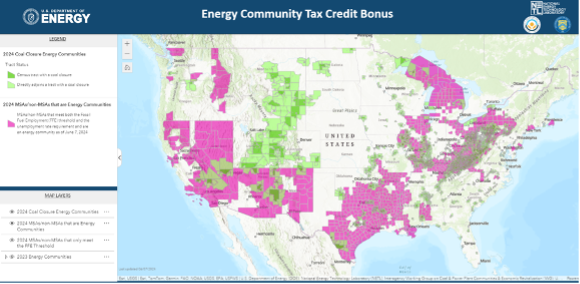
The energy community tax credit bonus comes with an added percentage increase to the base credit rate for projects located in certain areas. These could be historically tied to fossil fuel industries or going through economic challenges.
Broadly, there are three categories to this:
- Brownfield sites
- Statistical areas with significant fossil fuel employment or tax revenue
- Census tracts linked to retired coal mines or coal-fired power plants
This bonus can materially improve project economics. However, claiming it requires careful validation and ongoing record keeping.
Why Compliance Is More Complex Than It Appears
At first glance, qualification may seem like a simple mapping exercise. In reality, the energy community tax credit bonus depends on technical definitions, evolving datasets, and precise timing rules.
Common complications include:
- Boundaries that change as government data updates
- Different rules for various credit types
- Interaction with other bonus credit requirements
It may appear that your project is qualifying early on. However, if your documentation is not correct or the timing does not match up with IRS rules and regulations, it can fail later on.
Risk 1: Misidentifying the Project Location
One risk that is most commonly encountered is incorrectly determining whether a project is physically located in a qualifying energy community or not. The IRS relies on specific geographic identifiers, not general descriptions.
Issues often arise when:
- Developers rely on outdated maps or third-party summaries
- Project boundaries span multiple census tracts
- Equipment locations differ from the main site address depending on the credit type
Mitigation approach: For geographical data, use official sources. Along with that, hold on to GIS-based mapping evidence that shows exactly where the generating equipment is located. Screenshots and general references do not work on their own.
Risk 2: Failing to Tie Qualification to the Correct Time
Being eligible for the energy community tax credit bonus is decided based on conditions at a specific point in time. This could be when construction began or when the project is placed in service.
Problems occur when:
- Projects assume eligibility based on current status without confirming the relevant determination date
- The construction start documentation does not clearly establish timing
- Delays push key milestones into periods where community status has changed
Mitigation approach: Align energy community analysis with formal construction start documentation and retain dated evidence showing qualification at the required time.
Risk 3: Overlooking Interaction with Other Bonus Requirements
Projects claiming the energy community tax credit bonus frequently also pursue bonuses tied to domestic content or low-income community criteria. These bonuses have separate and sometimes overlapping compliance frameworks.
Risks include:
- Confusing documentation standards between bonus categories
- Assuming qualification for one bonus automatically supports another
- Failing to track each bonus independently in the records
Mitigation approach: Keep separate files for each bonus category. Even if the same project qualifies for multiple uplifts, your compliance files should be different.
Risk 4: Insufficient Documentation for IRS Review
As per the IRS’s regulations, the taxpayer should substantiate eligibility with contemporaneous records. For the energy community tax credit bonus, this means more than simply stating that a site qualifies.
Essential documentation often includes:
- Census tract identifiers and supporting maps
- Government data sources used to determine eligibility
- Internal memos explaining how the qualification criteria were met
Without a clear audit trail, the bonus portion of the credit may be challenged, even if the base credit remains intact.
Risk 5: Changes in Project Scope or Layout
Project designs frequently evolve during development. Equipment may be relocated within a site, or additional facilities may be added later. These changes can affect whether all energy property remains within a qualifying area for the energy community tax credit bonus.
Exposure arises when:
- New equipment is installed outside the originally assessed boundary
- Temporary construction areas are confused with permanent facility locations
- Expansion phases are not separately evaluated
Mitigation approach: Take a look at geographical qualifications again whenever the project footprint changes. After that, document how every major component fits with the eligibility.
Risk 6: Overreliance on Third-Party Summaries
Many market participants use online tools or summary reports to confirm energy community status. While helpful as a starting point, these tools do not replace formal analysis.
Risks of overreliance include:
- Tools based on outdated data releases
- Lack of clarity on methodology
- Missing documentation suitable for an audit file
Mitigation approach: Treat third-party tools as preliminary guidance only. Always retain primary source data and internal analysis supporting eligibility for the energy community tax credit bonus.
Key Compliance Risk Areas at a Glance
| Compliance Area | Typical Risk | Why It Matters | Practical Control |
| Geographic identification | Using incorrect census tract data | Bonus could be disallowed | Use official datasets and GIS mapping |
| Timing of eligibility | Misaligned construction start evidence | Qualification may not apply | Tie analysis to dated construction records |
| Bonus interaction | Mixing documentation between bonuses | Gaps in the audit trail | Maintain separate compliance files |
| Project changes | Equipment outside the eligible area | Partial loss of bonus | Reassess after design or scope updates |
| Data reliance | Outdated third-party tools | Unsupported claims | Keep primary source documentation |
Building a Defensible Compliance File
A defensible position on the energy community tax credit bonus is built over time, not at the point of tax filing. Documentation should be organised so that an external reviewer can clearly follow the logic from eligibility determination to credit claim.
Strong compliance files typically include:
- A written eligibility memorandum
- Supporting geographic data and maps
- Construction timeline documentation
- Records showing consistency between the physical project and the analysed location
This level of preparation helps demonstrate reasonable, good-faith reliance on available data.
The Long-Term Nature of the Risk
Unlike some one-time tax positions, the energy community tax credit bonus may remain exposed to review years after a project is placed in service. If the underlying analysis is weak, the financial impact can extend well beyond the initial filing year.
Because of this, businesses should treat energy community qualification as an ongoing compliance matter rather than a one-off check during development.
Final Thoughts
The energy community tax credit bonus offers meaningful financial upside, but it also introduces technical compliance obligations that should not be underestimated. Geographic precision, timing alignment, and thorough documentation form the foundation of a defensible claim.
By approaching eligibility with the same rigour applied to core credit requirements, developers and investors can reduce the likelihood of disputes and protect the long-term value of their tax positions.