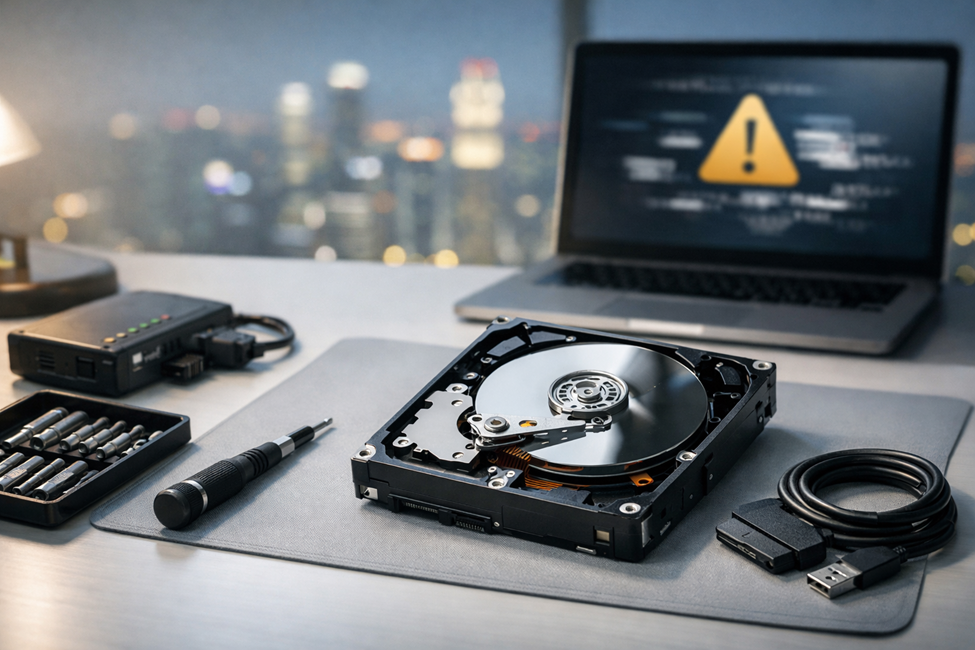
It is very uncommon for hard drives to just die, without any warning. In the vast majority of cases, your device will whisper warnings well before it decides to nope out on boot day or before that folder suddenly becomes unreadable, and files appear corrupted.
Whether you’re focused on managing the website for an entire organization or running a household of websites, thinking about maintaining your site’s data in the same way you maintain its content can save a world of heartache. Year over year writing for tech brands and IT teams has taught me one consistent lesson: people don’t need to “lose their data” because it was sudden, they lose it because when first confronted with subtle clues of what is to come, these signs feel easy to ignore.
If you’re seeking a data recovery service singapore offering or comparing to other data recovery singapore options, this guide will help you identify failure symptoms, what they mean and when exactly you should stop DIY-ing it up before talking to someone who knows how.
Why Do Hard Drives Fail More Often Than You’d Think
A mechanical device is a hard disk drive (HDD) of the prior art. It whirls platters that spin furiously, and a delicate read/write head floats just microns above the surface. More common long term environmental factors can also cause failure. Even if you are exceedingly cautious, regular wear takes its toll over time.
What makes this gravely serious is that “failure” is not one thing. That typically read error lead to bad sectors, slow transfer lead to hanges up and finally the disk itself became unreadable. The faster you act, the better your chances of recovery and the lower your risk of permanent harm.
Obvious Indications That Your HDD Is Malfunctioning
Strange Noises, Clicking, or Grinding
Your hard drive should be silent if it’s healthy. The repeated clicking, beeping or chugging sound may involve mechanical problems such as those with the head movement or platter damage. If you are hearing any of these sounds treat the disk as delicate. If you keep on using it, the physical condition may deteriorate fast and this will make singapore hard disk data recovery cases more complicated.
Freezes All the Time and Sluggish as Hell
If your PC is taking an inordinately long time to open folders, copy files or boot up Windows it could be a sign the disk keeps encountering errors when reading data. Yes, RAM and Windows updates tend to be the things that people blame but regular pauses around file operations are an old warning from your disk.
Really Bad Corrupted Files and Lots Of Error Messages
Files that previously opened fine may display an error message such as “file is damaged,” “cannot read from source” or even a CRC error. These could occur as the drive is growing bad blocks. To stave off corruption of important documents, photos or project files that begin reacting badly, don’t keep trying to open them.
Disappearing Files or Missing Partitions
Whether folders go missing, partitions report “RAW” instead of a file system, or your drive appears to work but actually has bad sectors and/or corrupt firmware, these symptoms can all indicate one or more of the following problems: file-system corruption, partition-table damage due to fire or flood/fire suppression systems; dysunctional firmware. This is one of the times when snap judgments count the most.
SMART Warnings and Bad Sector Warnings
Monitoring machinery health values (often as SMART) is supported by a variety of devices. If you get a SMART warning, it’s not just blowing smoke up your ass. T indicates that your drive is reporting conditions connected to failure, such as reallocated sectors, read errors or bad spin-up attempts.
When to Stop DIY and Look for Data Recovery in Singapore
There is a time for plain vanilla troubleshooting and there is a time to play defense. The best solution is simply to halt anything that is stressing the drive, if the data matters.
Before it actually happens You need to get in touch with a professional data recovery service singapore provider right away if any of the following take place:
- the drive starts to click or make other unusual sounds
- your system is no longer able to look for and recognize the device consistently anymore,or can’t detect it at all
- the partition has turned RAW
- you see a message asking you to format the disk that contains your files, your files are visible stuffed up as well
In my experience the most harmful mistake made by people with misbehaving hardware is to repeatedly run “repair” scans on an unstable disc. Tools: Yes, Tools can be useful but they can push a failing drive over the edge to failure by stressing the damn thing too much like reading heavily damaged areas that were being left alone before thus cooling.
Whether business data, research work, or (eek) irreplaceable family media that you’re too lazy to burn to discs regularly, you can treat the drive as a “read once” situation. Each subsequent boot attempt is a bet.
HDD vs. SSD vs. RAID Data Recovery in Singapore
Hard Disk Data Recovery (HDD)
Hard drive recovery generally involves physical failure, bad sectors or corrupted file systems. An important consideration is that with really broken phones, data can still sometimes be recovered using specific hardware methodology. But, mechanical damage can get worse rapidly so speed and handling are critical in hard disk data recovery Singapore cases.
SSD Data Recovery
SSD Failures “Feel Sudden” SSD failures “feel sudden” because as already mentioned, they do not give the same audible warning as HDDs. SSDs use a type of disk known as flash memory, which performs wear leveling and data mapping via a controller. If the controller fails or the firmware is corrupt, the drive could vanish at any second.
ssd data recovery singapore job may become more complicated Encryption, TRIM behavior and controller level problems can prevent a certain about of output. This is why immediate intervention and accurate assessment are crucial.
RAID Data Recovery
RAID complicates this because information needs to be recovered from data striping and stored on more than one device and recovery comes down to the RAID level, stripe size, specific drive order, and factors such as controller metadata: It’s a mistake you can make when rebuilding the array as well, where you can clobber parity or generate an incorrect configuration.
In situations like this, you need a method that works to rescue your lost data including the process of raid data recovery in Singapore – diagnose, image drives safely, recreate virtually and extract without causing more damage.
Must-Have Qualities of a Reliable Data Recovery Service in Singapore
Diagnosis should be a professional’s starting point, not guesswork. Find transparent assessment, clear communication about prospects for success and a process that emphasizes safe imaging before extraction. In good quality data recovery singapore service, we avoid things it will be actual lost some of the things that you have.
Also consider privacy and confidentiality. If your disk includes company files, student research or personal records, you don’t want a provider that takes data handling lightly or doesn’t explain how your files are protected on the go.
FAQs
Is it possible to retrieve data on my own when my hard drive is crashing?
If the drive is solid, and it’s just a matter of an erased file, these free recovery programs will work well. But you hear clicking noises, find missing partitions, corruption or detection issues, any DIY tries can decrease the possibility of successful recovery. In high-value cases, professional assistance is the safer bet.
How long should I wait before consulting a data recovery professional in Singapore?
As soon as you notice the warning signs, go directly to a specialist: If the data is critical. Waiting creates more damaging, weaker corruption of worse yet — complete failure to the device, which limits the potential for recovery.
Is recovering data from SSD more difficult than from HDD?
Often yes. SSDs can die in less predictable ways and the likes of TRIM, encryption and controller behavior might make recovery more difficult. Feasibility can more accurately be determined by a technician who has worked with ssd data recovery singapore cases.
What can I do right after suspecting the drive is failing?
Cease using the drive, do not attempt to repair scan it, don’t format it if at all possible. If possible, power down safely. Next best is to have a pro do it, espeically for hard drive recovery singapore or raid installation.
Final Thoughts
When a hard drive is failing the two most valuable skills are to know when to leave it alone. The symptoms are typically those bearings you get clicking, rough sounding or slow access, corruption and SMART warnings or lost data.
If your files are important, don’t take the “one more restart” approach; instead, consider expert help early. The truth is that in many cases the right data recovery service Singapore provider can salvage what appears to be lost, but as a rule of thumb, the best possible outcomes result from careful, early decision-making.