Introduction
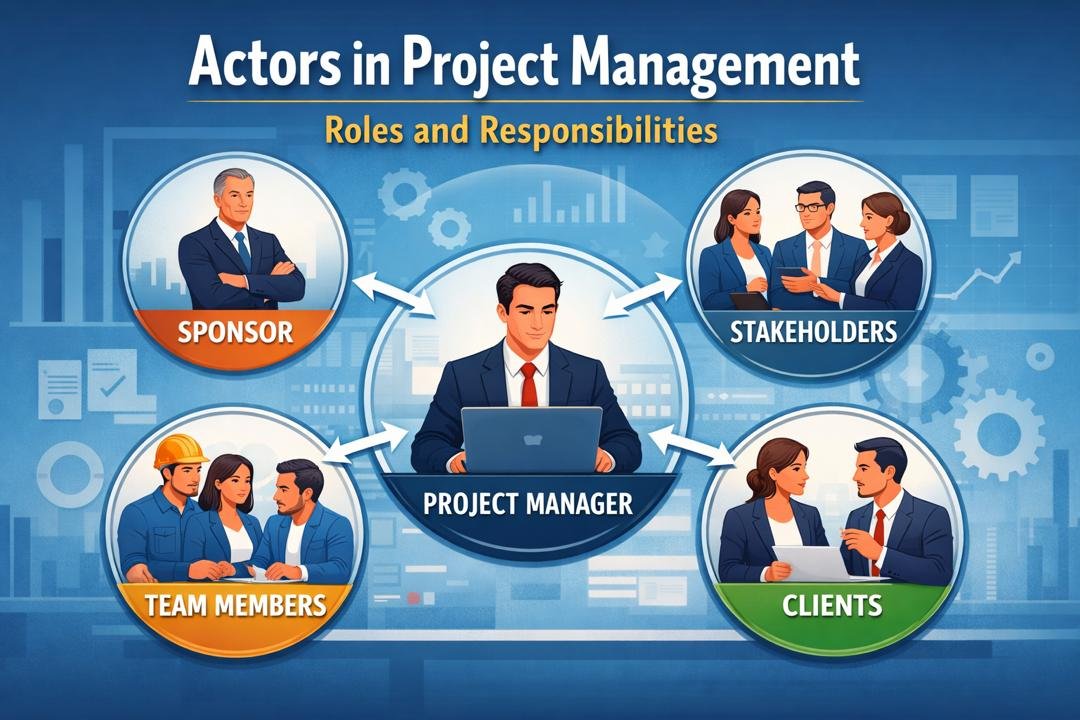
Project management does not pertain to schedules, budgets and tools only, it is all about people. Project large or small in any industry, rely on a team of people and organizations, collaborating in order to accomplish a work of goal. These people are referred to as the actors in project management. The roles of each actor are different, and each actor provides his/her particular knowledge and impact on the effectiveness of the planning, implementation, and delivery of a project.
Knowledge of job and duty of project actors is key to effective project outcomes. Conflicts, duplication of efforts, missed deadlines and poor communication are common in projects where roles are not defined or they are not clearly defined. However, in the scenario where every actor comprehends his/her roles and the role vice versa that of other actors, it will be easier to collaborate, minimize risks and increase the probability of project success.
In this article, we shall understand the main players in the project management among them being the project sponsors, project managers, team members, project stakeholders and clients. We shall discuss their roles, responsibilities and interdependency and how effective communication and interaction among these actors will lead to project success during the project life cycle.
Significance of Project Management Actors
Project management can be classified into five broad categories that are the main actors:
- Project Sponsor
- Project Manager
- Project Team Members
- Stakeholders
- Clients or Customers
Even though their responsibilities might cross in certain instances, each of the actors has specific duties that can be said to lead to the overall success of the project.
The Project Sponsor
Role of the Project Sponsor
The project sponsor refers to the person or group that approves the project and gives the required resources and assistance. Making important decisions and funding are the prerogative of the sponsor, which is normally a senior executive or manager in the organization.
The sponsor plays the role of champion of the project. They make sure that the project is in line with organizational strategy and business objectives. Most projects do not have a sponsor and therefore have no direction, authority and a long term support.
Project Sponsor Responsibilities
Primary tasks of project sponsor are:
- Accepting the project business case and objectives.
- Funding and obtaining resources.
- Selection of the project manager.
- Executive level support of the project.
- Solving the big problems and disputes that are not within the scope of the project manager.
- Delivery of benefits on the project.
Significance of the Project Sponsor
The project sponsor is very important towards minimizing the organizational barriers. The sponsor uses his/her power to eliminate any challenges and keep the stakeholders committed when difficulties occur. A powerful sponsor has high chances of success and a weak or passive sponsor tends to create failure in the project.
The Project Manager
Role of the Project Manager
The key participant in project management is the project manager. Their role is to plan, organize, lead and control the project until its completion. The project manager serves as an interface between sponsor, the team, and the stakeholders to the client.
The project manager is also more concerned with the execution of the operation, which is not the case with the sponsor who is more concerned with strategic direction.
The Project Manager responsibilities
The project manager should have the following significant roles:
- Setting project scope, goals and deliverables.
- Preparation of the project plan and schedule.
- Managing resources budget and risks.
- Team activity coordination.
- Interaction with the stakeholders and clients.
- Measuring performance and progress.
- The quality standards are to be observed.
- Finalization of the project and recording lessons learned.
The Competencies of a successful Project Manager
A good project manager must possess technical skills as well as interpersonal skills which include:
- Leadership and motivation.
- Communication and negotiation.
- Decision-making and problem-solving.
- Management and organization of time.
- Risk and conflict management.
People and processes coordination is one of the direct impacts of the project manager on project success.
Project Team Members
Role of Project Team Members
Project team members refer to people that do the real work of the project. They come with technical knowledge, practical skills and special knowledge that are required to accomplish tasks and deliverables.
The personnel can consist of engineers, designers, analysts, accountants, developers, marketers, or any other professionals who can be involved in the project.
Project Team Member Responsibilities
Their duties will normally include:
- Accomplishing given tasks and activities.
- Offering technical contribution and solutions.
- Co-working with other members of the team.
- Updating the project manager on the progress.
- Risk and problem identification.
- Being able to maintain quality in their work.
Importance of Team Members
The working foundation of the project is the team members. A project may not be successful despite the good planning because without a good and motivated team, the success will not be realized. Teams that are well cooperating enhance productivity, innovativeness and problem solving.
Stakeholders
Who Are Stakeholders?
Stakeholders are groups or individuals who are interested in the project or the results of the project. Stakeholders can either be internal or external to the organisation.
Examples of the stakeholders are:
- Senior management.
- Employees.
- Suppliers and contractors.
- Regulatory bodies.
- Community members.
- Investors.
Stakeholder responsibilities
The role of the stakeholders in the project is not necessarily direct, but they shape it in the following ways:
- Available requirements and expectations.
- Giving of feedback and approval.
- Answering or opposing project changes.
- Being involved in making decisions where necessary.
Stakeholder Management
Stakeholder management would entail:
- Determining all the stakeholders.
- The analysis of their interests and influence.
- Frequent communication with them.
- Dealing with anticipations and anxieties.
The lack of stakeholder management is one of the frequent causes of resistance, lack of understanding, and conflicts that may kill a project.
Clients or Customers
Role of Clients
Client is any individual or organization which is the recipient of final product or service of the project. The sponsor may be the client in other occasions, even though in most instances they are distinct.
Client establishes the definition of success on a user level.
Clients Responsibilities
Clients are responsible for:
- Identifying requirements and needs of the project.
- Giving approvals and feedback.
- Being involved in testing and evaluation.
- Approving or disapproving final deliverables.
Importance of Clients
Clients are key in project success since their satisfaction will be the key in determining whether the project has met its objective or not. Even a technically successful project can fail when the project is not able to satisfy the client expectations.
Interdependency between the Project Actors
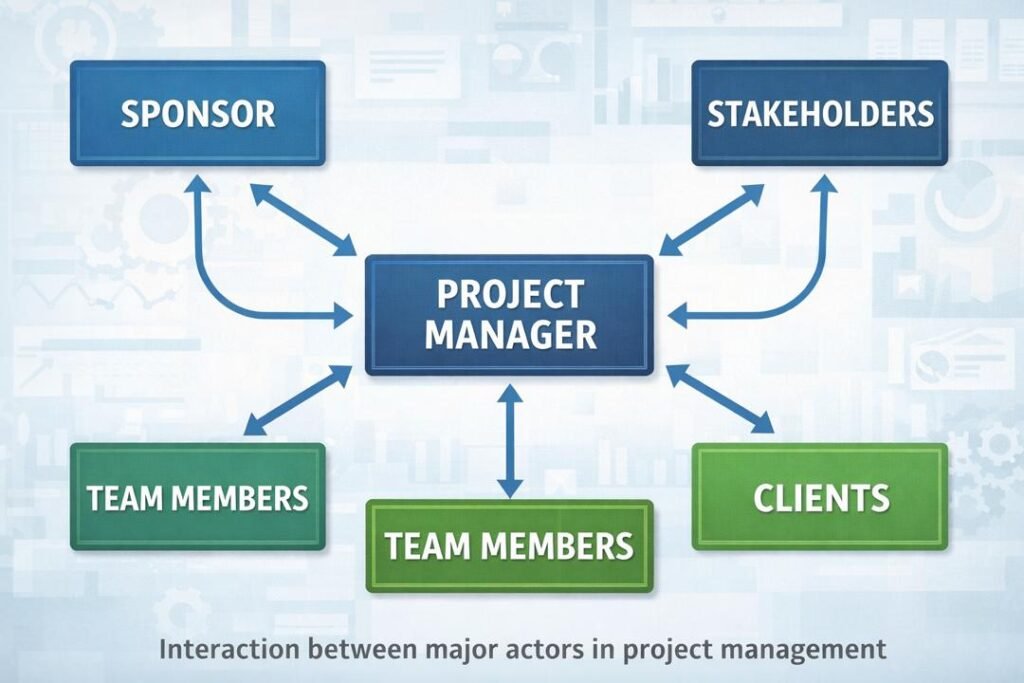
Actors of project do not work alone. Their functions are interrelated, and no actor is able to make decisions, resources, and information independent of other actors.
Sponsor and Project Manager
The project manager relies on the sponsor to provide results whereas the sponsor relies on the project manager to provide authority and support. Trust is required in this relationship and effective communication.
Team Members and Project Manager
Task assignments and coordinating activities are done by the project manager, and feedback and input in terms of technical support are offered by the team members. Open communication and respect can help enhance morale and performance.
Project Manager and Stakeholders
The project manager reports the progress, sets and manages expectations, and conflict resolution with stakeholders. In turn, the stakeholders have an impact on the project decisions and outcomes.
Clients and the Project Team
The team receives the requirements given by the clients and interprets them into deliverables. Constant communication translates to less confusion, and a higher degree of quality.
Teamwork and Networking in Project Management.
Significance of Communication
Effective project management is based on communication. It ensures that:
- Everyone is familiar with the objectives of projects.
- There is a clear definition of responsibilities.
- Issues are identified early.
- The decisions are recorded appropriately.
Lack of communication brings about confusion, delays and disagreement.
Tools for Communication
Such tools of communication as:
- Meetings and briefings.
- Emails and reports.
- Project management software.
- Performance metrics and dashboards.
Project manager normally takes care of the design and maintenance of the communication plan.
Collaboration and Teamwork
Teamwork promotes team responsibility and team problem-solving. When actors work well together:
- Trust is built.
- Innovation increases.
- Disputes are also solved more quickly.
- Performance of the project is enhanced.
Project Actor Role through Project Life Cycle
Project life cycle is comprised of five major stages namely, initiation, planning, execution, monitoring and controlling, and closing. The different actors have different roles in the various phases.
Initiation Phase
- Project approved by the sponsor.
- Project manager is selected.
- The stakeholders are determined.
- Client requirements are stated.
Planning Phase
Project manager designs road maps.
- Experts are provided by team members.
- Stakeholders analyze and accept.
- Sponsor grants ultimate approval.
Execution Phase
- Team members perform tasks.
- Project manager acts as a coordinator.
- Sponsor sustains and fixes problems.
- Clients provide feedback.
Controlling and Monitoring Phase
- Performance is monitored by project manager.
- Stakeholders are provided with reports.
- Sponsor is a goal aligner.
- Clients validate progress.
Closing Phase
- Project manager completes deliverables.
- Client accepts results.
- Sponsor evaluates benefits.
- Team lessons learned are documented.
The Problem of Clear Roles and less Conflict
The lack of resources, tight deadlines, and conflicting expectations are typical in the projects. Nevertheless, well-established roles minimize conflicts because:
- Eliminating role ambiguity.
- Elimination of duplication of effort.
- Improving accountability.
- Enhancing communication.
Misunderstanding is reduced to a minimum and decision making is more efficient when everybody knows who does what.
Conclusion
Successful completion of projects does not solely rely on the technical tools and techniques but also the successful coordination of people. The stakeholders, the project team members, the clients, the project manager, and the project sponsor are essential in the final results of the project. Their tasks are interrelated and their cooperation will make a project successful or unsuccessful.
This knowledge of key actors in project management enables organizations to allocate roles in a better manner, enhance communication, and minimize conflicts. The collaboration of these actors where they share common goals, respectful roles and duties will most likely result in timely completion of projects on the expected budget and to the satisfaction of all the involved parties.
Primarily, project management is a discipline that involves humans, and the relationship quality between the project actors is as significant as the quality of plans, schedule, and systems.
Get more well prepared information about actors in project management here.