Abstract
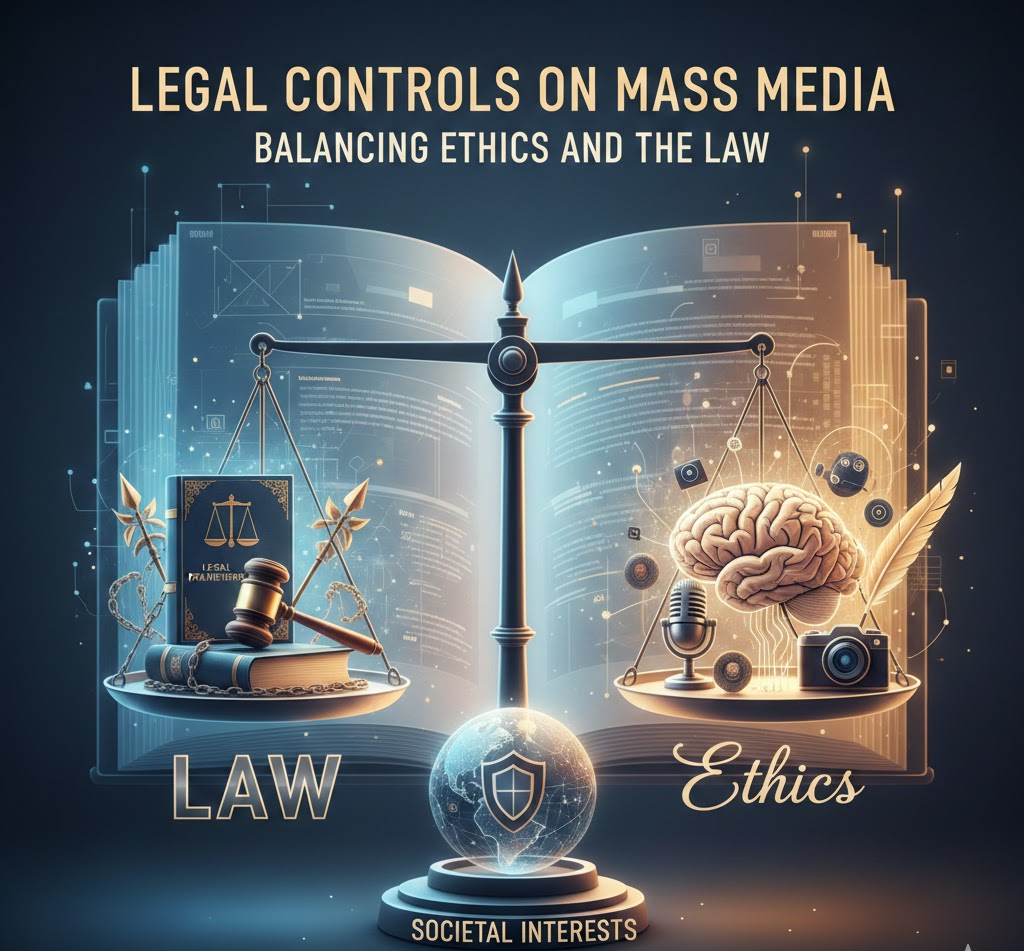
The legal frameworks are critical in controlling the mass media operations, besides promoting ethical journalism. Media have boundaries which are ensured by laws and which ensure that the rights of individuals and societal interests are safeguarded, and moral principles control responsible behavior. This paper will discuss the relationship between legal systems and media ethics in establishing a balanced field, both in freedom of expression and accountability. The research relies on a qualitative literature review and case study to explore the fundamental principles of law, the codes of ethics and practical application to explain how legal frameworks regulate mass media operations.
Keywords: legal frameworks, mass media, media ethics, responsible journalism, freedom of expression
1. Introduction
Mass media occupies an influential place in modern society; it shapes the opinions of people, political rhetoric, and social actions. This comes with the twin challenge of not just following the code of ethics, but also the law. Although journalists and media outlets are free to express themselves, legal models place restrictions to avoid breaching the freedom of expression, invasion of privacy, hate speech, and other illegal activities.
Learning to comprehend legal regulations of mass media activities is essential for media practitioners. The combination of legal and ethical factors helps journalists act responsibly in their work, preserve the trust of the people, and safeguard people’s rights. This paper will examine the law and ethics interaction in mass media with particular attention to the significance of a balance between individual rights and the freedom of the media.
2. Literature Review
2.1 Legal Regulations in Mass Media
The legal regulations in mass media are addressed in the legal chapter of mass media research.
The responsible media conduct is based on legal frameworks. The laws on defamation and libel make journalists avoid publishing statements that can be harmful to the reputation of an individual (Ward, 2019). Laws of privacy are used to ensure that personal information is not disclosed to unauthorized third parties, and copyright and intellectual property laws are used to protect works of creativity (McQuail, 2010). The regulations of broadcasting guarantee the norms of content distribution, and the legislation of anti-hate speech prohibits the call to violence.
Literature points out that legal compliance is a low-level accountability that allows journalists to be held responsible. Nonetheless, researchers believe that the law cannot address all ethical issues in reporting, especially the complex or novel ones like the social media coverage and investigative journalism (Christians et al., 2016; Plaisance, 2014).
2.2 Journalist Ethics
Ethical codes of conduct also direct media practitioners in matters that are not clearly spelt out in the law. Accuracy, fairness, transparency, minimizing harm and independence are some of the principles that define professional judgment (Kovach and Rosenstiel, 2014). Ethical standards support legal obligations by pushing the journalists towards moral discretion, especially concerning vulnerable groups, sensitive matters, or reporting beyond a country.
The interaction between law and ethics is not straightforward, and several real-life examples can be used to illustrate that ethics is not the simple outcome of law.
An overview of earlier literature notes that both ethical and legal frameworks are complementary and not contradictory. Although law imposes compulsory compliance, ethics can help a journalist make judgments and keep the audience on his side (Christians et al., 2016). According to the scholars, the organizations that combine legal and ethical standards gain more credibility and responsibility (Ward, 2019).
3. Theoretical Framework
Two theories have been the foundation of this paper:
3.1 Normative Media Theory
It holds that media organizations are required to serve in the dictates of society and within the law, to ensure that they are legitimate (McQuail, 2010).
3.2 Social Responsibility Theory
This theory underlines the fact that freedom of the press is accompanied with the responsibility to respect human rights, spread democracy, and not harm (Christians et al., 2016).
These theories justify dual dependency on legal and ethical guidelines as important tools in the regulation of mass media activities.
4. Methodology
This paper uses qualitative method of analysis which utilises secondary sources such as scholarly articles, media law books and reports by journalism organisations. Content analysis of:
- Legal laws and case law concerning libel, privacy and broadcast law.
- Codes of ethics, i.e. NUJ Code of Conduct and international journalism guidelines.
- Empirical research and reports of the application of ethics and law in journalism.
The qualitative analysis enabled the trends, obstacles, and practice excellence in the intersection of law and ethics in media to be identified.
5. Legal Controls on Mass Media
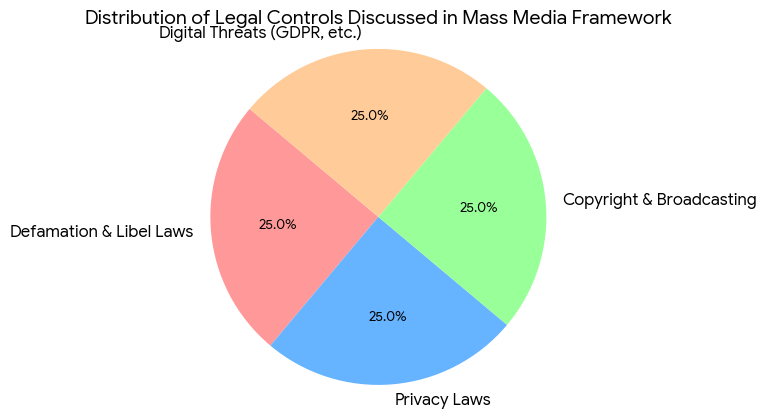
5.1 Defamation and Libel Laws
The laws of defamation aim to ensure that one is not subjected to false remarks that may destroy their reputation. Journalists should ensure that facts are strictly checked prior to publication because they should not face legal liabilities (Ward, 2019). These laws are supported by ethical standards, which promote accuracy, fairness, and openness of reporting.
5.2 Privacy Laws
The individual privacy guarantees against the illegal release of personal or sensitive data. Ethical codes are used to supplement the legal minimum because they teach journalists to take dignity into consideration, particularly when they are reporting on minors, crime victims, or marginalized groups (Christians et al., 2016).
5.3 Copyright and Broadcasting Regulations
The laws on intellectual property safeguard the rights of innovators, whereas broadcasting laws form the norms of distribution of content. The ethics entail that journalists must use copyrighted material in a responsible manner and offer proper attribution.
5.4 Digital Threats on the Horizon
The misinformation, online harassment and breach of data privacy are some of the legal and ethical challenges coming with digital media. The journalism ethics are overlapped by laws like the GDPR, which demands that the media companies establish effective compliance and ethical review procedures (Plaisance, 2014).
6. Practical Applications
6.1 Editorial Decision-Making
The law influences editorial decisions, fact-checking policies and even content vetting. These policies are supported by ethical factors, which guarantee fairness, precision, and social responsibility (Kovach & Rosenstiel, 2014).
6.2 Case Studies
- Cases of defamation: Intense scrutiny of facts avoids lawsuits and respects journalistic integrity.
- Privacy breaches: The principles of ethics help to report sensitive issues responsibly and follow the law.
6.3 Global Media Variations
The laws of one nation are not the same as those of another. Ethical norms have been used to offer a reliable foundation of responsible journalism in international settings where cross-border reporting will not infringe on local or international professional ethics.
7. Findings
In accordance with the literature analysis and professional codes, the study discovers:
- Laws have established a well-defined framework through which the media practice is regulated to hold them accountable in case of defamation, privacy, and intellectual property.
- Ethical codes are used to supplement laws, and they help in situations which are not clearly stipulated by the law.
- Combining freedom of expression and compliance with the law is a challenge, particularly in investigative reporting and in the digital media industry.
- Ethical oversight is necessary because digital media makes it hard to enforce.
- Culture and training have an impact on compliance, where institutions that are focused on ethics and law gain more societal trust.
8. Discussion
8.1 Complementarity of Law and Ethics
The course has helped me realize that relativism in law and ethics is a real concept and that it is important to impart the law to students in a way that would resonate with their moral principles.
Ethics offer moral advice, as laws set the bare minimum. This two-tier system ensures not only that journalists will not evade punishment but also that they will be credible and trustworthy.
8.2 Practical Implications
The combination of law and ethics enhances editorial judgments, privacy policy, and fact-checking. Firms that have effective ethics management are more accountable.
8.3 Global and Digital Reflections
Cross-border reporting is sensitive to local legislation, but it should adhere to universal ethical standards. The digital media also makes it more difficult to regulate, requiring new legislation and strengthening ethics.
8.4 Limitations and Future Research
Enforcement, interpretation and integration of technology problems still exist. The empirical case studies of legal-ethical violations and the effectiveness of the training programs in inculcating responsible journalism should be investigated in future research.
9. Conclusion
Ethical codes and legal frameworks are the two most common pillars of responsible journalism. And the knowledge of the legal frameworks governing the operations of the mass media assists the journalists to reconcile freedom of expression with respect to individual and societal rights. By keeping to the law and ethical issues, media organizations might be credible and facilitate people to trust media and be productive to the democratic society.
References
Christians, C. G., Fackler, M., Richardson, K. B., Kreshel, P. J., & Woods, R. H. (2016). Media Ethics: Cases and Moral Reasoning (10th ed.). Routledge.
Kovach, B., & Rosenstiel, T. (2014). The Elements of Journalism: What Newspeople Should Know and the Public Should Expect (3rd ed.). Three Rivers Press.
McQuail, D. (2010). McQuail’s Mass Communication Theory (6th ed.). Sage Publications.
Plaisance, P. L. (2014). Media Ethics: Key Principles for Responsible Practice. Sage Publications.
Ward, S. J. A. (2019). Ethics and the Media: An Introduction. Cambridge University Press.