
Introduction
In the current world of great competition and dynamism in business, it is true that organizations are under constant pressure to be effective in their result delivery, beat customer expectations and be flexible. It does not matter which industry it is technology, construction, education, healthcare, or finances, organizations are not assessed by what they produce anymore but how successfully they can organize the process of producing it. Project management is critical in this situation. The purpose of Project management is mainly aimed at making sure that the organizational objectives are accomplished through proper planning, performance, and ongoing check-ups of the activities, funds, and risks.
Project management offers systematic methods of conceptualizing ideas into reality. It provides tools, techniques, and models to assist organizations in defining goals, resource allocation, management, and provision of outcomes within specific timeframes and budget within constraints. Project management is what makes the difference between a project idea that is very innovative and a project that fails to perform because of a lack of coordination, miscommunication, or wasting of resources.
This articles reviews the main aim of project management and the reasons why it is of paramount importance to organizational success. It emphasizes the way project management can synchronize projects and strategic objectives, allocate resources efficiently, reduce risks, deliver projects on time, improve accountability, improve decision-making, and promote a sustainable growth of both small and large organizations.
Project Management
One may say that project management is the process of applying knowledge, skills, tools and techniques to project activities with an aim of achieving certain objectives. A project in itself is a short-term activity done to develop something unique whether as a product, service or outcome. Projects unlike normal operations have a distinct start and finish, set objectives and deliverables.
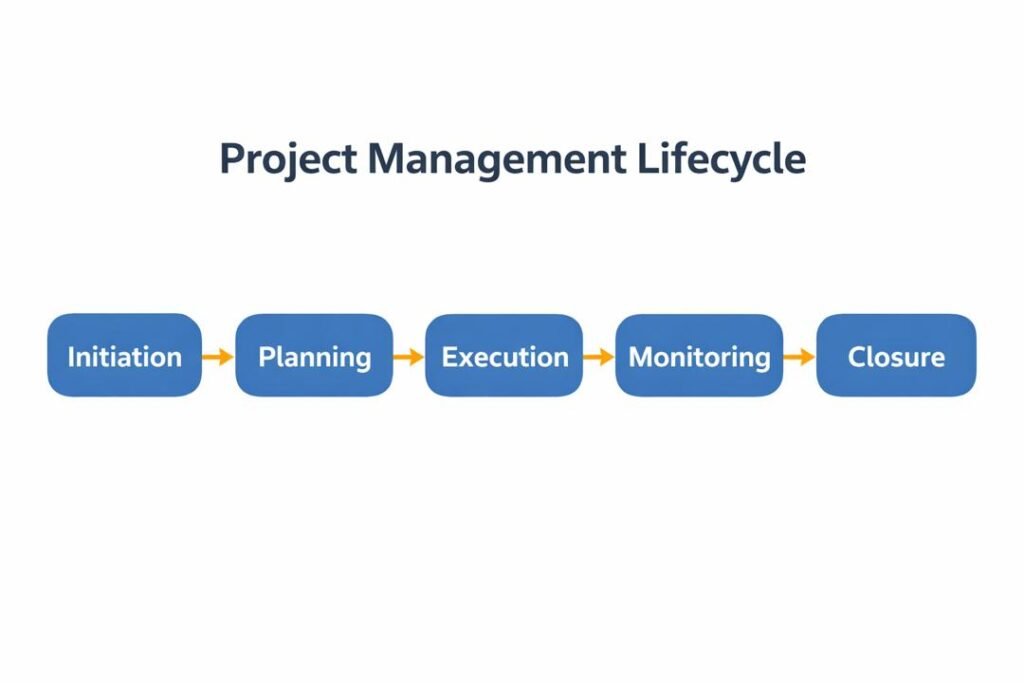
Project management normally comprises five main stages:
- Initiation – identification of the project and its purpose.
- Planning – identification of tasks, schedules, resources and budgets.
- Implementation – the implementation of the project plan.
- Surveillance and Adjustment – following up and revision.
- Closure – wrap up of the project and evaluation.
These phases give project management structure and clarity as everyone involved knows what should be done, who is to do what and how success can be evaluated.
Importance of Project Management
Balancing scope, time, cost, and quality is the main purpose of project management to make sure that project completion is successful. This can be translated into practical terms, that is, to provide the appropriate results, at the appropriate time, with the right quantity of resources, and to the satisfaction of the stakeholders.
Project management will act as an interface between the strategy and execution of the organization. It converts abstract business objectives to practical tasks and targets that can be measured. Organizations that lack project management risk wastage of resources, default of the deadline, and will never attain its strategic goals.
In order to appreciate this purpose, it is necessary to discuss the most important roles played by project management in organizations.
Fitting the Projects with Strategic Goals
Aligning projects with the strategic objectives of an organization is one of the most significant functions of the purpose of project management. Long-term goals can be the growing market share, customer satisfaction, expansion into new markets, or even use of new technologies in organizations. Nevertheless, without projects that are well managed it is impossible to achieve these goals.
Project management will make sure that each project is geared towards the overall organizational mission. Project managers can determine how a project contributes to business strategy through proper planning and analysis of stakeholders. The alignment assists organizations to focus on projects that have maximum value and prevent them spending their resources on projects that are not aligned to the organizational goals.
To illustrate, a company that wants to be more digitally competitive can introduce initiatives to upgrade the system, provide staff training, and introduce customer experience platforms. The project management is used to make sure that these initiatives are synchronized and directly associated with the strategic vision of the company.
Maximizing the Use of Resources
Every organization is limited in the use of resources. Such resources are time, money, personnel, equipment and information. The optimization of the use of these resources is one of the fundamental goals of project management.
Project management assists organizations in efficient allocation of resources by determining what is required, when and how it is supposed to be applied. This avoids over-allocation, underutilization and conflict of resources. It also minimizes wastage and makes sure that the resources are allocated to high-priority activities.
As an example, in a construction project, project management makes sure that the materials arrive on time, the workers are planned in time and the equipment is available on time. In a software development project, it does not allow duplication of work as there is coordination among the developers, designers and testers.
Project management enhances competitiveness and sustainability of organizations in terms of productivity and cost reduction by maximizing the use of resources and minimizing costs of operation.
Reducing the Risks and Uncertainty
All projects are associated with a certain degree of risk. Such risks can be financial, technical problems, market developments, or human mistakes. One of the primary intentions of project management is to find, examine, and reduce such risks.
Project managers are able to evaluate the possible threats and come up with strategies to avoid or reduce these threats through risk management techniques. This is a proactive measure that minimizes the chances of project failure and equips organizations with a new solution in the event of a problem.
An example of this is when a project manager realizes the threat of delays by suppliers and develops alternative sources. They can also be aware of the danger of employee attrition and come up with systems of knowledge sharing to avoid reliance on individual employees.
Project management provides a predictive environment amidst uncertainties in the business environment because of its ability to manage risk.
Ensuring Timely Delivery
Time is a very important element in the success of an organization. Delays may result in higher expenses, customer distrust and lost market opportunity. Project management is among the factors that are meant to make projects be delivered within the right time.
Scheduling tools that are used to track progress and identify possible delays by project management include Gantt charts, timelines and milestones. The tools enable the project managers to control the tasks, redistribute the workloads, and reassign the resources in case of need.
Time is of the essence when it comes to technology and marketing industries where sometimes speed will be the competitive edge. A product with low timeliness can become irrelevant or it would not be able to capture the market demand.
Project management assists organizations to meet deadlines, resolve the stakeholders and retain their competitive edge by delivering the projects on time.
Increasing Accountability and Responsibility
The other significant role of the purpose of Project management is to increase accountability in the organizations. Working in cross-functional teams projects in most organizations includes members of diverse departments. When there are no clear roles and responsibilities then confusion and conflict may arise.
Project management creates clean lines through defining activities and responsibilities as well as performance expectations. This clarity can guarantee that each person is aware of his or her role and how his or her input would impact on the entire project.
Performance is also enhanced through accountability. People will tend to remain focused, work towards deadlines and the quality standards are likely to be upheld when they realize that they are in charge of certain results.
This way, the culture of responsibility, transparency and professionalism are nurtured within the project management.
Improving Decision-Making
Any organizational success will be determined by effective decision-making. Nevertheless, choice is usually complicated and entails numerous parties, limitations, and ambiguities. Quality decision making is one of the objectives of project management by the use of accurate information and strategic process.
Project management will give the information about the performance of the project in terms of costs, schedules, risks, and resource utilization. Such information helps managers to make evidence-based decisions as opposed to assumptions.
In case an example, when a project is lagging behind the schedule, the project manager will be able to examine the reasons and choose whether to set deadlines back, allocate more resources, or redefine the scope. These are decisions backed by real-time information and transparent performance indicators.
Project management also minimizes the use of guesswork and enhances the chances of attaining desired results by making better decisions.
Enabling the Communication and Collaboration
Communication is an important determinant of a successful project. Lack of communication can easily result in miscommunication, repetition of work and conflicts. Project management is one of the goals aimed at ensuring effective communication and interaction between the stakeholders.
The purpose of Project management includes communication plans that stipulate the manner in which information is shared, with whom they are shared with and the frequency with which they are shared. This will make sure all the parties are informed and involved in the project lifecycle.
Project management in team set ups enhances cooperation through goal sharing, exchange of ideas and brainstorming. The teamwork strategy increases creativity, innovation, and morale.
Good communication also creates trust within the stakeholder which is crucial in ensuring that the organization succeeds in the long run.
The Role of Project Management in Small Organizations
Project management is an aspect that is frequently ignored in smaller organizations because of the lack of resources or informal organization. Nevertheless, the use of project management to major project management is equally important in small organizations as it is in large organizations.
Small organizations have their own problems like low budgets, less personnel and a lot of uncertainty. Project management assists them to prioritize initiatives, effectively manage resources as well as minimize risk of failure.
An illustrative example of this is a small business that is starting off a new product and can implement project management to establish specific objectives, have realistic time schedules and monitor cost. Such an organizational method maximizes success opportunities and eliminates expensive errors.
Project management is also useful in small organizations as they help develop systems and processes that can be increased when the organization grows.
The Role of Project Management in Large Organizations
Projects in big organizations are usually tricky and encompass various departments, stakeholders, and external collaborators. Project management, in this case, is mainly aimed at coordination and making the activities and organizational alignment.
Big organizations are usually known to have a number of projects at a given time. Without project management, these projects can compete over resources, take various priorities or even end up delivering contradicting results.
The governance mechanisms, standard processes, and performance measurements that project management offers are the way to guarantee consistency and control. It also allows the top management to check on progress being made at the organization and undertake strategic changes where it is necessary.
Project management in large organization is necessary to uphold efficiency, minimize duplication and meet long-term strategic goals.
Supporting Sustainability in Growth
Sustainable growth needs organizations to balance between the short run performance and the long run development. Sustainable growth is one of the crucial uses of project management as it ensures that projects can produce sustainable value.
Project management encourages the practice of constant improvement through post project evaluation and learning. The lessons learnt are recorded and applied to enhance the future projects and this result into improved performance as time goes by.
It also contributes to innovation since it enables a good environment to test new ideas. Organizations can experiment and pay using pilot projects and controlled experiments, which cannot put them at too much risk.
Project management allows organizations to develop sustainably in dynamic competitive environments by facilitating learning, innovation, and flexibility.
Conclusion
Project management is mainly done with the aim of having the organizational goals met in an efficient, effective and sustainable manner. It offers an organized method of planning, implementation, and management of projects in a way that organizations bring value within set limitations.
The purpose of Project management promises to match the projects with the strategic goals, optimize the use of resources, reduce risks and deliver on time. It increases accountability, better decision making, helps to enhance communication, and promotes collaboration. Above all, it establishes a platform of sustainable development through learning, innovation and constant improvement.
Project management is not only a technical activity in small and large organizations but it is a strategic requirement. With change being the order of the day and competition being high, organizations that invest in effective project management are in a better position to adapt, perform, and achieve in the long-term perspective.
Get more well researched information about project management here.