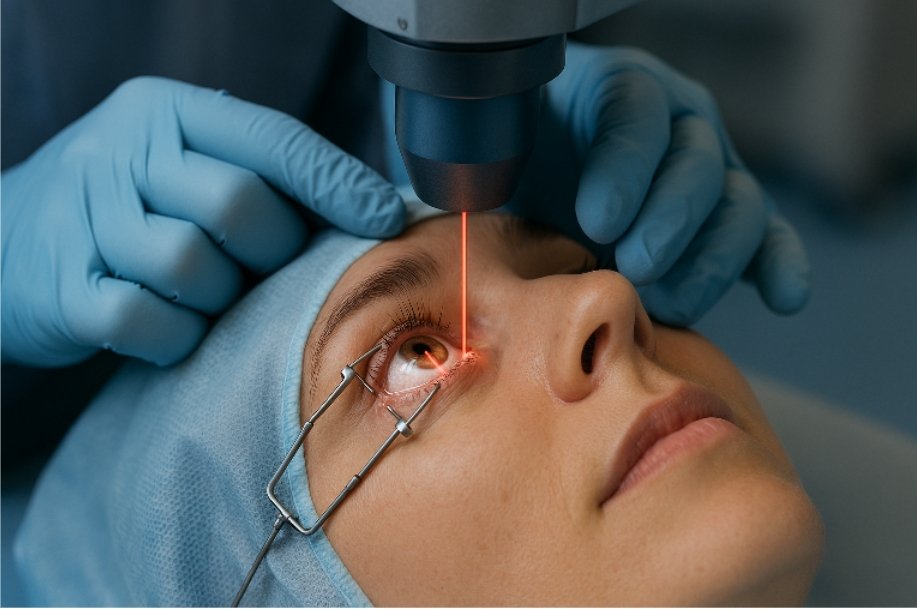
Laser eye surgery has come a long way in a short time. Procedures like LASIK and SMILE are now powered by advanced technology that improves accuracy, safety, and consistency – while also making recovery smoother for many patients.
In practical terms, these advancements have led to:
- More precise treatment planning tailored to the shape and behaviour of your eyes
- Greater consistency during surgery (less variability, more control)
- Faster recovery for many patients
- Improved vision quality with fewer night-vision side effects in suitable candidates
The evolution of laser eye surgery
LASIK (Laser-Assisted in Situ Keratomileusis) helped revolutionise the treatment of common refractive vision issues, including:
- Myopia (short-sightedness)
- Hyperopia (long-sightedness)
- Astigmatism
Early LASIK relied on less detailed measurements and less sophisticated tooling than we have today. Results were still strong, but personalisation and precision had limitations compared to modern techniques.
As technology has improved, surgeons can now measure the eye in greater detail and guide treatment more accurately – which is a major reason outcomes and patient experience have continued to improve.
Femtosecond lasers: more accurate flap creation in LASIK
In traditional LASIK, creating the corneal flap was done using a mechanical instrument (microkeratome). While effective, it could be less consistent compared to modern methods.
Today, many LASIK procedures use a femtosecond laser, which creates the flap using rapid pulses of laser energy. This helps improve:
- Precision (more accurate flap thickness and shape)
- Consistency (greater repeatability across patients)
- Safety (reduced risk of certain flap-related complications)
This is one of the biggest technology upgrades within the LASIK procedure itself.
Wavefront technology: a more personalised laser treatment
Wavefront technology (often referred to as Custom LASIK) maps how light travels through your eye. It can identify smaller imperfections that standard prescriptions don’t fully capture.
This matters because it can help reduce visual symptoms some people notice in low light, such as:
- Glare
- Halos
- Reduced night clarity
Wavefront-guided treatment gives the surgeon a more detailed “fingerprint” of your vision so the laser plan can be tailored more precisely to the individual.
SMILE: a newer approach with a smaller incision
SMILE (Small Incision Lenticule Extraction) is one of the newer innovations in laser vision correction. Rather than creating a large flap, SMILE uses a small incision and removes a thin piece of corneal tissue (lenticule) to correct refractive error.
Because it’s less disruptive to the cornea, SMILE is often associated with:
- A smaller incision compared to LASIK
- Less impact on the corneal surface
- Reduced dry-eye symptoms for many patients
- Fast recovery for suitable candidates
To learn more about this option, visit: SMILE laser surgery.
Wavelight Plus (Ray-Trace Technology): more detail, better targeting
Modern diagnostic tools can build a detailed 3D map of the cornea, capturing subtle variations in shape and curvature.
This level of detail helps surgeons:
- Identify areas that need precise correction
- Plan treatment more accurately for the individual eye
- Reduce the risk of over-correction or under-correction
In simple terms: better measurements lead to better planning – and better planning supports better outcomes.
Faster recovery and stronger visual outcomes
One of the clearest benefits of modern laser technology is improved patient experience after surgery. Precision reduces unnecessary tissue impact, which can mean:
- Less discomfort after the procedure
- Faster return to normal activities (often within days, depending on the procedure and patient)
- More stable visual outcomes over time
For many patients, the combination of wavefront planning + advanced laser delivery is also improving vision quality – particularly in challenging light conditions.
The next frontier: AI in laser eye surgery
Artificial intelligence is increasingly being explored in eye care to support:
- More advanced analysis of diagnostic data
- Better prediction of outcomes based on patient variables
- Earlier identification of potential risks or complications
While AI isn’t “doing the surgery,” it may soon play a bigger role in helping surgeons make even more informed decisions – improving precision and safety even further.
A new standard for vision correction
Technology has raised expectations of what laser eye surgery can deliver. Tools like femtosecond lasers, wavefront-guided planning, SMILE, and 3D mapping have helped make modern procedures:
- More precise
- More personalised
- More predictable
- Easier to recover from for many patients
If you’re considering laser eye surgery, the right next step is a professional assessment to determine which procedure (if any) suits your eyes, goals, and lifestyle.