Abstract
Press freedom is still one of the major pillars of democratic rule and social responsibility. It facilitates the flow of information, promotes the informed participation of the people, and serves as a watchdog to those in authority. Although in a central position, press freedom is not absolute, and it should be within the boundaries of ethics and the law to avoid causing harm to both people and society. This paper discusses the concept and historical aspects of press freedom and its significance in maintaining transparency and accountability, as well as the ethical restrictions that govern its exercise. The analysis of current issues, application of relevant literature on the topic, and the normative media theories help outline the balance between the ability to ensure the independence of the press and ethical responsibility in the form of respect towards privacy, national security, and the morality of the people. The article concludes that a responsible and ethically guided press is necessary in the sustenance of democratic values and trust of the population.
Keywords: Media ethics, freedom of the press, democracy, accountability, transparency, journalism ethics
1.0 Introduction
Even though the concept of press freedom has been well established as one of the pillars of democratic societies, it is actually a tool where citizens get information, air their views, and keep authorities in check. The press, in a democratic society, not only acts as a channel for passing the news and information but also acts as a go-between the government and the people. The press is a source of democratic stability and good governance by whistleblowing, pointing out social injustice, and allowing the people to talk about their issues.
Digital age press freedom has rediscovered a fresh focus with the speed of information exchange, citizen journalism, and international media platforms altering the manner of news production and consumption. Although these changes have opened up access to information, there have been concerns about misinformation, sensationalism, and breaches of ethics. This understanding of this concept must consequently involve not only the exploration of the democratic worth of this concept, but also the exploration of ethical limits upon which this concept would be practiced in a responsible manner.
This paper discusses the freedom of the press as a democratic requirement, its contribution to transparency and accountability, and evaluates the ethical limitations that help to avoid the misuse of said freedom. The argument is based on scholarly literature, media theory, and ethics applicable to modern journalism.
2.0 Literature Review
2.1 Historical Development of Press Freedom
In the scholarly literature, the foundations of press freedom can be traced to the first attempts to fight dictatorship and censorship. Arguing in favor of free expression as a natural right and the necessity to seek truth and to be able to progress in society, Milton, in Areopagitica, and the post-glorific thinkers of the Enlightenment concluded the argument. Siebert, Peterson, and Schramm (1956) argue that the rise of libertarianism ideology placed the press as a self-sufficient institution that was not interfered with by the state.
In contemporary democracies, the freedom of the press is usually written in the constitution, like in the First Amendment of the United States Constitution, and in a few other democratic nations. Nevertheless, researchers observe that having a legal status is not sufficient to guarantee real press freedom, particularly in those societies where political influence, economic factors, and monopoly on ownership restrict media autonomy.
2.2 Freedom of Press and Democracy
There is a large body of literature that underlines the relationship between the freedom of the press and democracy. According to Norris (2014), the free press increases political accountability through exposing malpractices and making people vote wisely. On the same note, McQuail (2010) emphasizes the fact that independent systems of media help in pluralism and deliberation among the people.
On the other hand, the limitation of press freedom is mostly linked with dictatorial leadership and a decline in transparency, as well as corruption. Studies by Freedom House always indicate that there is correlation between a lack of media freedom and a weak democratic establishment.
2.3 Ethics in Press Practice
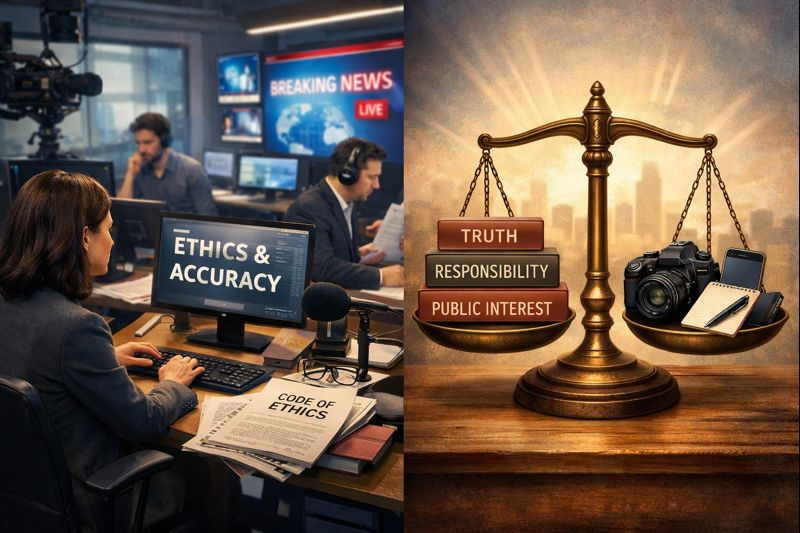
Although he or she is espousing the idea of press freedom, scholars acknowledge the need to have ethical regulations. According to Ward (2015), unregulated freedom may result in unethical practices like intrusion of privacy, misrepresentation, and sensationalism. The literature on media ethics points out that freedom should be accompanied with accountability to avoid injury and preserve the faith of the population.
3.0 Conceptual Review
3.1 Defining the Concept of Freedom of the Press
Freedom of the press is the right of media institutions and journalists to assemble, publish, and spread data without oppression and censorship. It includes editorial freedom, the right to information, and freedom against intimidation or retaliation.
3.2 Importance of Freedom of the Press
The freedom of the press allows media to act as an observer of social and political processes, hence making contributions to informed citizenship and democratic participation. Investigative reporting contributes to increasing transparency and accountability as the leaders and institutions become open to the control of the population.
3.3 Freedom of the Press and Openness
The press also reveals information that would not otherwise have been known by researching the activities of the government and the businesses. Investigative journalism has been instrumental in bringing out corruption, human rights violations, and policy failures around the globe. The free media will also make the officials in government undergo scrutiny, thus lessening chances of power abuse.
3.4 Responsibility and Social Control
Accountability is enhanced because freedom of the press gives avenues through which criticism and debate can be done. The media allows people to determine how leaders and institutions perform through reporting and analysis. This is a critical oversight function, which only exists in democracies whereby power is vested by the people.
4.0 Theoretical Framework
4.1 Libertarian Theory of the Press
Libertarian theory of the press is very rare because the theory is founded on the idea of freedom of the press, which is central to the libertarian school of thought. According to the Libertarian theory, the government should not interfere in the operations of the press and should leave the marketplace of ideas to free competition. In this theory, the truth is supposed to be revealed in a free debate, and the press should also be a watchdog over power.
Though powerful, critics believe that the libertarian model does not consider inequalities in the economy and ethical obligations. Complete freedom without responsibility may make strong media houses take control of conversation.
4.2 Social Responsibility Theory
The social responsibility theory was a reaction to the weakness of the libertarian approach. It upholds a view that the press is free, but it has a duty to influence the interest of the people. This theory suggests that media organizations have to ensure that they have some standards of accuracy, fairness, and ethical practices.
This model is specifically applicable to the discourse of ethical limits because it allows considering that freedom should be used in a responsible manner to safeguard social values and individual freedoms.
5.0 Press Freedom Ethical Frontiers
5.1 Respect for Privacy
Right to privacy is one of the greatest ethical constraints to press freedom. Journalists have to enjoy the freedom of information of the masses at the expense of the rights of people to have certain privacy and self-respect. Such disclosure of personal information without any visible public interest may be detrimental and may destroy media trust.
Ethical journalism involves giving keen attention to the need to disclose or otherwise, as to whether the disclosure is in the general good or as a way of relieving curiosity.
5.2 National Security Reflections
Freedom of the press can also be limited under national security issues. Although transparency is crucial, uncontrolled release of classified information may jeopardize lives and reduce the safety of states. Ethical decision-making comprises the evaluation of the possible impact of publication and the possibility of it against the societal interest.
5.3 Social Responsibility and Public Morality
Social norms and values are affected by the media. Material which encourages hate, violence, or discrimination can negatively affect social cohesion. Ethical boundaries are thus a responsibility to the morality of the masses, especially in pluralistic and diverse societies.
6.0 Findings
The literature and theory analysis show that freedom of the press is an inalienable element of democratic governments that have to be controlled by morality. When the press freedom is strong in a society, transparency and accountability are likely to be high. But malpractices undermine the credibility of the people and give reasons for prohibitive regulation.
The findings indicate that ethical self-regulation, professional standards, and media literacy are essential in ensuring that there is the maintenance of balance between freedom and responsibility.
7.0 Discussion
The conflict between the freedom of the press and ethical limits is an indication of the bigger discussions regarding rights and obligations in democratic societies. Although there is a need to have legal safeguards, they cannot work without effective ethical cultures in media houses. The social responsibility model presents a realistic framework for overcoming such hurdles in modern media settings.
The digital age, when the information flows like rivers and has its sources around the globe, makes ethical issues more urgent. As the media and journalists respond to changing technologies, they have to learn to adjust ethical considerations to the new technologies without diminishing fundamental principles of democracy.
8.0 Conclusion
The freedom of the press is one of the keystones of the democratic system, as it facilitates transparency and accountability of the government, as well as effective participation of the population. Freedom is, however, not absolute and this has to be exercised within ethical limits that safeguard privacy, national security, and moral values among the people. Such a solution as a balance between legal protection and ethical responsibility is the key to the preservation of trust in people and the integrity of democracy. Finally, having the freedom and responsibility of the press empowers democracy and social cohesion.
References
McQuail, D. (2010). McQuail’s mass communication theory (6th ed.). Sage Publications.
Norris, P. (2014). Why electoral integrity matters. Cambridge University Press.
Siebert, F. S., Peterson, T., & Schramm, W. (1956). Four theories of the press. University of Illinois Press.
Ward, S. J. A. (2015). The invention of journalism ethics (2nd ed.). McGill-Queen’s University Press.