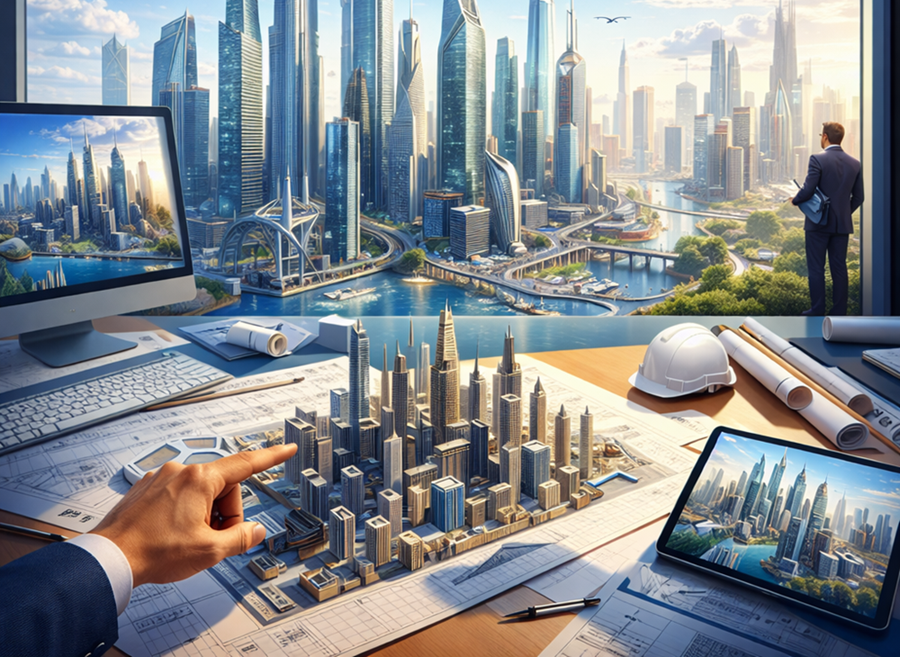
In the high-stakes world of global development in 2026, a building is no longer judged solely by its physical foundation. It is judged by its digital precursor. As urban density increases and the demand for “Net-Zero” architecture becomes a regulatory mandate, the transition from an abstract blueprint to a tangible reality has become the most critical phase of the design lifecycle.
This evolution has birthed a new standard: The Architecture of Persuasion. Today, the success of a multi-million-dollar development hinges on the ability to translate complex technical data into a visual narrative that stakeholders, municipal boards, and the public can intuitively understand.
The Evolution of External Narratives: Why Static Drawings No Longer Suffice
For decades, architectural exteriors were presented through watercolors or static CAD line-drawings. While technically accurate, these traditional methods lacked the “human context” required for modern urban planning. They couldn’t simulate the way a glass facade would interact with the low-angled sun of a winter afternoon, or how a biophilic “vertical forest” would look after five years of growth.
In 2026, the “Information Age” of architecture has arrived. Developers are now utilizing Physically Based Rendering (PBR) and real-time ray tracing to create digital environments that are indistinguishable from reality. This shift is not just about aesthetics; it is about risk mitigation.
Closing the Perception Gap: From Blueprint to Reality
The “Perception Gap” is the cognitive distance between what an architect imagines and what a non-technical stakeholder sees. When a developer invests in high-end architectural curb appeal assets, they are effectively closing that gap.
By integrating high-fidelity textures—such as the subtle grain of sustainable timber or the matte finish of low-carbon concrete—visualizers allow clients to “feel” the building’s material palette. In an era where “Soft Modernism” and organic curves are replacing the rigid boxes of the past, capturing the way light wraps around a curved facade is essential for conveying design intent.
Technical Mastery: How Lighting and Texture Simulate Human Experience
The “secret sauce” of a 2026 visualization lies in its atmospheric accuracy. Advanced CGI engines now account for localized environmental data, allowing artists to simulate:
- Global Illumination: Accurately reflecting the specific sky-dome colors of a city like Singapore vs. New York.
- Pixel-Level Detail: From the way rainwater beads on a hydrophobic coating to the reflection of neighboring structures in a triple-glazed window.
- Emotional Resonance: Using “Cinematic Composition” to place the viewer at eye-level, fostering a sense of belonging and community.
Environmental Transparency: Using High-Fidelity Models for Sustainable Approvals
Sustainability is no longer a footnote; it is the headline. In 2026, municipal boards in cities worldwide require “Shadow Studies” and “Thermal Simulations” as part of the approval process. A high-fidelity exterior model is the only tool capable of providing this data in a readable format.
By visualizing solar-passive designs and integrated solar panels, architects can prove their building’s efficiency. They can show how a specific orientation reduces the cooling load or how natural ventilation corridors work in real-time. This level of transparency doesn’t just win over skeptical planning committees; it builds public trust.
Conclusion: Why the Next Decade of Architecture Will Be Defined by the Quality of the “Pre-Built” Image
As we look toward 2030, the line between the virtual and the physical will continue to blur. The most successful firms are those that recognize that their digital assets are as valuable as their physical ones.
The “Architecture of Persuasion” is about more than just selling a project; it is about ensuring that our future cities are built with clarity, empathy, and technical precision. When we invest in high-fidelity visualization, we aren’t just creating a picture; we are creating a roadmap for a better-designed world.