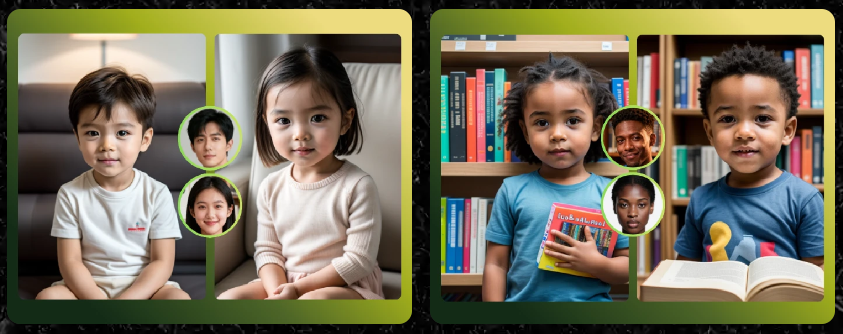
Curiosity about the future is a universal human trait. Among the many questions people ask, one stands out as both emotional and personal: What will my future baby look like?
In recent years, the rise of AI-powered visual tools has made it possible to explore this question in a surprisingly realistic way. One of the most popular innovations is the AI Baby Generator, a technology that uses facial analysis and generative models to predict how a future child might appear based on photos of one or two parents.
Unlike traditional photo filters or simple face-morphing apps, modern AI baby generators aim to simulate genetic blending, producing lifelike baby portraits that feel personal, fun, and highly shareable.
What Is an AI Baby Generator?
An AI baby generator is a tool that analyzes facial features from uploaded photos and uses machine learning to create a synthetic image of a potential child.
Instead of randomly mixing pixels, advanced systems focus on:
- Facial structure (jawline, cheekbones, eye distance)
- Skin tone and texture
- Nose, lips, and eyebrow patterns
- Overall facial proportions
The result is not a guarantee of how a real child will look, but a visual prediction based on statistical similarity and feature blending.
For many users, this experience feels closer to a “genetic simulation” than a novelty filter.
Why AI Baby Generators Became So Popular
The popularity of AI baby generators is driven by three main factors:
1. Emotional Engagement
People are naturally drawn to tools that relate to relationships, family, and identity. Seeing a possible future baby triggers strong emotional reactions — curiosity, excitement, humor, and even nostalgia.
2. Social Sharing
Generated baby images are highly shareable on social platforms. Couples often post results to friends, while single users experiment with celebrity combinations just for fun.
3. Improved AI Realism
Early face generators produced cartoon-like results. Today’s AI models generate images with natural lighting, realistic skin details, and human facial expressions.
This shift from “fun toy” to “realistic simulation” significantly increased adoption.
Real User Scenarios
AI baby generators are used in more ways than most people expect.
Couples Exploring the Future
Many couples use AI baby generators out of curiosity before marriage or parenthood. It becomes a playful way to imagine future life together.
Content Creators and Influencers
Creators generate baby faces with celebrities or fictional characters, turning results into viral content.
Entertainment and Gifting
Some users generate baby images as digital gifts for partners on anniversaries or Valentine’s Day.
In all cases, the tool becomes a mix of emotional storytelling and visual entertainment.
How AI Baby Generators Work
While each platform uses different models, the core process usually includes:
Step 1: Facial Feature Extraction
The system scans uploaded photos and identifies key facial landmarks such as eyes, nose, mouth, and facial shape.
Step 2: Feature Blending
The AI calculates statistical similarities and blends features using generative algorithms trained on large face datasets.
Step 3: Visual Rendering
The final image is generated with realistic lighting, texture, and proportions.
Some platforms also allow users to select the baby’s gender, adjusting facial patterns accordingly for more personalized results.
Take Overchat AI future baby generator as a worked example of those checks. You upload a clear, front-facing photo of each parent — JPG, PNG, or WEBP — and choose which version of the child you want to see: a baby girl or baby boy, a school-age girl or boy, or a teenage version. The render comes back in roughly two seconds, in high resolution and with no watermark stamped across it, which matters when the whole point is dropping it into the group chat thirty seconds later.
On the privacy question, the answer is the one you want to hear: uploaded photos are processed and then automatically deleted rather than kept on file, and they aren’t shared with third parties. It’s a paid tool tied to an Overchat account, which is worth knowing before you start uploading — though that same account covers the platform’s wider set of image tools, so a baby render is rarely the only reason people end up there.
The honest caveat applies here as much as anywhere else: those six age variants are a stylistic range, not a developmental forecast. Seeing a “teen” version of a hypothetical child is fun precisely because nobody involved is pretending it’s a prediction — it’s the same blend of your two faces, rendered at a different age.
Beyond Static Images: Bringing the Baby to Life
A major trend in AI baby generation is moving beyond still images.
Modern tools allow users to:
- Animate baby faces
- Generate baby talking videos
- Create singing baby clips
Instead of just seeing a face, users can interact with a digital baby, making the experience feel more immersive.
This shift reflects a broader trend in AI: static content is being replaced by dynamic, expressive media.
The Role of AI Baby Generators in Digital Entertainment
From an industry perspective, AI baby generators sit at the intersection of:
- Generative AI
- Social media content
- Personalization technology
These tools don’t just predict faces — they create emotional micro-experiences.
In marketing psychology, content that connects to identity and relationships has higher engagement rates than purely informational tools. That’s why baby generators outperform many other AI visual apps in time-on-page and social sharing metrics.
Practical Considerations Before Using an AI Baby Generator
While AI baby generators are mostly used for fun, users should consider:
Photo Quality
Clear, front-facing photos produce more realistic results. Poor lighting or extreme angles reduce accuracy.
Privacy
Always check whether uploaded images are stored or deleted after processing.
Expectations
AI predictions are not genetic science. They provide visual simulations, not real biological forecasts.
The best mindset is to treat the results as entertainment with emotional value, not factual prediction.
A More Interactive AI Baby Experience
Some platforms take the concept further by allowing users to generate both baby images and videos.
One example is this AI baby generator by Lipsync.video that not only predicts your future child’s face but also lets you create animated baby videos where the baby can sing or talk.
Instead of stopping at “what your baby looks like,” these tools explore “how your baby might move, react, and express emotions.”
This creates a deeper emotional loop and keeps users engaged longer.
Why AI Baby Generators Convert So Well
From a product perspective, AI baby generators have unusually strong conversion patterns.
Key reasons include:
- Low entry barrier – users only need photos
- High emotional reward – personal relevance
- Strong social proof – easy to share results
- Instant feedback loop – results in seconds
This combination makes them one of the most effective consumer-facing AI tools today.
Unlike productivity tools that solve abstract problems, baby generators tap directly into human curiosity and imagination.
The Future of AI Baby Generation
As generative models improve, future AI baby generators may include:
- 3D baby avatars
- Voice synthesis for baby speech
- Aging simulations (baby → child → adult)
- Family tree visualizations
In other words, the simple question “What will my baby look like?” may evolve into full AI family simulations.
Final Thoughts
AI baby generators represent a unique category of AI applications: they are not about efficiency, automation, or business optimization. They are about emotion, imagination, and storytelling.
By combining facial analysis, generative models, and interactive media, these tools turn curiosity into a personalized digital experience.
Whether used by couples, creators, or casual users, AI baby generators reflect a broader shift in technology — from solving problems to creating meaningful, emotionally engaging content.
And in a world where attention is scarce, that emotional connection may be the most powerful feature of all.