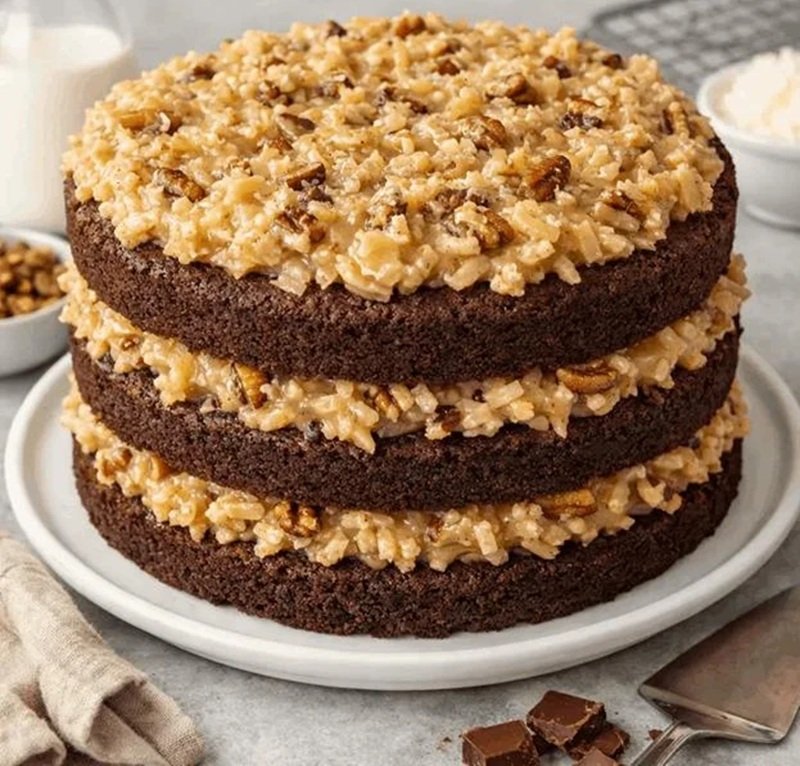
German chocolate cake is a classic American dessert known for its mild chocolate layers and its rich coconut-pecan filling. This recipe-style guide is written to be practical and precise, focusing on exact ingredients, clear preparation steps, and reliable techniques so you can produce consistent, high-quality results at home.
This is not a shortcut version of the cake. It is a full, from-scratch method that explains not only what to do, but also why each step matters. By following this recipe carefully, you will end up with tender chocolate layers, a thick and flavorful filling, and a finished cake that slices cleanly and holds its shape.
If you’re looking for a rich and indulgent dessert to impress your readers, German chocolate cake is a timeless classic that perfectly combines moist chocolate layers with a creamy coconut-pecan frosting.
German Chocolate Cake Recipe Overview
Yield, Time, and Skill Level
This recipe produces one three-layer round cake suitable for about 10 to 12 servings. Total active and inactive time is approximately 2 and a half to 3 hours, including baking and cooling. The skill level is moderate and requires careful attention to mixing and cooking stages.
What Makes This Recipe Different
This recipe uses sweet baking chocolate, separated eggs with whipped whites, and a cooked coconut-pecan filling. These three elements are essential to achieving the traditional texture and flavor. Skipping or simplifying any of them will noticeably change the final result.
Ingredients
Ingredients for the Cake Layers
| Ingredient | Amount |
| Sweet baking chocolate | 4 ounces |
| Butter | 1 cup |
| Sugar | 2 cups |
| Eggs, separated | 4 |
| All-purpose flour | 2 and 1/2 cups |
| Baking soda | 1 teaspoon |
| Salt | 1/2 teaspoon |
| Buttermilk | 1 cup |
| Vanilla extract | 1 teaspoon |
Ingredients for the Coconut-Pecan Filling
| Ingredient | Amount |
| Evaporated milk | 1 cup |
| Sugar | 1 cup |
| Egg yolks | 3 |
| Butter | 1/2 cup |
| Shredded coconut | 1 and 1/3 cups |
| Chopped pecans | 1 cup |
| Vanilla extract | 1 teaspoon |
Equipment Needed
Essential Tools
You will need three round cake pans of equal size, mixing bowls, cake blender, an electric mixer, a saucepan, measuring tools, parchment paper, and a cooling rack. These tools are necessary to ensure even baking, proper mixing, and safe handling of both cake and filling.
Step-by-Step Instructions
Step 1: Prepare the Pans and Oven
Preheat the oven to 350 degrees. Position the oven rack in the center so the pans bake evenly. Grease three round cake pans thoroughly, then place parchment paper in the bottoms and lightly grease the parchment as well.
This preparation is critical because these cake layers are soft and can stick easily. Properly prepared pans ensure the layers release cleanly without tearing or breaking.
Step 2: Melt and Cool the Chocolate
Place the sweet baking chocolate in a heat-safe container and melt it gently over low heat. Stir it frequently until it is completely smooth and no solid pieces remain.
Once melted, set the chocolate aside and allow it to cool until it is warm but not hot. If the chocolate is added to the batter while too hot, it can melt the butter and affect the texture of the cake.
Step 3: Cream the Butter and Sugar
In a large mixing bowl, beat the butter and sugar together until the mixture becomes pale, light, and fluffy. This usually takes several minutes with an electric mixer.
This step is not just for combining ingredients. Proper creaming incorporates air into the mixture, which helps give the cake a lighter texture.
Step 4: Add Egg Yolks, Chocolate, and Vanilla
Add the egg yolks one at a time to the creamed butter and sugar, mixing well after each addition. This helps create a smooth, stable base for the batter.
Next, add the melted and cooled chocolate and the vanilla extract. Mix until the color and texture are completely uniform with no streaks.
Step 5: Combine Dry Ingredients and Buttermilk
In a separate bowl, mix together the flour, baking soda, and salt. These should be evenly distributed before being added to the batter.
Add the dry ingredients to the batter in three portions, alternating with the buttermilk in two portions. Begin and end with the dry ingredients. Mix gently and only until the batter is smooth. Overmixing at this stage can make the cake tough.
Step 6: Whip the Egg Whites
In a clean, dry bowl, beat the egg whites until they form stiff peaks. This means the whites should hold their shape firmly when the mixer is lifted.
Properly whipped egg whites are essential for the light, airy structure that is traditional in German chocolate cake layers.
Step 7: Fold Egg Whites into the Batter
Add about one third of the whipped egg whites to the batter and gently fold them in to lighten the mixture. Then add the remaining egg whites in two additions, folding carefully each time.
Use slow, gentle movements and avoid stirring. The goal is to keep as much air in the batter as possible while still blending everything evenly.
Step 8: Divide and Bake the Batter
Divide the finished batter evenly among the prepared pans. Gently level the tops so the layers bake evenly.
Bake until the centers are set and a testing tool inserted into the middle comes out clean or with only a few moist crumbs. Avoid opening the oven too early, as this can cause the cakes to sink.
Step 9: Cool the Cake Layers
Let the cakes cool in their pans for about 10 minutes, then carefully turn them out onto a cooling rack. Remove the parchment paper and let them cool completely.
The layers must be fully cooled before assembly. Even slight warmth can cause the filling to melt and slide.
Step 10: Cook the Coconut-Pecan Filling
In a saucepan, combine the evaporated milk, sugar, egg yolks, and butter. Cook over medium heat, stirring constantly and scraping the bottom and sides of the pan.
Continue cooking until the mixture thickens enough to coat the back of a spoon. This can take several minutes and should not be rushed. If the heat is too high, the eggs can curdle.
Step 11: Finish and Cool the Filling
Remove the thickened custard from the heat and immediately stir in the shredded coconut, chopped pecans, and vanilla.
Transfer the filling to a bowl and let it cool completely, stirring occasionally. As it cools, it will continue to thicken to a spreadable consistency.
Step 12: Assemble the Cake
Place one cake layer on a stable serving surface. Spread a thick, even layer of filling over the top, stopping just short of the edge.
Place the second layer on top and repeat. Add the final layer and spread the remaining filling over the top. Traditionally, the sides are left mostly uncovered.
Step 13: Set and Prepare for Serving
For best results, let the assembled cake rest for a short time so the filling can settle and firm up slightly. If the cake feels soft, it can be refrigerated briefly to stabilize it.
Slice with a sharp knife, wiping the blade between cuts to keep the layers clean and clearly defined.
Storage and Serving
How to Store
Because the filling is custard-based, the cake should be stored covered in the refrigerator for longer keeping. Let it sit at room temperature briefly before serving for the best texture.
How to Serve
Use a sharp knife and wipe it between slices for clean cuts. The cake is best served slightly cool, not cold.
Common Issues and Fixes
If the cake is dry, it was likely overbaked. If the filling is runny, it was not cooked long enough. If the filling is too stiff, it was overcooked. Careful attention to visual and texture cues during cooking prevents these problems.
When made carefully and assembled with patience, German chocolate cake delivers a balanced combination of tender chocolate layers and rich, textured coconut-pecan filling. This recipe method gives you a reliable, repeatable way to produce a classic cake that looks professional, holds its shape, and tastes exactly the way this American favorite should.