Introduction
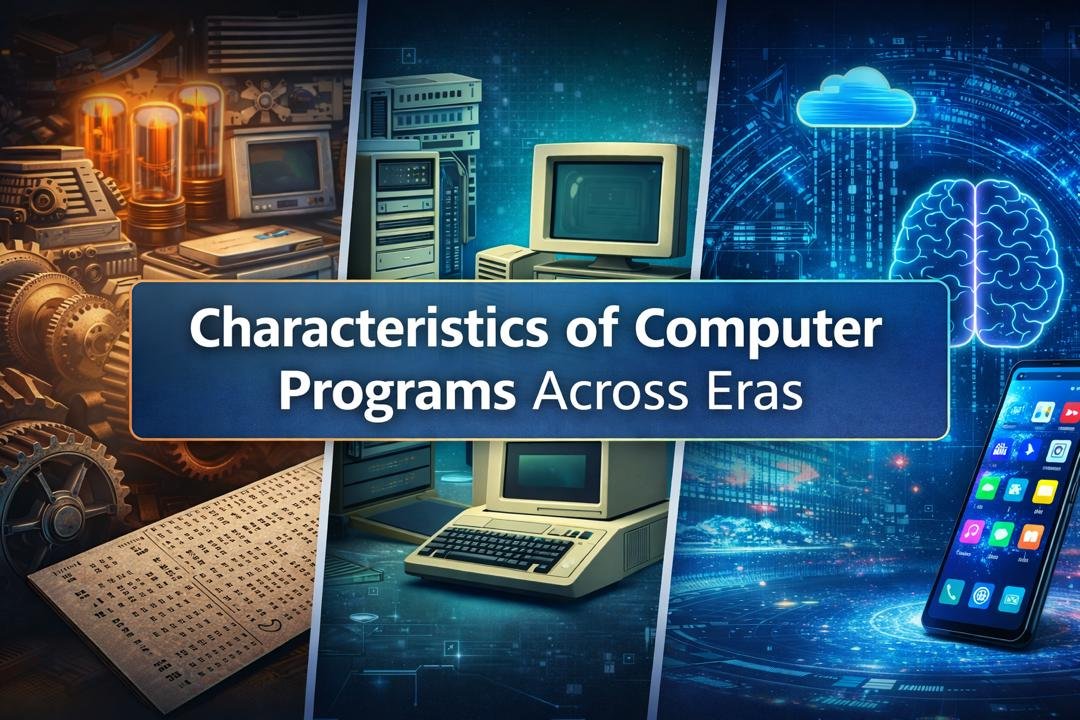
Characteristics of computer programs are the invisible force behind the digital world. All the gadgets we are familiar with today, such as phones and laptops, ATMs, hospital equipment, traffic lights, and even smart homes, cannot operate without software directives. However, computer programs did not start in the all-engaging, intelligent and easy to use mode that we have today. Rather, they have experienced a lengthy and complicated evolution, influenced by both hardware development, transformation of user necessities as well as the swift increase in technological progression across the globe.
Early computer technology saw programs simply as fixed programming in the form of wired instructions that were physically built into machines. With time, they evolved into adaptable, intelligent things able to learn, communicate and adapt. This change is not just a result of advances in technology but also societal change and the requirements of the society. It demands faster processing, less complicated interfaces, more storage and instant access to information.
This article will discuss the nature of computer programs at various periods in computer history. It points out the development of programming languages, efficiency, user interaction and capabilities of the system. Through this journey, readers are in a better position to appreciate the manner in which the software development has kept pace with the advancement of hardware as well as the needs of the society.
The Mechanical and Pre-Computer Era (Before 1940)
Prior to the advent of the electronic computers, people were using mechanical machines to carry out calculations. The examples are abacus, the calculator of Pascal and the Analytical Engine of Charles Babbage. Though these machines did not have any digital software, they brought with them the concept of the possibility of a machine running through a series of orders.
Characteristics of Programs during this period
- Physical Programming: The implementation of instructions was done on gears and levers, as well as on punched cards instead of written code. Physical adjustments were necessary to change the functioning.
- Fixed Functionality: After the machine was configured it was capable of only performing one task.
- No Flexibility: Programs were not easily modified, any alteration involved a redesign of some machine parts.
- Very Slow Processing: The mechanical movement was a constraint to calculations.
Despite the primitive nature, this period has formed a basis of any subsequent computer program.
First Generation Computers (1940s-1950s)
The vacuum tubes were utilized in the first generation of computers like ENIAC and UNIVAC. They were gigantic in size, took massive amounts of electricity and produced too much heat.
Characteristics of Computer Programs
- Machine Language: The binary code was used to write programs thus making them slow and prone to error.
- Hardware-Specific Programs: The programs developed in one computer could not be used in another.
- Minimal Efficiency: Programs were very memory consuming and slow.
- No User Interaction: Punch cards and switches were used as input and output was printed.
- Limited Storage: Programs were forced to be very small.
This was the period that proved that electronic machines were better placed to run instructions than the mechanical systems.
The Second Generation Computers (1950-1960s)
The second generation computers were pioneering computers that were used in teaching, research, and social services within universities and industrial sectors. It was an innovation of computers that found their way in the teaching, research, and social service in the universities and industrial sectors.
Computers became smaller, faster and more dependable with the invention of transistors as a replacement of vacuum tubes.
Characteristics of Computer Programs
- Assembly and High-Level Languages: Symbolic coding was permitted in FORTRAN and COBOL.
- Better Efficiency: Programs were more dependable and quicker.
- Batch Processing: The programs were run in batch mode and were not interactive.
- Improved Accuracy: Errors were minimized by high-level languages.
The period was a turning point as it has made programming more accessible.
Third Generation Computers (1960s-1970s)
Integrated circuits mounted a number of transistors on one chip.
Characteristics of Computer Programs
- Operating Systems: The memory and hardware were managed by systems.
- Multiprogramming: There were several programs that are running simultaneously.
- Time-Sharing: Users communicated in real time.
- Structured Programming: Such languages as C and Pascal enhanced logic.
- Portability: There was cross-system adaptability of programs.
Fourth Generation Computers (1980s-1990s)
The fourth generation of computers was characterized by user-friendly, improved memory, and disc drives.The microprocessor made personal computers at homes and offices.
Characteristics of Computer Programs
- Graphical User Interfaces: The commands were substituted with icons and windows.
- Object-Oriented Programming: C++ and Java languages were able to reuse codes.
- High Processing Speed: More complicated applications were made possible.
- Application Software Boom: There was an increase in office tools, databases, and games.
- Networking: Programs that are transmitted via computers.
Fifth Generation and Modern Era (2000s -Present)
The period is characterized by artificial intelligence, cloud computing, and mobile gadgets.
Characteristics of Computer Programs
- High-Level Languages: Python, and JavaScript, Swift, and others
- Cross-Platform Design: Applications are executed on various machines.
- AI and Machine Learning: Programs learn and adapt.
- Cloud Computing: Software is accessed online.
- User-Centered Design: Focus on usability.
- Real-Time Processing: Instant responses.
- Big Data Handling: Big data storage and analysis.
User Interaction Evolution
The forms of interaction between users were virtually unheard of in the ancient days of computing. Punch cards were prepared by the programmers and took hours or even days before the results could be seen. It did not have a screen, a keyboard, and no opportunity to make corrections instantly. This turned computing to a slow technical process that could only be done by a specialist.
This was changed when time-sharing systems were introduced in the third generation whereby a computer could be used by many users on a terminal. The first time, users were able to type commands and they were almost immediately able to get feedback. This transition changed computers into closed-loop machines of calculation to interactive machines.
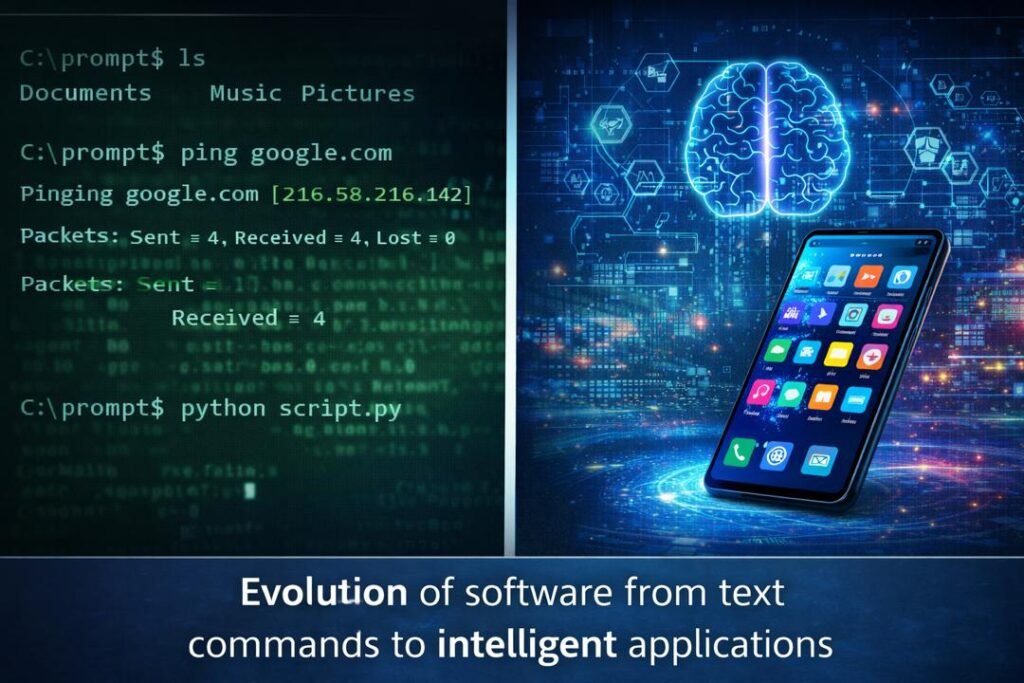
The fourth generation introduced graphical user interfaces (GUI) where text based commands were eliminated in favor of icons, menus and windows. This has opened up computers to non-technical users and enabled individuals to acquire software by visual feedback as opposed to memorized instructions.
Nowadays, the interaction of users has reached much further than keyboards and mice. The touchscreens, voice recognition, facial recognition, motion sensors and virtual assistants like Siri, Alexa and Google Assistant enable individuals to interact naturally with machines. The principles of user experience (UX) are incorporated in modern programs and aim at simplicity, accessibility, speed, and personalization. This development indicates that software has evolved to be machine-oriented design to human-oriented design.
Real-Life Applications
The computer programs present-day are entirely integrated in our daily life. Software is used to handle online payment systems, mobile payment systems, fraud detection systems, and cryptocurrency in the banking and financial services industries. Programs in healthcare will help in the management of patient records, medical imaging, robotic surgeries, and the diagnosis of diseases with artificial intelligence.
Learning management systems, online testing platforms, virtual classrooms, and learning systems are used in education to assist millions of students across the globe. Software in the transport industry regulates traffic lights, airline schedules, GPS navigation and the technology of self-driving cars.
Entertainment is very dependent on software to stream platforms, video games, music production, animation, and social media. Programs are used in businesses in payroll, inventory, marketing, and customer relation management. Software is relied upon in governmental data on census, taxation, national security and digital identity systems.
The examples presented above prove that the features of computer programs have undergone changes to be more reliable, scalable, intelligent, and connected to the world.
Societal influence on Software
The society has always contributed significantly in development of computer programs. With the increase in population and the growth of businesses, automation was highly required to cut the number of human beings doing the work. This requirement gave rise to business software, accounting and enterprise application.
The emergence of the internet has formed a global community, relying on communication, social networking, e-commerce and telecommuting. Consequently, programs got networked, secured and interactive. Mobile technology also brought about the urge among developers to develop light, fast and user friendly applications.
Nowadays, the issues of privacy of data, cybersecurity, accessibility, and ethical artificial intelligence are affecting the software design. Developers are currently supposed to come up with programs that are no longer otherworldly but also balanced, accommodative, and socially responsible.
Future Outlook
The future computer programs will be influenced by their lightning technological change and increasing dependence on digital systems worldwide. The software is going to increase in its level of intelligence, adaptability and autonomy as hardware is becoming faster, smaller, and more energy efficient. The desire to use artificial intelligence and machine learning is one of the most important trends as it enables programs to process a lot of data, identify patterns and make decisions with minimum or no human interference.
The other significant advancement is the emergence of quantum computing. In contrast to the old-fashioned computers with binary bits, quantum computers have qubits which may represent several states simultaneously. This will see the future programs solve complex issues within a few seconds compared to the current computers that will require thousands of years to do the same particularly in cryptography, medicine, climate modeling and financial forecasting.
Moreover, the security of cyber and ethical software design will put on the first list of priorities. Since digital systems are taking over more of the things that people do in their day to day life, developers need to be clear and responsible in making programs transparent, fair, secure and considerate of privacy. Legal regulations will be an increasing factor in the creation and usage of software.
Lastly, smart cities, automation of healthcare systems, and virtual reality, as well as augmented reality will radically embed the future computer programs into society. The new developments will change even more the aspects of education, business, communication, and entertainment, and then the software will become even more necessary in the lives of people.
Conclusion
Human creativity, advancement in technology and social transformation are manifested in the development of computer programs. Software has evolved through the years to cater to the ever-increasing needs, with the simplest mechanical directions all the way to smart, cloud-based technologies. The computer programs brought in new features with every period, which enhanced speed, efficiency, usability, and intelligence.
Knowledge of this development will enable us to value the technological advancement and be ready to the modern innovations. With the further evolution of computers, computer programs will be the core of the global development and define how people work, learn, communicate and live.
Get more well researched information about the characteristics of computer programs here.