Introduction
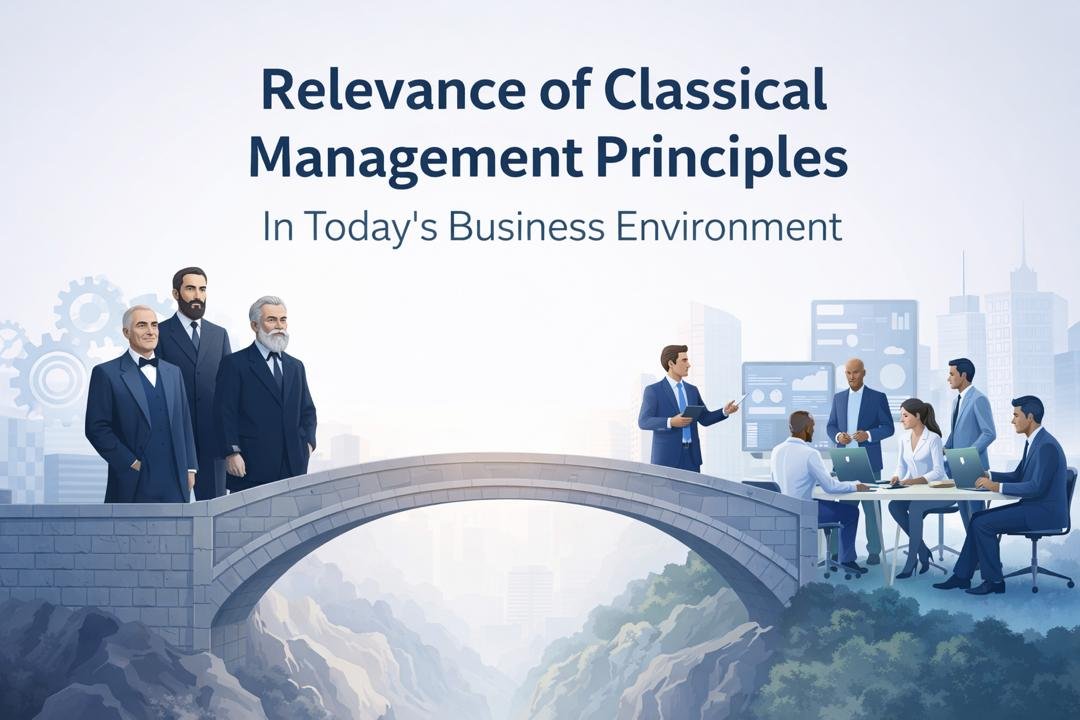
The discipline of management has over the years changed greatly due to the change in the economy, growth in technology, globalization and workforce expectations. Nevertheless, even with these transformations, the majority of the original concepts formulated by the early management theorists still have an impact on the organizational structure and leadership today. The relevance of classical management principles that began to appear in the end of the 19th century and the beginning of the 20th century were supposed to enhance efficiency, productivity and control of the organization. The opponents state that these principles are inflexible and obsolete, although their adherents believe that they remain a solid guideline in developing successful management as long as they are adjusted to new realities.
This paper is an evaluation of relevance of the classical concepts of management in the contemporary business world. It takes a closer look at major classical theories, contrasts them with the current ones, primarily, contemporary management principles, and proves how old ideas still form leadership performance and organizational success.
Introduction to Classical Management Theories
Classical management theory is concerned with efficiency, form and official authority in organizations. It came into the picture during the industrial revolution whereby organizations sought methodical means in which they could accommodate the increasing number of workforces and the demanding processes. There are three major theories that can be categorized under the classical approach, namely: Scientific Management, Administrative Management and Bureaucratic Management.
Scientific Management Theory
The Scientific Management, which is the invention of Frederick Winslow Taylor, focuses on enhancing efficiency whereby a systematic study of the work process is done. Taylor was of the opinion that work ought to be divided into smaller units, standardized and optimized to ensure maximum output is realized. Some of the major principles are the time and motion studies, division of labor, performance pay and the distinct separation of planning and execution.
Scientific management elements are present in current organizations. Taylor is concerned with efficiency, and this is evident in standard operating procedures, workflow optimization, performance metrics, and productivity tools. Although modern organizations understand the importance of creativity and employee welfare more, efficiency has been a managerial goal.
Administrative Management Theory
The Administrative Management theory by Henri Fayol deals with management of organizations as a whole and isolated work as an individual. Fayol determined the main functions of the management, such as planning, organizing, commanding, coordinating, and controlling, and suggested 14 principles of the management, such as division of work, unity of command, authority and responsibility, discipline, and scalar chain.
Modern management education is based on these principles. The direct applications of the ideas of Fayol include planning cycles, organizational hierarchies, reporting lines and control systems. These functions continue to be used by managers in flexible and flat organization in order to make decisions and allocate resources.
Bureaucratic Management Theory
Bureaucratic Management was introduced by Max Weber, where emphasis was made on formal rules, authority hierarchy, impersonality and advancement on merit. Bureaucracy is meant to bring equity, consistency, and accountability to the operations of an organization.
Despite the fact that bureaucracy has always been criticized as being slow and inflexible, it is still necessary in such areas as government, healthcare, education, and big corporations. Weber principles of bureaucracy are reflected in the policies, procedures, compliance systems and documentation requirements in a contemporary manner.

The Major Tenets of Classical Management
There are a number of classical management principles which are still used in the formation of modern organizational practices:
- Division of Labor: Specialization brings about efficiency and expertise.
- Power and Accountability: Managers are required to be able to issue orders and are responsible for results.
- Unity of Command: It should also have single superior who tells the employees what to do to avoid confusion.
- Scalar Chain: There is a clear line of command, and this means that there is effective communication.
- Discipline: The organization needs rules and norms that bring about stability.
- Order: Materials and human beings must be in place at the opportune moment.
These principles are not as rigid as they need to be in modern organizations, although they are used to coordinate and control.
Development of Modern Management Practices
Present day management practices became as such in reaction to the constraints of the classical theories. These new strategies are flexible and creative, in touch with their employees, and receptive to change. They have an understanding that organizations exist in a dynamic environment that is full of uncertainty and complexity.
The main characteristics of modern management are:
- Employee involvement and empowerment
- Team-based structures
- The focus on leadership instead of power
- Concentrate on organizational culture and values
- Technology and evidence-based decision-making
- Adaptability and flexibility
Compared to classical management, which considers employees as economic assets first, modern management approaches perceive employees as knowledge workers whose needs are emotional, social, and creative.
The comparison of Classical and Contemporary Management Approaches
Structure and Flexibility
Classical management is more inclined towards formal structure, hierarchical structure, and centralized decision making. Modern day management however encourages flatter, decentralization and flexibility. Nonetheless, even flexible organizations need to have a certain degree of structure in order to work. Classical principles continue to play a role in job roles, reporting lines and systems of accountability.
Leadership Style
Classical management focuses on authority, control and compliance as compared to modern management which focuses on leadership, motivation and collaboration. In spite of this transformation, power has not been lost. Managers continue to make strategic decisions, implement policies and make sure performance standards are achieved. The distinction is in the form of the exercise of power, which is not by command, but by influence.
Employee Motivation
The early classical theorists had a belief in the employees being driven by financial rewards. Modern management has identified intrinsic motivation as recognition, self-growth and meaningful work. Nevertheless, incentives, bonuses, and productivity targets that are based on classical thinking in terms of performance-based incentives are still popular.
Decision-Making
In classical management, management is centralized and the style promotes participation and teamwork in contemporary management practices. However, when it comes to crisis situations or major changes in the strategies, centralization is usually needed, which proves the classical principles remain still relevant.
Persistence of Classical Management in Contemporary Organizations
Although the management philosophy has changed, the classical principles still play a role in contemporary organizations in a number of areas.
Organizational Design
A majority of organizations continue to have departmentalized structures like the finance, operations, and marketing and human resource departments. This division of work is similar to the principle of division of work by Fayol and the bureaucratic structure of Weber; this is the reason why this departmentalization is similar to these two theories.
Performance Management
Scientific management is based on performance measurement systems, key performance indicators (KPIs), and productivity benchmarks. To this day, even such tools as performance dashboards and analytics platforms are designed based on Taylor and his insistence on measurement and efficiency.
Leadership and Control
The planning, organizing and controlling are also crucial functions of the manager. The contemporary uses of the classical principles of administration are strategic planning, budgeting, risk management, and internal controls.
Operational Efficiency
It is true that Lean management, Six Sigma and process improvement approaches are contemporary, but strongly affected by classical concepts of efficiency, standardization, and waste reduction.
Weaknesses and the Limitations of Classical Management
Although the relevance of classical management principles are still applicable, we cannot say that they are unlimited. Opponents suppose that these theories:
- Excessive focus on efficiency to the detriment of employees.
- Make assumptions about stabilized environments, which are not true in the modern world that are changing rapidly.
- Minimize the significance of human behavior and organizational culture.
- At times it may cause inflexibility and unwillingness toward change.
Consequently, the current organizations have to adjust the principles of the classical thought instead of using them strictly.
Combining Classical and Contemporary Approaches
The best organizations in the present combined to form a hybrid, which is a combination of traditional managerial beliefs and modern-day practices. The integration enables the organizations to be structured and efficient and it promotes innovation, flexibility, and engagement of employees.
For example:
- Clearly defined roles and responsibilities (classical) and teamwork (contemporary).
- Classical policies (formal) with contemporary leadership styles (inclusive).
- Classical performance measures versus modern employee development programs.
This is a moderate way of approaching complexity and at the same time retains operational stability in organizations.
Conclusion
The relevance classical management principles are still very applicable in the current business setting in spite of the fact that the organizational structures, technology, and workforce expectations have changed significantly. The concepts proposed by the founders like Taylor, Fayol and Weber still influence the current management experiences especially in efficiency, organizational structure, authority and control. Although the current management trends focus on flexibility, employee empowerment and adaptability, they do not annul classical principles completely. Rather, they develop them by refining and altering the original ideas to fit the contemporary issues. A combination of classical management and modern has to be effective in leadership and success in an organization.
To sum up, the conventional principles of management are not irrelevant; they are solid pillars that even when implemented with intelligence and adaptability, can remain useful in the contemporary context of management and long-term success of the organization in the current business environment.
Get more properly researched information about the Relevance of classical management principles here.