Introduction
The sharing, understanding and acting of information are critical in determining the effectiveness of decisions made by the management in any organization, whether small, medium or multinational. The most brilliant strategy may fail when communicated poorly and a simple strategy may work when there is effective communication which is clear and timely. This fact renders communication as an imperative managerial skill that is in the spotlight of all management functions such as planning, organizing, leading, and controlling.
Management communication is not only about transfer of information between a person and another, but it is the process of establishing meaning between and among people, aligning objectives, coordination and influencing individuals to achieve desired results. Communication is a major part of the time of the managers giving directions, holding meetings, report writing, listening to the feedback, and conflict resolution. Lacking proper communication, there will be a breakdown in coordination and misinterpretations will be experienced and the organization will underperform.
This paper reviews communication as a critical managerial competence that connects between strategy and action. It discusses formal and informal modes of communication, the obstacles to effective communication and practical ways that managers can employ to bring about clarity, coordination and efficient implementation of organizational plans.
Understanding Communication in Management
Management communication is the process where managers pass information, ideas, goals, policies, and expectations to the employees and get feedback on the same. It is a two-way mechanism comprising of a sender, a message, a medium, receiver and feedback. Communication can only be effective when the message is received in the intended way by the receiver.
Communication in management has a number of crucial roles:
- It assists managers to plan through sharing organizational goals and strategies.
- It helps in organization by explaining the roles, duties as well as the reporting relationship.
- It improves leadership through motivating, directing and influencing employees.
- It helps in control as it gives a feedback on performance and detects any deviation on plans.
Since communication is involved in all these functions, it has been aptly termed as the backbone of management.
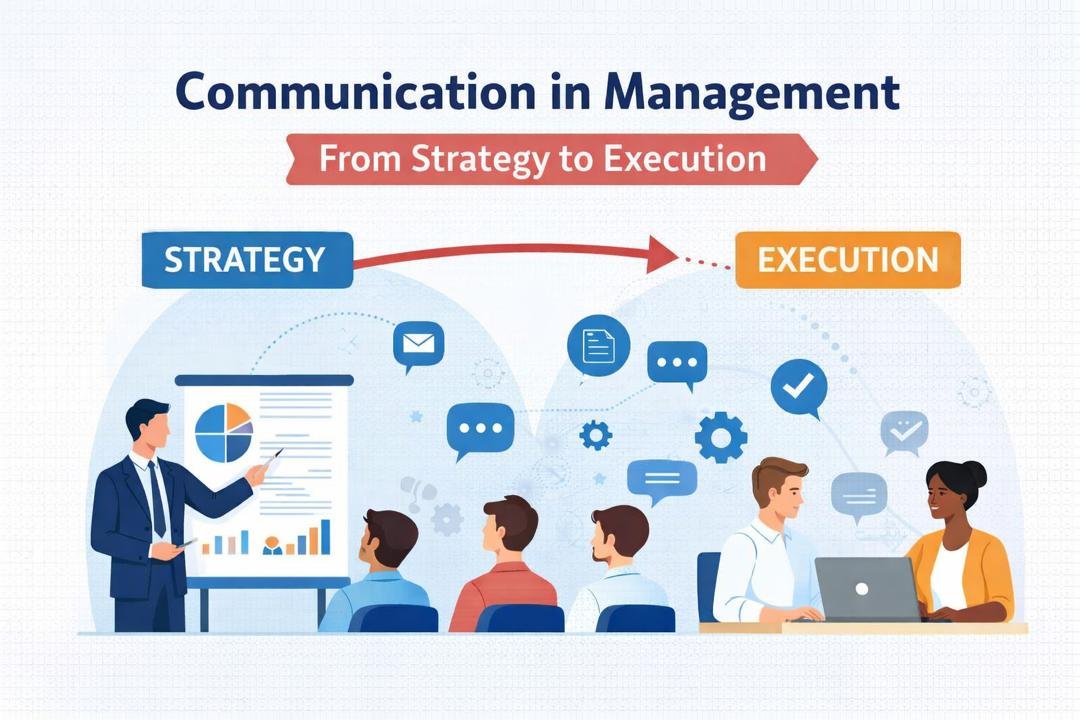
Communication as the Intermediary between Strategy and implementation
Strategy formulation entails the establishment of long term objectives of an organization and their methodology. Implementation on the other hand refers to putting those plans into action. It is communication that bridges these two stages.
Any properly-laid strategy is of no use when it is not conveyed to those who are to be in charge of their execution. The employees should know not just what the strategy is, but also why it is significant and what the personal role is in its successful implementation. That is why communication as a key managerial skill determines the decisive position in turning the strategic intent into operation outcomes.
Communication helps managers to:
- Describe strategic goals and priorities
- Co-align departmental goals to organizational strategy
- Organize inter-team and inter-unit activities
- Track the progress and give corrective feedback
Communication as an important managerial skill
Communication can be discussed as one of the fundamental managerial skills as it directly influences the decision making, involvement of employees and performance of the organization. Effective communicating managers are more likely to create trust, generate commitment and less resistance to change.
The managerial communication entails:
- Clarity- making messages uncomplicated, accurate and clear
- Consistency – how the verbal and written communication and actions are in line
- Empathy – knowing the views and feelings of employees
- Active listening – listening to feedbacks and concerns
Lack of communication skills by managers can result in poor performance of even good teams through confusion, lack of morale or conflict. On the other hand, weak resources or harsh conditions may be addressed through effective communication, although this ability takes considerable time and effort.
Management Formal Communication Channels
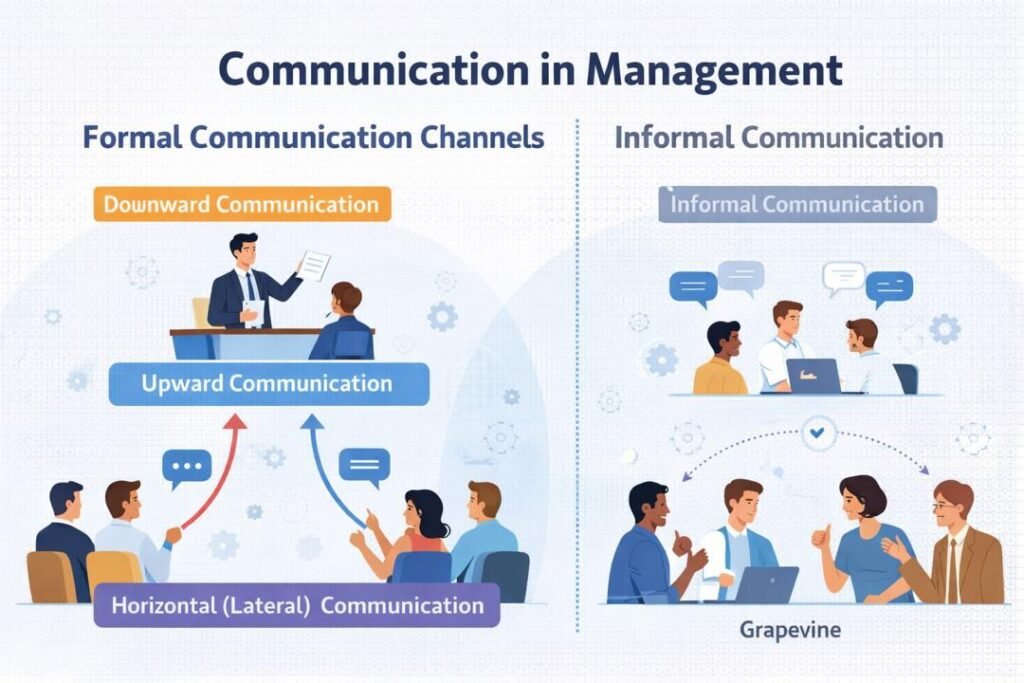
Formal communication mediums are established officially between the flows of information within the organization. These channels are arranged, written and adjusted to the organizational hierarchy.
Downward Communication
The top to bottom communication involves the communication of the top management to the organization lower levels. It is commonly used to:
- Share objectives, policies and strategies
- Provide instructions and directions
- Give feedback on performance
- Elaborate on changes in organizations
Memos, policy manuals, emails, staff meetings and official announcements are some of the examples. Good downward communication makes employees know what is expected of them as well as how their efforts can be used to achieve the organizational objectives.
Upward Communication
Communication flows down to the manager. It allows employees to:
- Give comments on policies and procedures
- Report issues or difficulties
- Share ideas and suggestions
- Provide complaints and dissatisfaction
They are reports, suggestion boxes, surveys, performance reviews and supervisor meetings. Informed decision making would not be possible without upward communication which would enable a manager gauge the effectiveness of the strategies used.
Horizontal (Lateral) Communication
Horizontal communication comprises an employee or departments of the same level. It promotes:
- Coordination of activities
- Information sharing
- The interdepartmental problem-solving
- Teamwork and collaboration
They can be interdepartmental meetings, project groups and collaborative platforms. Unless horizontal communication is well established, departmental operations can be in cross-functional silos, causing incompetence and overlapping in work.
Informal Management Channels of communication
Unofficial and spontaneous communication channels are informal. They are formed as a result of social interactions between the employees, and are commonly known as the grapevine.
Features of the Informal Communication
- It is fast and flexible
- It is not bound by hierarchy
- It tends to spread rumors or unofficial information.
- It depicts feelings and attitudes of employees.
Although, informal communication may sometimes propagate false information, there is also the positive side of it. Informal channels help managers understand the morale of the employees, form relationships, and support formal messages.
Instead of trying to eradicate informal communication, competent managers get to learn how to deal with it by:
- Communicating through proper channels giving the right information at the right time.
- Addressing rumors openly
- Having open-door policies.
Barriers to Successful Management Communication
Communication in organizations is usually hampered in a number of ways despite its significance. These obstacles have the potential to misrepresent messages, decrease clarity, and slow down implementation.
Physical Barriers
Physical barriers entail noises, distance, poor infrastructures, and where communication tools are insufficient. As an illustration, broken internet connection or congested offices may interfere with the flow of communication.
Psychological Barriers
Emotions, attitudes, and perceptions are the cause of psychological barriers. The stress, fear, mistrust, and low self-esteem can make people unable to communicate freely and read the messages properly.
Semantic Barriers
The semantic barriers arise when words or symbols are obtained differently by the receiver and the sender. Misunderstanding is usually caused by technical terminologies, unclear words and cultural diversities.
Organizational Barriers
These are hard hierarchies, high levels of bureaucracy, poor reporting and overload of information. There is the likelihood that messages will be distorted or delayed when there are too many levels between managers and employees.
Cultural Barriers
In various companies, there can be misunderstandings caused by the difference in language, values, and mode of communication. Something perceived as polite or right in one culture may be viewed in a different way in another culture.
Plans of successful managerial communication
Managers require conscious communication practices in order to break the barriers of communication and have a successful implementation of organizational plans.
Clear and Simple language should be used
Unnecessary jargon must be avoided and language that fits the level of understanding of the audience must be used by the manager. Inspired communication helps in the minimization of confusion and errors.
Promote Bi-Directional Communication
Communication does not occur in one direction. The managers are advised to stimulate questions, feedback and dialogue so that they can get to understand one another.
Practice Active Listening
Speaking is as significant as listening. The managers ought to listen, not to interrupt, and be empathetic when their employees bring up issues or ideas.
Select the appropriate medium of communication
Message and medium should be in line. The sensitive or complicated matters are better addressed directly, whereas the routine news may be relayed via mails or reports.
Deliver Timely and Accurate Information
Rumors and resistance may be caused by delay, or even incomplete information. Change and decisions should be communicated as soon as possible by the managers.
Strengthening Messages Systematically
Important messages are to be repeated, reinforced by various mediums in order to get agreement and comprehension.
Develop an Open Communication Culture
Managers ought to provide a conducive environment in which employees are free enough to raise their opinions without the threat of being punished. Trust and innovation are encouraged by open communication.
Informational and Effective Implementation of Organizational Plans
The implementation requires concerted action, and the coordination requires communication. In case of effective communication:
- The employees know what to do and what not to do
- There is efficient distribution of resources
- The problems are discovered at the earliest possible time and dealt with promptly
- Teams collaborate on common purposes
It is in the best interest of an organization to focus on communication as a key managerial skill that will help it adjust to change and handle crises and long-term success.
Conclusion
Communication is not a skill among many others of the management- it is the building block of all other management processes. Communication makes sure that ideas are turned into action and plans to result between strategy formulation and execution.
Through the knowledge of formal and informal communication routes, barriers to effective communication and practical communication strategies to amplify clarity and coordination, managers are likely to boost performance within organizations by a long way. The modern business world is dynamic and complex, and nowadays effective communication as a managerial skill is not a mere option but the key to success and successful management.
Get well researched information about Communication in management here.