
The ability to think critically is a vital factor in modern society as it helps people to analyze the information, make calm conclusions and make ethical choices. The tradition of arguments analysis and questioning assumptions might appear as a modernist one, but its roots can be traced back as far as two thousand years ago. The examples of ancient writings by Plato, Aristotle, and Socrates are the foundation of systematic inquiry, logical thinking, and argumentation, which still impact the contemporary practices of critical thinking. This article discusses how these classical works formed the intellectual framework that forms the basis of critical thinking in the modern world.
Philosophical Legacy of Socrates
Socrates (470-399 BCE) is frequently regarded as the father of the Western philosophy and the theorist of the critical thinking. Socrates did not leave any written work as was the case to the later philosophers who wrote voluminous treatises. His thoughts have been mostly preserved in the form of dialogues of his pupil, Plato. The Socratic thought focused on doubting assumptions and having reflective dialogue as one of the ways of seeking truth.
The Socratic Method: The Questioning as Inquiry
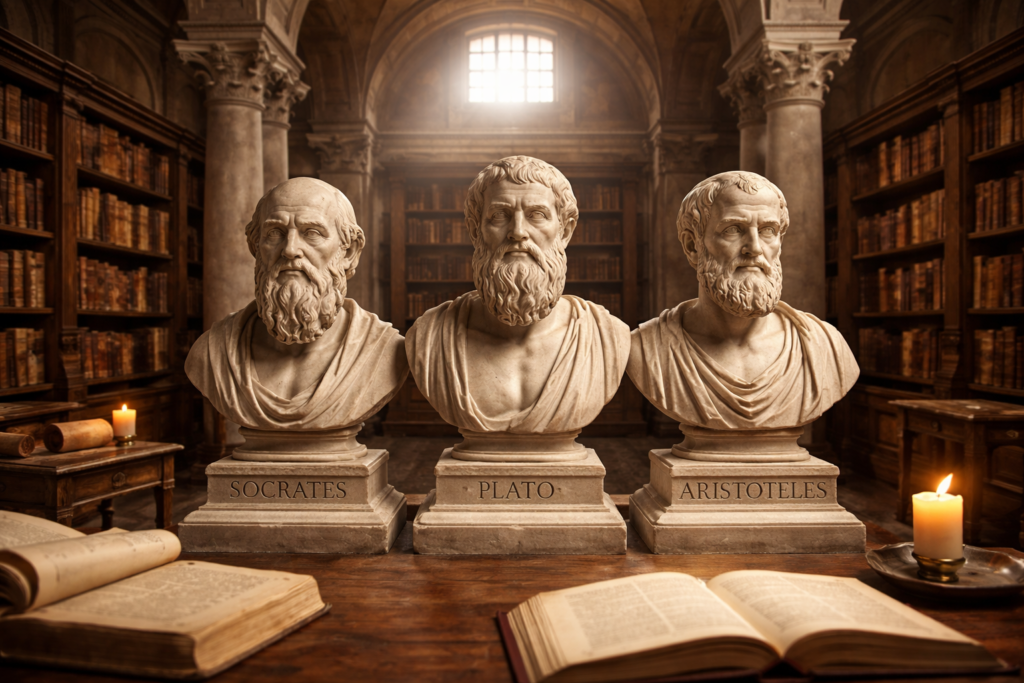
The key to Socrates was the Socratic Method, which is also a type of dialectic questioning that is aimed at revealing inconsistency and provoking thought. Socrates could not give direct answers but instead gave probing questions, which prompted the interlocutors to look into the basis of their beliefs. As an illustration, in case he is speaking of such concepts as justice or virtue, Socrates would break down his definitions and assumptions until his dialogue partner would understand more thoroughly, or would realize that he knows nothing.
This approach laid down one fundamental rule of the modern critical tradition, that knowledge is not produced passively by acceptance, but by an active questioning process. Paul and Claudius show the power of intellectual humility and the repetitive nature of the idea-refining process by proving that constructive questioning results in clarity.
Through Dialogue to Reflect Ethically
Critical reasoning was also associated with ethical inquiry by Socrates. According to him, one needed to know the character of virtues like justice, courage and temperance to live a good life. The Socratic focus on ethical reflection still shapes modern strategies of decision-making and critical thinking, especially in situations in which a moral judgment is involved with an analytical one.
Plato: The Eorderly of Thinking by Dialogue
Plato (427-347 BCE), who was a disciple of Socrates, developed the approaches of his teacher, and his dialogues developed knowledge, reality, and morality in a systematic manner. The works of Plato are full of philosophical endeavor and present deep thoughts on how to reason, logically, and argue.
Theory of Forms and the Rational Inquiry
Theory of Forms is one of the major contributions of Plato which assumes that abstract ideas, like justice, beauty, and equality, exist apart of the realities of their manifestations. According to Plato, one should know only by means of these universal forms and not basing his/her knowledge only on the senses.
This view is similar to that of surface observation and the analytical reasoning of an object in modern critical thinking. Plato penetrated into the argument through encouraging thinkers to look beyond perception and focus on the principles the argument is based on, thus creating a system of judging arguments and ideas in a systematized, logical fashion.
Conversations as Learning Resources
The dialogues alone by Plato are themselves educational. The two discussions resemble each other in the way they demonstrate analytical thinking, an emphasis on steps in question, analysis, and synthesis. The combination of the points of view stimulates the readers to be active and test the arguments and find the logical flaws. Such an approach is very similar to modern approaches to critical thinking instruction, including case studies, debates and reflection.
Aristotle: Rationalism, Categorization and Theoretical Discipline
Whereas Socrates preferred to ask questions and Plato discussed ideal forms, Aristotle (384-322 BCE) was interested in logic and observation. Aristotle was a student of Plato, and he attempted to systematize knowledge and form principles of consistent arguments in all fields.
The Principles of Formal Logic
Aristotle is said to have given birth to formal logic by writing works like Organon. He came up with such concepts as syllogism, which was a deductive form of reasoning, where conclusions were derived logically by the premises. For example:
- Assumption 1: Every human being is mortal.
- Premise 2: Socrates is human.
- Verdict: Socrates is a human being.
This model offers the basis of assessing arguments and forming logical conclusions- a method of critical thinking that is at the centre of contemporary critical thinking practice. Aristotle made it possible to differentiate between the sound reasoning and the invalid arguments by codifying the principles of logic.
Categorization and Intuitive Experiment
Systematic classification and empirical observation were also stressed by Aristotle especially in natural science and ethics. His methodology was based on gathering facts, establishing trends, and making rational conclusions. This empiricalism supported the ethos that knowledge could be based on evidence, which has continued to be one of the pillars of critical thinking in both academic and professional settings.
Ethics and Practical Reasoning
Aristotle had discussed the concept of practical wisdom (phronesis), or the skill to make good decisions under particular circumstances, in his Nicomachean Ethics. He said that moral conduct must not just be knowledge of the general rules but also apply them to real-life situations. This interconnection between the principles of moral reflection and analytical thinking represents the long-standing association between the classical philosophy and contemporary perspectives on decision-making.
Lasting Impact on Critical Thinking Nowadays
These approaches to thinking that were formulated by Socrates, Plato and Aristotle all formed the intellectual foundation of critical thinking, argument and the pursuit of ethics. They are reflected in the modern educational practices, professional problem-solving and analysis.
Doubting and Intellectual Humility
Socratic method develops a spirit of curiosity and receptiveness whereby learners are urged to challenge assumptions and seek alternative points of views. Contemporary critical thinking focuses on comparable abilities that can help people to assess evidence, think about biases and address problems in the intellectual humility manner.
Structured Argumentation
The dialogues of Plato and formal logic of Aristotle have theories of making coherent arguments. Whether it is a case of an academic essay, a scientific study or a debate on any policy, the skill of reasoning methodically, pointing out logical contradictions, and being able to prove some points by evidence is key in good thinking.
Ethical Reflection and Practical Reflection
The inculcation of moral logic and critical thinking is also emphasized by classical works. Similar to Socrates and Aristotle who associated knowledge with virtuous action, modern critical thinking provokes a person to think not only of the true or valid but also of what is just and responsible.
Practices in Multiple Disciplines
The values inherent in these ancient philosophers are not only limited to philosophy but they spread into law, science, literature and ordinary decision making. The techniques of debates, case studies and reflective exercises are becoming more popular in modern educational programs as the means of developing the analytical skills, which was the case long ago in the field of pedagogy.

Conclusion
The intellectual origins of critical thinking were founded in ancient writings by Socrates, Plato, and Aristotle, which offered approaches to inquiry, argument, and reflection on ethics which are crucial to this day. These works show the timelessness of orderly thought, empirical evidence and considered judgment through Socratic inquiry, Platonic dialogue and Aristotelian logic. With these classical tenets read and applied, modern thinkers have successfully improved the modern critical thinking processes, and as such, the quest of knowledge has become vigorous, ethical and transformative.
The heritage of these philosophers gives us to understand that critical thinking is not just a skill but a tradition, one that is centuries old, constructed through centuries of inquiry, debate and consideration. In the era of the intricate information environments, the pre-modern wisdom still manages to show our way to the road of rational, moral, and intelligent decision-making.