Choosing the right tempered (toughened) glass thickness isn’t just a “bigger is better” decision. The best thickness depends on what the glass is doing, how it’s supported, how big the panel is, how much movement you can tolerate, and what hardware you’ll be using (hinges, clamps, channels, stand-offs, etc.).
Tempered glass is designed to be safer than standard (annealed) glass because it breaks into smaller, blunt “dice-like” pieces rather than sharp shards. In the UK and Europe, thermally toughened soda-lime-silicate safety glass is covered by standards such as BS EN 12150, which defines key characteristics like tolerances, fragmentation, and physical/mechanical properties.
Below is a practical, buyer-friendly guide to help you confidently pick 6mm, 8mm, or 10mm tempered glass.
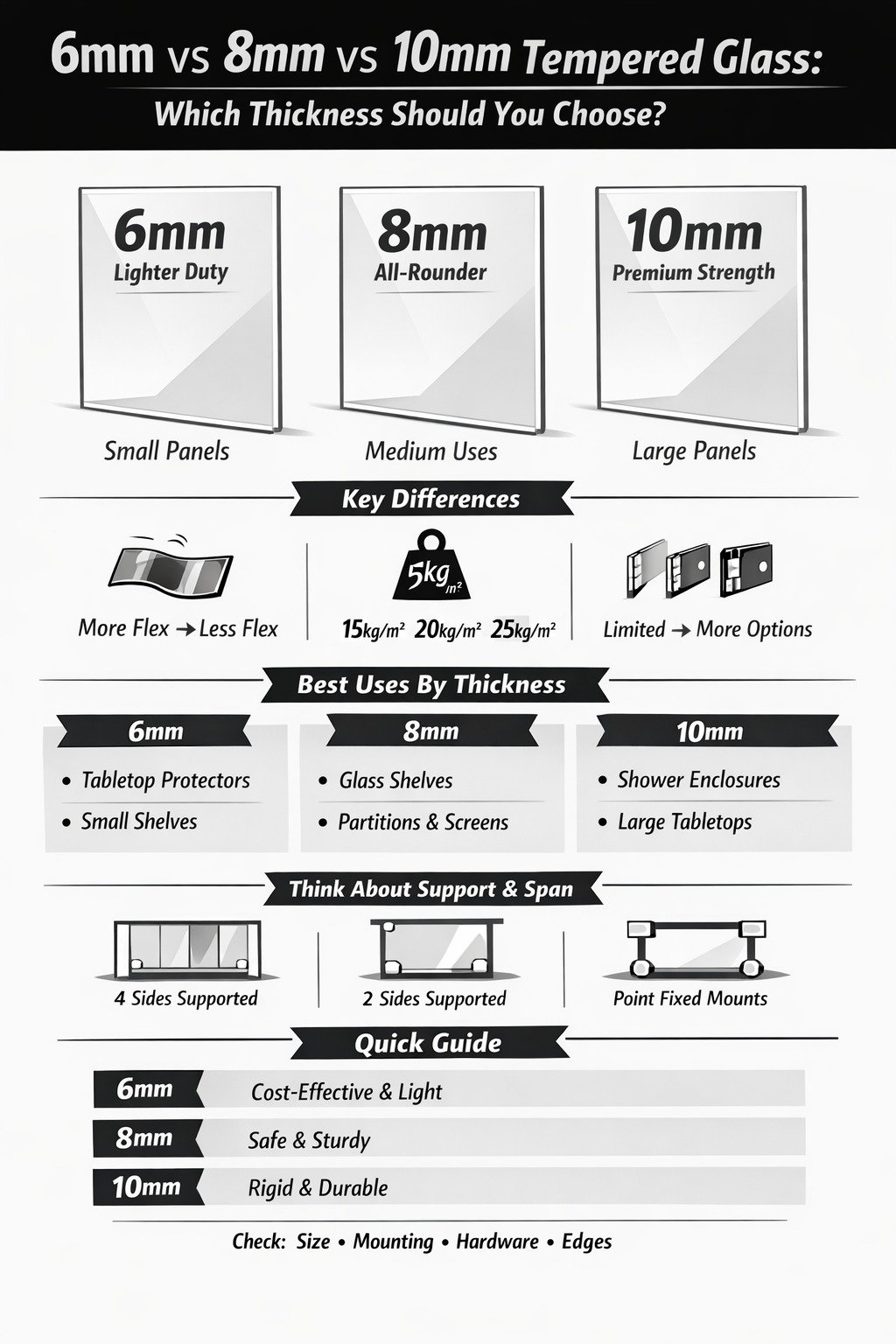
Quick rule of thumb (works surprisingly well)
- 6mm: best for smaller panels and lighter-duty uses where the glass is well-supported (and you can accept a little more flex).
- 8mm: the all-rounder—a safer default for many home projects, with a noticeably sturdier feel.
- 10mm: best when you want a premium, rigid feel, larger sizes, heavier use, or hardware that prefers thicker glass (especially common in shower and structural-style applications).
What “thicker” really changes (and what it doesn’t)
What thickness does change
- Stiffness (flex/wobble)
The biggest “real life” difference between 6/8/10mm is how solid it feels. Thicker glass flexes less, which matters for shelves, screens, and larger panels. - Weight
Thicker glass gets heavy fast. A commonly used rule is:- 6mm ≈ 15 kg/m²
- 8mm ≈ 20 kg/m²
- 10mm ≈ 25 kg/m²
- 6mm ≈ 15 kg/m²
- That affects handling, shipping, fixings, and installation.
- Hardware compatibility
Many hinges, clamps, and channels are designed around specific thickness ranges. In showers especially, 8mm and 10mm often have broader hardware compatibility.
What thickness doesn’t automatically change
- “Strength” in a simple way
Tempering improves impact resistance and changes break pattern, but the “best” thickness still depends on span, support, and load type. Also, a wrong choice of thickness can still fail if the glass is poorly supported or edges are damaged.
The #1 factor people ignore: support and span
A piece of glass doesn’t fail because it’s “only 6mm.” It usually fails because of how it’s mounted (or what it’s asked to span without enough support).
Ask yourself:
- Is it supported on two sides, four sides, or only at points (like stand-offs)?
- Is the load static (decor items) or dynamic (people pushing, doors swinging, repeated use)?
- How wide is the unsupported span?
As span increases, you typically move from 6mm → 8mm → 10mm (and beyond in truly structural uses). Even many shelf guides and calculators emphasize that span and support are decisive.
Best uses for each thickness
6mm tempered glass: where it shines
Choose 6mm if:
- The panel is small to medium in size
- It’s fully supported around edges or sits on a stable surface
- You want a lighter, more cost-effective option
- Flexing slightly is acceptable
Common 6mm uses:
- Smaller tabletop protectors
- Small shelves with short spans and good support
- Cabinet inserts and smaller interior panels
- Some splashbacks (depending on installation and heat considerations)
Many suppliers list toughened glass across a wide range of home and commercial uses, but the safe choice depends on panel size and mounting.
When 6mm is not ideal:
If you’re building anything that should feel rigid (like larger shelves), or where movement is a problem (like shower screens), 6mm can feel “springy.”
8mm tempered glass: the practical “default” for many homes
Choose 8mm if:
- You’re not sure what to pick and want a safer all-round thickness
- You want a shelf or panel that feels solid without going “ultra heavy”
- You’re using common channels/clamps and want good compatibility
Common 8mm uses:
- Most everyday glass shelves (especially medium spans)
- Interior partitions and screens (non-structural)
- Medium-size tabletops
- Some shower applications (depending on design)
In shower contexts, many installers and glass retailers recommend 8mm or 10mm because it feels sturdier, wobbles less, and often works with a wider range of fixtures.
10mm tempered glass: premium rigidity and confidence
Choose 10mm if:
- The panel is large or you want minimal flex
- It’s a high-use area (busy bathroom, commercial space, frequent cleaning/handling)
- You’re using heavier-duty hardware (hinges/clamps often feel best with thicker glass)
- You simply want that high-end “hotel shower” solidity
Common 10mm uses:
- Shower screens and enclosures (especially larger panels)
- Large, heavy-duty shelves
- Larger table tops where rigidity matters
- Heavier interior screens and panels
Trade-off: weight and handling. At ~25 kg/m², a big 10mm panel can become a two-person carry job quickly.
A simple decision table
| Your situation | Best pick | Why |
| Small shelf, short span, well-supported | 6mm | Cost-effective and light |
| Typical home shelf, moderate span | 8mm | Best balance of stiffness/weight |
| Long shelf span or you hate flex | 10mm | Noticeably more rigid |
| Shower screen/enclosure (especially larger) | 8–10mm | Less wobble + more hardware options Me and My Glass |
| Large tabletop where “solid feel” matters | 8–10mm | Stability and confidence |
| You’re unsure and want safer “default” | 8mm | Usually the best middle ground |
Real-world examples (to make it concrete)
Example 1: Bathroom shelf (toiletries + bottles)
- Small niche shelf with good support: 6mm can work
- Medium shelf with decent span: 8mm feels better day-to-day
- Wide shelf holding heavier items: 10mm reduces bounce and stress
Example 2: Shower screen
Even if 6mm is technically possible in some contexts, many shower specialists strongly prefer 8mm or 10mm because it’s sturdier, wobbles less, and fits more hardware systems.
Example 3: Desk or tabletop protector
If it’s sitting on a fully supported surface:
- 6mm is often enough
If it’s larger and you want a premium feel: - 8mm is a great upgrade
If it’s big and you want maximum rigidity: - 10mm (but make sure your base can handle the weight).
Don’t forget: edgework and cut-outs matter
Thickness isn’t the only safety and durability variable.
If your glass has:
- holes (for fixings),
- notches,
- cut-outs,
- exposed edges in a high-traffic area,
…then edge finishing (polished/arrised) and correct fabrication become even more important. Tempered glass can’t be cut after toughening, so everything must be correct before the tempering process.
Also: damaged edges are one of the most common causes of failure in glass projects—especially in busy areas where something might knock the corner.
Ordering checklist (use this before you buy)
When choosing 6/8/10mm, confirm:
- Exact application (shelf, shower, tabletop, partition, etc.)
- Panel size (width × height)
- How it’s supported (2 sides, 4 sides, point-fixed, hinges)
- Hardware thickness range (hinges/clamps/channel spec)
- Edge finish (polished edges for exposed areas)
- Safety needs (human impact risk, wet area, children)
- Weight handling (delivery, lifting, installation) — use the rough kg/m² guide
- Standard/quality expectations (ask if it’s made to relevant toughened safety glass standards like BS EN 12150)
The best choice for most people
If you want the most broadly “right” answer without overthinking:
- Go 8mm for shelves, table tops, and many home panels.
- Go 10mm when the panel is large, you want minimal flex, or it’s a shower screen/enclosure.
- Go 6mm when the piece is smaller, well-supported, and you want to keep weight and cost down.