Introduction
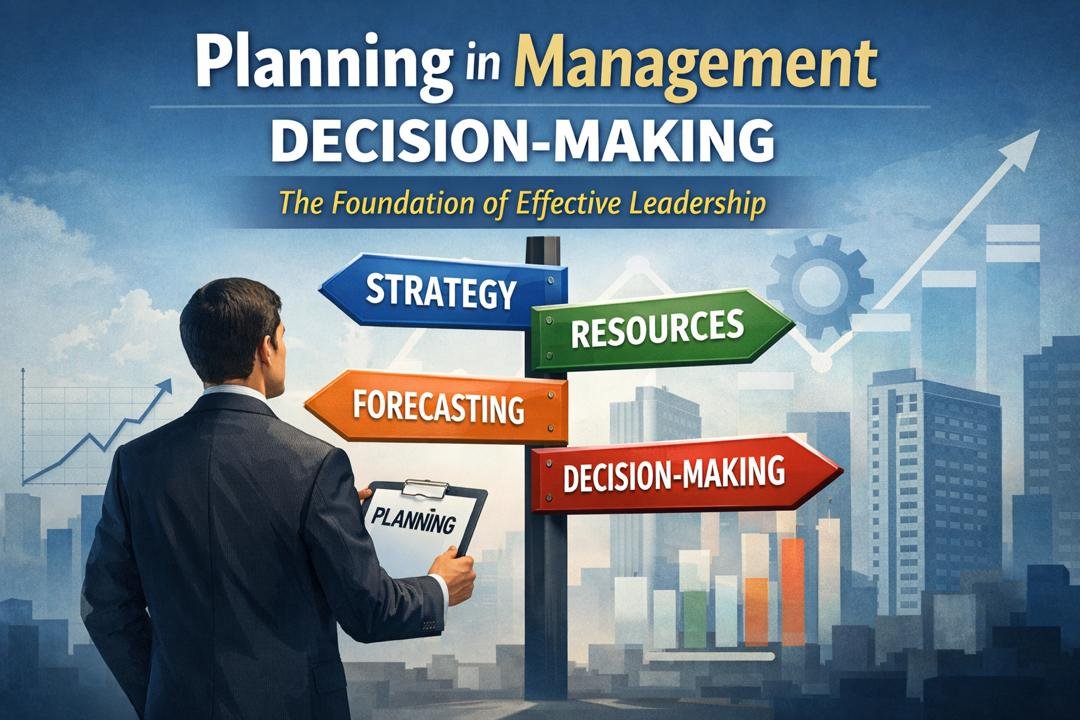
In the modern business world, which is quite active and competitive, there is a continuous pressure on the organizations to be able to adapt, be innovative as well as make reasonable decisions in uncertain conditions. The managers are expected not to just respond to the changes but they should also foresee the changes and get their organizations ready to succeed in a sustainable manner. Planning in management decision-making is the key to the success, and is at the core of this responsibility. Planning offers an orderly framework in defining goals of the organization, identifying the right strategies to adopt and in efficient utilization of the available resources to come up with the expected results.
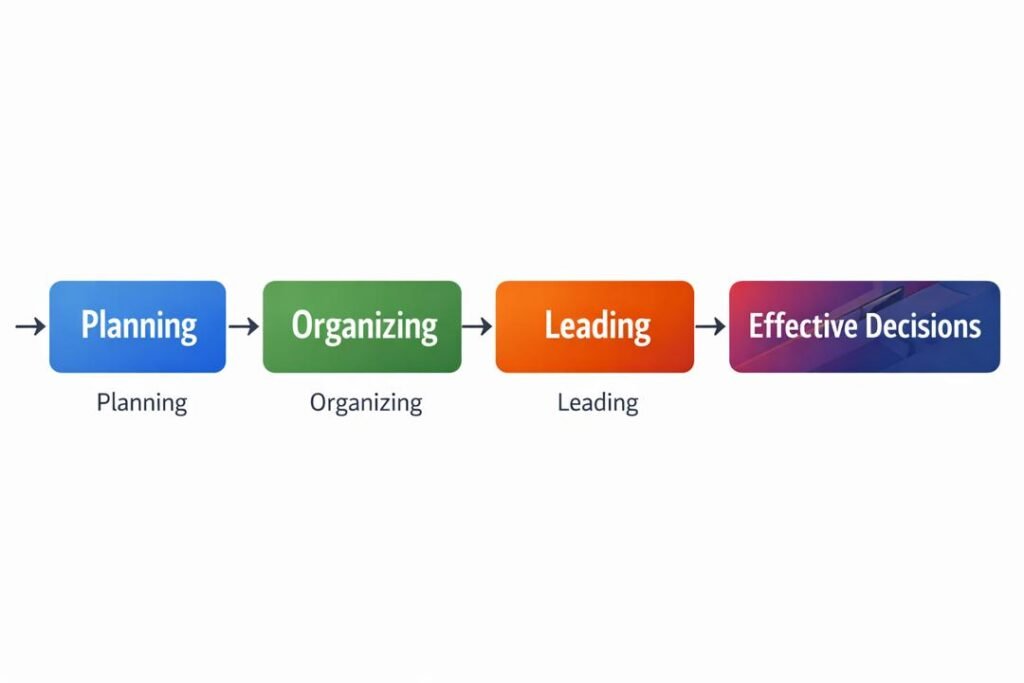
It has been widely known among management scholars that planning comes before all other managerial functions- organizing, leading and controlling, since it creates the structure upon which these functions are executed. Unless well planned, managerial decisions are reactive, uncoordinated, and ineffective which in most cases leads to squandered resources and lost opportunities. This paper discusses planning as an important managerial activity that determines the direction and the performance of organizations. It discusses the nature of plans, planning horizons and the purpose of forecasting and it explains how effective planning helps to lessen uncertainty, allocate resources better and aid in the development of strategies.
Vision Planning as a Managerial Function
The process of setting goals and deciding beforehand the right courses of action that will be taken to reach the goals may be referred to as planning. It entails making decisions regarding what to be done, how to be done, when to be done and who to be done. Planning gives managers direction and purpose, thus they make sure that organizational efforts are all geared towards a similar objective. Through planning in management decision-making, organizations can align their goals with available resources and long-term strategies.
Planning is considered to be the initial and the most basic area of management since it preconditions all the other managerial processes. Plans are crucial to organizing to plan the tasks and responsibilities, plans are important in depending to plan how to motivate and communicate and lastly plans are the benchmarks in evaluating performance that are used in controlling. Planning, therefore, would serve as the roadmap to the managerial decision making.
Planning is an important managerial process
Planning is a very important managerial process that allows managers to base their decisions on intuition to well informed decisions that are based on evidence. It promotes the development of systematic thinking, assists in identifying possible risks, and trains organizations to react to changes both internally and externally. Planning boosts confidence and stability in management and in the organization by defining goals and laying out plans.
Classifications of Organization Plans
There are various plans that organizations use to meet different needs, level of management, and time periods. They keep the long-term vision and short-term operations in line with these plans.
Strategic Plans
Strategic plans are long term plans which are formulated by top management to lay out the general direction of such an organization. They attend to general goals, including positioning in the market, competitive advantage, growth plans, and organization mission. Strategic planning entails an external environment analysis, an evaluation of internal capabilities, and an evaluation of strategies that will help the organization attain its objectives in the long term.
Strategic plans are essential in decision-making as they give one the sense of direction and purpose. In their absence, organizations stand the chance of going astray or reacting unevenly to changes occurring in the environment.
Tactical Plans
Strategic goals are converted into specific actions to the middle management in the form of tactical plans. They tend to be medium-term oriented and geared at departmental or functional goals, and could be marketing campaigns, production goals or staffing requirements. Tactical planning will see to it that the strategic intentions are put to effective use at different levels in the organization.
Tactical plans enhance efficiency in decision-making by closing the disconnection between strategy and operations, thus better coordinate and increase accountability.
Operational Plans
Operational plans are short term plans that are developed by lower level managers in which they plan how to conduct their daily operations. These are work plans, schedules, procedures and budgets. Operational planning helps in making sure that the routine activities are performed effectively and in a regular manner.
Operational plans are significant to the decision-making processes of managers through the formulation of precise directions and performance criterion. They minimize uncertainty and allow managers to check on progress and work on the deviations at an early stage.
Contingency Plans
Contingency plans refer to alternative action plans that are meant to counter any unexpected events or emergencies. Contingency planning is becoming more critical in the present day business environment, which is uncertain. Such plans will allow managers to be prompt and decisive in cases where things go wrong.
Contingency planning helps organizations to be stronger and more prepared to deal with risks and so minimizes the adverse effects of unexpected disruptions.
The Horizons of Planning and their Significance
Planning horizons are the periods of an organizational plan. The different planning horizons can only be understood and managed in order to make effective decisions.
Short-Term Planning
Short term planning is normally one year or less and is concerned with the goals in the present moment. It entails choices that concern day-to-day operations, cash flow operations, and short-term performance goals. Short term strategies play essential roles in ensuring the efficiency of the operations and fulfilling immediate expectations of the stakeholders.
Medium-Term Planning
Medium-term planning will last between one and five years and will be aimed at fulfilling tactical goals intended to aid in the enforcement of long-term plans. It involves making of decisions that concern capacity expansion, workforce development, and product development. The middle-term planning assists companies in moving easily between the short-term activities and long-term goals.
Long-Term Planning
Long term planning is greater than five years and is aimed at the direction the organization is headed to. It solves such problems as diversification, technological innovation and long-term investments. The long-term planning plays a critical role in maintaining the competitive advantage and organizational survival.
The combination of long, short and medium term planning will enable managers to make balanced decisions to meet the immediate needs but protect the future success.
The Use of Forecasting in Planning
Planning involves a very important aspect of forecasting. It entails making forecasts about the future basing on the past data, trends and assumptions. Proper forecasting helps managers to predict demand, cost, technology and competitive environment changes.
Types of Forecasting
Forecasting may either be qualitative or quantitative. Quantitative and qualitative forecasting are based on the statistical models and numerical data versus the expert judgment, market research and scenario analysis. The two methods are useful and in most cases, they are applied together in a bid to improve accuracy of planning.
Decision-Making and Forecasting
Forecasting helps in managerial decision making since it gives information about other possible events in the future. It assists managers to evaluate risks, alternatives, as well as choosing the suitable strategies. Forecasts though they are not always precise, eliminate uncertainty and enhance preparedness. Planning in management decision-making relies heavily on forecasting to reduce uncertainty and improve the accuracy of managerial choices.
Companies that invest in good forecasting are in a better position to allocate their resources effectively, prevent overproduction or shortage and react effectively to change of environment.
The Way Planning Minimizes Uncertainty
The ability to minimize uncertainty is one of the greatest advantages of planning. Although uncertainty cannot be avoided during the planning process, it allows managers to foresee the possible challenges and respond to them.
Planning in management decision-making assists managers to recognize the trends, opportunities and threats in the environment through environmental scanning and forecasting. This is a proactive strategy to reduce the occurrence of surprises and to increase the level of organizational preparedness. Once managers are aware of the potential events that might happen in future, then they will be able to make an informed decision instead of making decisions based on guesswork.
Resource Allocation and Planning
Resource allocation is dependent on effective planning. Organizations work with minimal resources such as time, money as well as human capital. Planning helps in ensuring that such resources are allocated to activities that can be helpful in attaching organizational priorities.
The planning process leads to budgeting, manpower planning and scheduling. Planning enables managers to assign resources efficiently and prevent wastage by specifying the goals and goals. This will result in increased productivity and cost management.
Planning as an Aid to Strategy Making
Strategic decision making encompasses decisions that would have long term effects on the organizational performance and existence. Planning is the tool of analysis required to make such decisions.
Planning improves the quality of strategic choices by evaluating the alternatives, the evaluation of risks, and the connection of decisions with the organizational goals. It makes sure that no decisions are taken individually but in relation to the mission and vision of the organization.
Conclusion
Planning in management decision-making remains the foundation of success in an organization. It is an important managerial process that determines the organizational orientation, boosts performance, and promotes sustainability. Planning lessens the uncertainty, enhances resource allocation and other decision-making processes through the various types of plans, the right planning horizons, and the correct forecasting.
Organizations that value planning have a greater possibility to sail through in a rapidly changing and uncertain business environment. When managers realize and use planning as an essential managerial skill, they are better placed to spearhead their organizations to both the long-term growth and stability.
Get more properly researched information about planning and decision-making here.