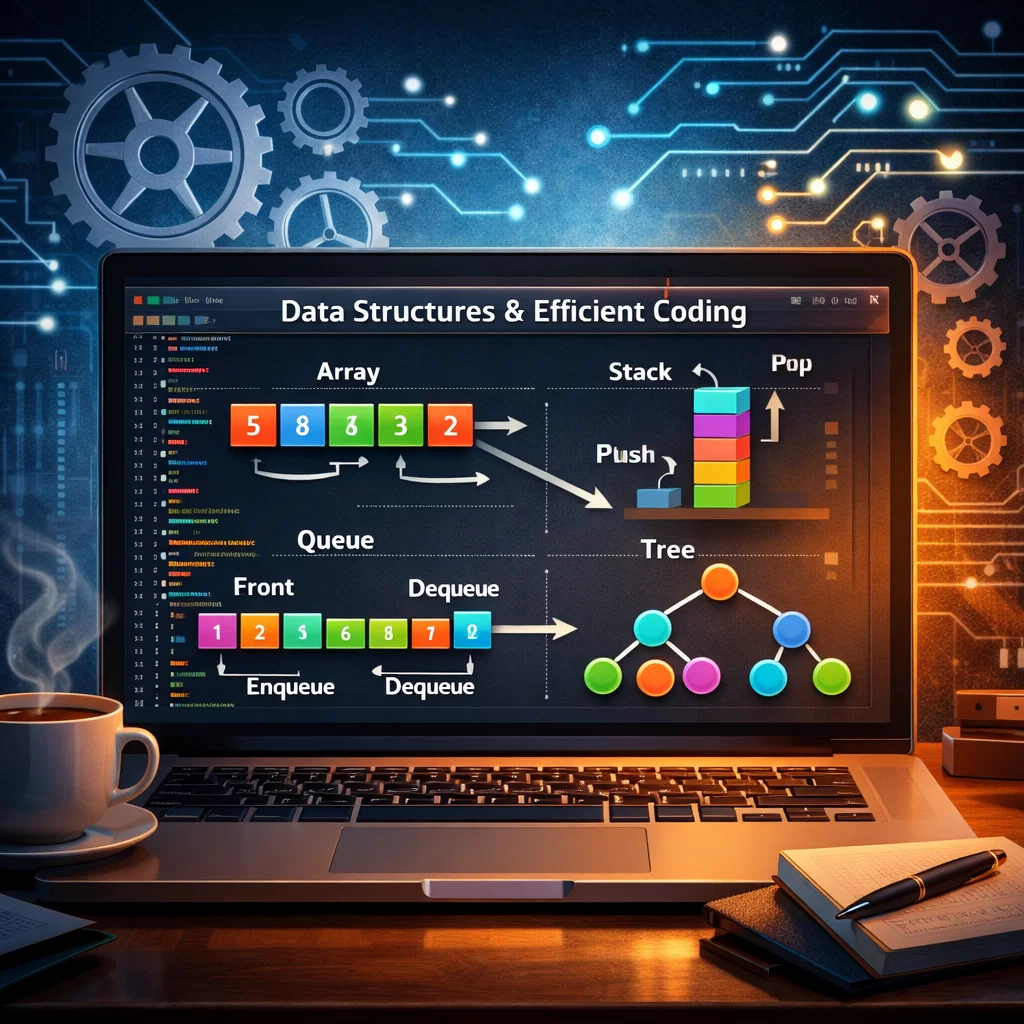
Efficient data management is the answer to developing high-speed and scalable applications in the world of computer programming. Data structures are specialized formats of organizing, managing, and storing data in a manner such that it can be easily accessed, edited, and various operations done on it. In their absence, the programmability would not be efficient and hence slower to execute, consume more memory, and not as scalable. In this article, we are going to discuss the different data structures, their significance, and the effect it has on the performance of programs, which will eventually make the programs efficient and scalable.
What Are Data Structures?

A data structure is a specific arrangement and storage of data in a computer in such a manner that it could be accessed and altered efficiently. A proper data structure enables the software developers to carry out data operations fast and using small amounts of resources including memory and processing time. Properly applied data structures can improve performance and scalability of programs, thus can be more effective in working with larger datasets.
Types of Data Structures
There are numerous types of data structures, and each has different features that ensure that it fits certain activities. These are some of the most popular data structures in programming.
Arrays
Definition:
One of the simplest data structures is an array. It is a group of elements which are all of the same type and are stored in adjacent locations of memory. The elements are indexed, and it is possible to access any single element in constant-time.
Importance:
Arrays would be effective in a case when the amount of the data is known beforehand and does not vary very often. They are very useful in storing and recalling data when sorted by position as they have an O(1) time complexity on accessing the elements.
But the disadvantage of arrays with fixed size is that it may be a problem when working with dynamic data. Should the array have to change in size, whether it has to be expanded or reduced, a new array must be made and the elements have to be copied. This is computationally costly.
Stacks

Definition:
A stack is a linear data structure that is based on the Last In First Out (LIFO) principle. Items are stacked and unstacked on the top of the stack and are therefore used in tasks where the results are meant to be accessed in reverse order.
Importance:
Stacks are frequently utilized in recursion, whereby function calls are placed into a stack, or in application cases like undo functionality. They are a valuable device in handling temporary data because they are efficient in their memory storage and their straightforward functions.
The fact that it is fast and easy to add and take out the last bit of a stack makes it appropriate for tasks such as expression evaluation, syntax construction, and graph depth-first searches.
Queues
Definition:
A queue is a linear data structure which works on a First In First Out (FIFO) principle. Items are pushed to the rear of the queue and pulled off the front.
Importance:
Queues are applicable in situations where tasks are supposed to be done in the order in which they are received, as in job scheduling and task queues in a computer system. Queues are also significant in link-based graph theory breadth-first search (BFS), where nodes of a graph are considered in layers.
Queues are essential in handling streams of data, processing network packets, etc., because of the ability to process the elements in the sequence they come from.
Trees
Definition:
A tree is a hierarchical type of data structure consisting of nodes where each node has a value and points to child nodes. The highest node is referred to as the root, and all the nodes are joined together by edges.
Importance:
Trees are also extensively applied in situations where hierarchical connections are needed, such as file systems, databases, and web page layouts. One of the most popular types of trees is binary trees and binary search trees (BSTs), which offer an efficient system of searching, adding, and deleting elements.
A balanced binary search tree is also an assurance that any of the operations (search, insert, and delete) can be performed in O(log n) time, which is much less than linear time with a huge dataset.
The Importance of Data Structures in Programming

Data structures greatly influence the functionality of computer programs. By selecting the right data structure, developers are able to save on the time required to perform certain operations, minimize memory consumption, and enhance the effectiveness of the program as a whole. This can render a program scalable so that it is able to support increased datasets without degradation in performance.
Scalability of computer programs is one of the important concepts that are directly affected by data structures. Scalability is a quality of a program to perform more and more work or data efficiently. When data is correctly arranged with the correct data structure, then this data may be processed faster, and the program is able to process larger amounts of data without any difficulties of slowness or memory overflow.
As an example, with the help of a hash table, a lookup can be done faster than a linear search which, by its turn, directly influences the program’s scalability. In a similar fashion, a developer can also make sure that the program will also be efficient as the size of the data increases by using balanced trees.
Usage and Optimization of Memory
Memory is also used in programs depending on data structures. Certain data structures will be more efficient in their use of memory, and this means that programs will be in a position to process large datasets without wasting resources. An example is that linked lists can be dynamically scaled to create memory, without the cost of scaling an array. Equally, data structures such as heaps can be used to manage memory in programs that need to use priority queues, as is the case with scheduled systems.
In addition to that, algorithm performance can be optimized by the right data structure. Quick sort or merge sort algorithms have the advantage of being implemented using arrays or linked lists, depending on the situation being addressed, in order to make the sorting process as fast as possible.
Conclusion
In summary, data structures are an essential part of computer science and software development. They provide the foundation for efficient data management, which directly impacts the performance and scalability of applications. Choosing the right data structure for a given problem can lead to faster execution, reduced memory usage, and better scalability, allowing the program to grow and handle larger datasets effectively.
Whether you’re working with arrays, stacks, queues, trees, or more advanced data structures like hash tables or heaps, understanding their characteristics and performance trade-offs is crucial for building efficient and scalable applications. As technology continues to evolve and data grows, mastering data structures will remain a cornerstone of successful programming.