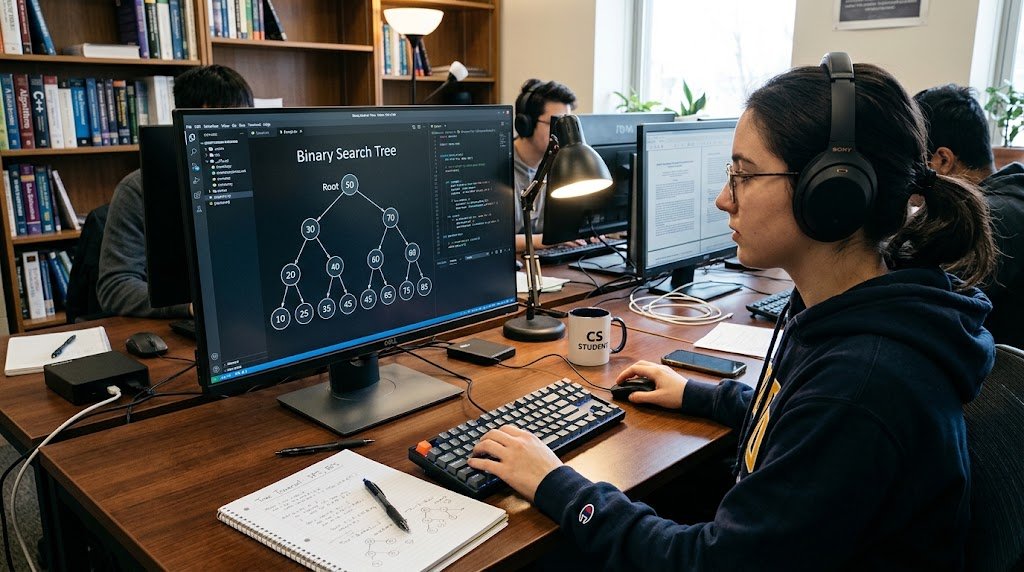
In the modern fast-changing world of technologies, languages, frameworks, and tools used in programming come and go. Due to the continuous changes and the appearance of new technologies, keeping track of all new tools appearing becomes even more challenging. Nevertheless, there is one constant and critical to success, and it is the ability to solve problems. Although it is certainly vital that one should know certain programming languages to solve certain problems, it is the skill to think critically and solve complicated problems that goes beyond both a language and a tool. This article will argue that skills in problem-solving in programming are more valuable than skills in a particular programming language, and how problem-solving can make you successful in the long term in the tech industry.
The Importance of Problem-Solving Skills in Programming
At the center of any successful program development project, there must be an issue that must be resolved. It can be a complex algorithm creation, a bug in the code, or just a new way to view a task. The skill to simplify a complex problem into small bits will be used by a programmer in their career. Problem-solving skills enable a developer to solve a large number of problems, regardless of the programming language or technology that will be employed.
Programming languages are simply the means of expressing ideas. They possess syntax, libraries, and special features, but fundamentally, they are an end in themselves. Good problem solvers are also interested in the reasoning, structure, and flow of their solutions, but not the way the code is written. Such critical and logical thinking is much more useful than the knowledge of the ins and outs of one programming language.
Moreover, an ever-growing number of technologies and platforms make the possession of strong problem-solving skills provide developers with the flexibility they require to operate with new languages and tools. Such flexibility is a necessity with the technology industry expanding and diversifying.
The Secret of Change in the Technology World
The technological world is characterized by innovation and fast changes. Almost every year, new programming languages, frameworks, and libraries are launched. To illustrate, JavaScript used to be mostly a client-side scripting language ten years ago, but currently, it has been the foundation of full-stack development due to the assistance of other technologies such as Node.js.
To a developer, the capability to learn and transition fast to new computer programming languages as well as tools is critical. Nonetheless, the process of learning a new language is not limited to memorizing syntax, but rather, it is getting to know the problem-solving paradigms that are applicable in that language.
Good problem solvers find it easy to move between languages due to the fact they emphasize the fundamentals of programming such as algorithmic thinking, data structures, and optimization. Essentially, after knowing how to solve a problem in a logical manner, then you can be able to use the same in a different language or platform.
Consider the case of a developer who has switched from Java to Python. A skilled problem-solver, irrespective of their Java or Python language background, will be able to find the appropriate algorithm to a problem. They will work on the effective solution of the problem, and will not be preoccupied with the language syntax. This capability to transfer the central ideas to other languages is a feature of good problem solvers and that is what is considered to make them good in the long run.

Problem-Solving Skills Develop Scalable and Efficient Solutions
When developers concentrate on enhancing their problem-solving skills, then they are able to come up with solutions that are not only effective, but also efficient. One thing to write code that works is quite one thing, but to write code that is much faster, consumes less memory, and is more scalable is a totally different ball game.
An effective problem solver is able to see a problem in a problematic manner. They will take into account various algorithms, trade-offs, and the selection of an optimal method to resolve a problem given certain constraints (i.e., time complexity, space complexity, or scalability). Such a type of thinking is useful, as one works with any language, as the mode of problem-solving will always stay the same, no matter what tool or language is used.
To give an example, a problem solver may consider how to reduce the processing time by using a faster algorithm, instead of brute force, when processing large data sets. The skills can be used in any language (such as C++, Python, or Java) that might not have the same libraries or pre-written functions but still apply the same basic concepts of algorithmic optimization.
Programming Languages Are an End in Themselves
The main aim of any programming language is to enable a developer to address real-life issues. Be it a Web 3 application being developed using Ruby on Rails or a data analysis tool in R, the goal is to build a useful, practical application that fulfills certain requirements of the user.
Good problem solvers do not view a programming language as a tool; rather, they view it as a medium of implementing ideas and solving problems. They do not get entangled with learning all the ins and outs of a particular language but rather emphasize how they can achieve a certain objective. Such an attitude gives developers the necessary tools to handle any coding language or framework that they are dealing with, even though they may not be familiar with it.
Problem-solving provides developers with the mental model to solve problems belonging to different domains, whether it’s a sorting algorithm optimization or a recommendation system design. This enables them to deal with complicated issues logically and with the aim of arriving at the best and most beautiful solutions.
Programming Problem-Solving Skills: The Secret of Career Life
A thorough knowledge of the programming principles and problem-solving skills would also allow the developers to establish a long-term career. The basis of good software design and problem-solving does not change, no matter how languages and technologies might change.
Hiring organizations appreciate developers with the ability to reason, debug problems effectively, and come up with new ideas. That is why problem-solving skills in programming should be at the center of the skill set of any developer. It is not necessary to be an expert in one language; it is about being able to acquire and utilize your problem-solving methods on a new language, tools, and technologies swiftly.
To those who would want to test their own problem-solving skills, such materials as this guide on how to evaluate the problem-solving skills of senior developers can be invaluable in gauging and refining their mindset and approach to solving a problem with code.
The Question of How to Become a Skilled Problem Solver
The good news is that a person can learn and develop the skills of problem-solving through practice. The following are some of the methods for enhancing problem-solving skills:
- Do: See an opportunity to practice consistently. Use coding exercises and hackathons, or work on open-source projects to practice how to solve real-world problems.
- Learn the Algorithms and Data Structures: The most important way of becoming a good problem solver is to understand the basics of aspects such as sorting algorithms, searching algorithms, and data structures.
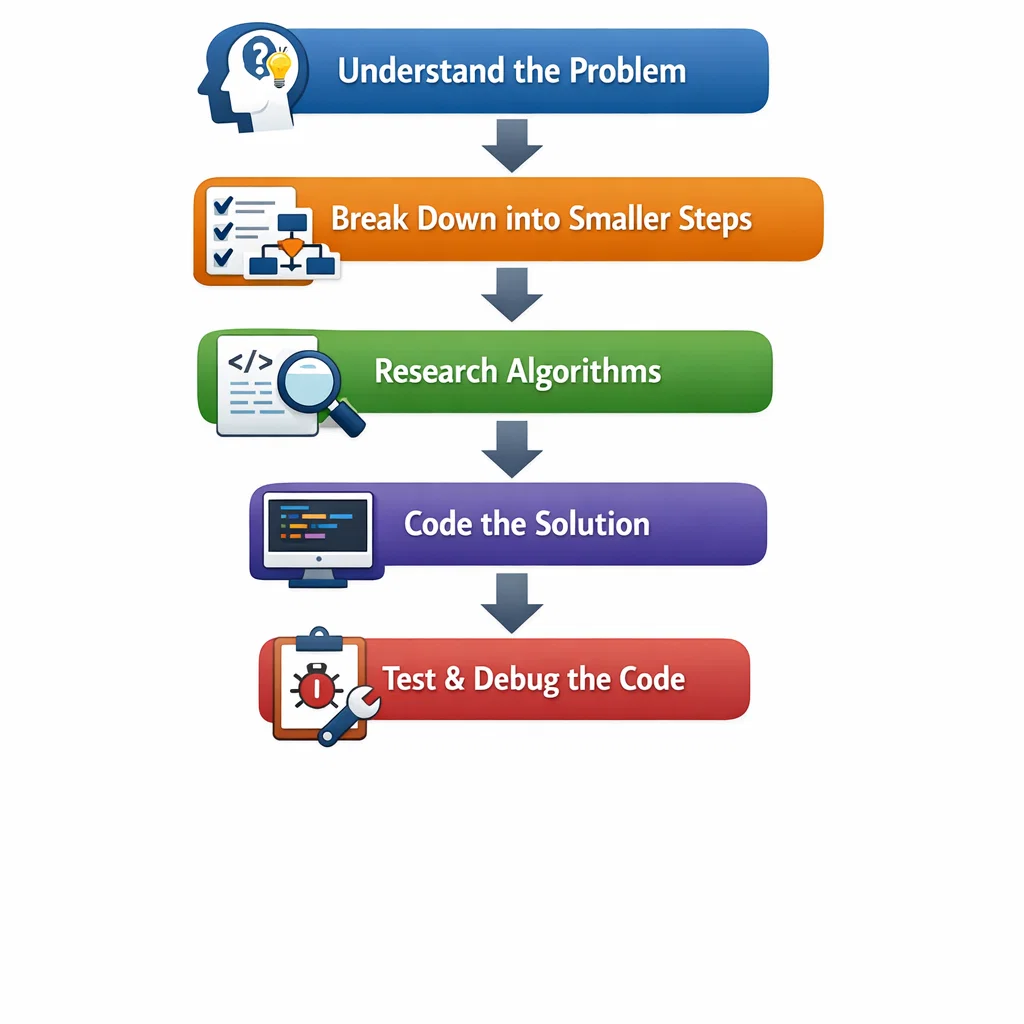
- Break Down Problems: When one has a problem, they should subdivide it into much smaller and manageable parts. This assists in coming up with a rational solution and enhances efficiency in problem-solving.
- Compare Data on Different Ways: In the run-up to coding, you will benefit by analyzing various ways of solving an issue. Attempt to establish the most effective time and space solution.
- Learn by Watching: Research solutions from other developers, especially those who have a different approach to problem-solving. This can assist you in expanding your personal problem-solving ROI.
Conclusion
The thing is that developers are the ones who distinguish themselves by their ability to think and resolve problems in a world where the programming languages and technologies are ever-evolving and changing. Although it is true that it is rather important to know a specific programming language in order to solve specific problems, skills in problem-solving will guarantee you the ability to fit in any new language or structure that will appear in your path.
Effective problem solvers do not only survive with the new challenges but also can develop solutions that are efficient and can be scaled to produce lasting effects. Whether you are an amateur or professional developer, time spent in developing your problem-solving skills will eventually be justified as a guarantee of success and a lasting career in a volatile technological environment.