
Introduction
The pillars of the Nigerian society are family and community. Social life in the country, with its variety of ethnicities, religions, and territories, is highly grounded in the concept of kinship and community, responsibility and upbringing as a whole. The Nigerian culture has high levels of interdependence, shared values and social cohesion as opposed to highly individualistic societies where personal achievement is accorded high priority over communal affiliation. These cultural trends determine behavior, social support and conflict resolution processes in societies. This paper will discuss the role of family and community in Nigerian culture especially the extended family, communal responsibility and communal raising of children. It brings out the role these aspects play in various communities in Nigeria and how they are still applicable even with modernization, urbanization and globalization.
The Family Structure in the Nigerian Society
In the Nigerian society, the social unit of family goes way further than the nuclear family of parents and children. The concept of family is widely defined and it can encompass grandparents, aunts, uncles, cousins, in-laws and even close friends of the family. Such relations are not mere symbols, they have actual obligations, expectations and responsibilities.
Conventionally, the identity of any person has close association with his/her family background and community. Social status, marriage, morality and even careers are all factors that are usually affected by family background. This emphasis on family is so strong that it strengthens social accountability and collective responsibility.
The extended family systems are one of the most characteristic elements of the Nigerian family life, as the social organization in many communities is based on them.
Nigerian Extended Family Systems at Long Lasting Period
The extended families are one of the fundamental aspects of the Nigerian culture. These systems entail networks of relatedness that have intimate social, economic and emotional connection. The extended families are unlike nuclear families, which work independently and the extended families are closely related units where members take care of each other across the generations. In the majority of the Nigerian communities, extended families cohabit or stay close within the family compounds. Though members may be separated by a long distance, it is through frequent communication, provision of finances and attending family events like weddings, funerals and naming that strong ties are maintained.
Extended Family Systems Functions
The extended family systems in the Nigerian society have a number of crucial roles:
1. Social Support: Family members help each other when they are suffering, when they are sick or when they are jobless or when someone dies. This minimizes reliance on formal systems of welfare.
2. Economic Cooperation: They tend to share the resources to finance education, initiate business or cope with emergency.
3. Moral Direction: Family elders are important towards instilling value, customs and proper conduct.
4. Conflict Mediation: Family elders often solve disputes before they can lead to legal and violent conflicts.
In most ethnic groups like the Yoruba, Igbo, Hausa-Fulani, Ijaw, Tiv, and others, the extended family is still an important unit in ensuring stability and continuity.
Social Accountability and Joint Occupancy
Outside the family, the Nigerian culture is so much focused on the community. The citizens are supposed to watch over each other, to work towards common good and engaging in the communal life.
In the traditional world, communal life is structured with communal work, communal rites and communal decision making. Farming, house-building, festivals, and security are some of the activities that are frequently done in a collective manner. This collective responsibility will help in solidarity and minimization of social seclusion.
For example:
The rural areas could be characterized by the neighbors sharing farmlands or helping each other during harvesting.
- City dwellers are also organizing themselves in communities, unions of landlords or town unions to help in the solving of problems in their regions.
- Religious groups are also significant in strengthening the community in terms of charity, counseling and social outreach.
The sense of communal responsibility also makes one understand that they do not only affect themselves but also the community at large. This promotes discipline, teamwork and respect of common norms.
Group Upbringing of Children
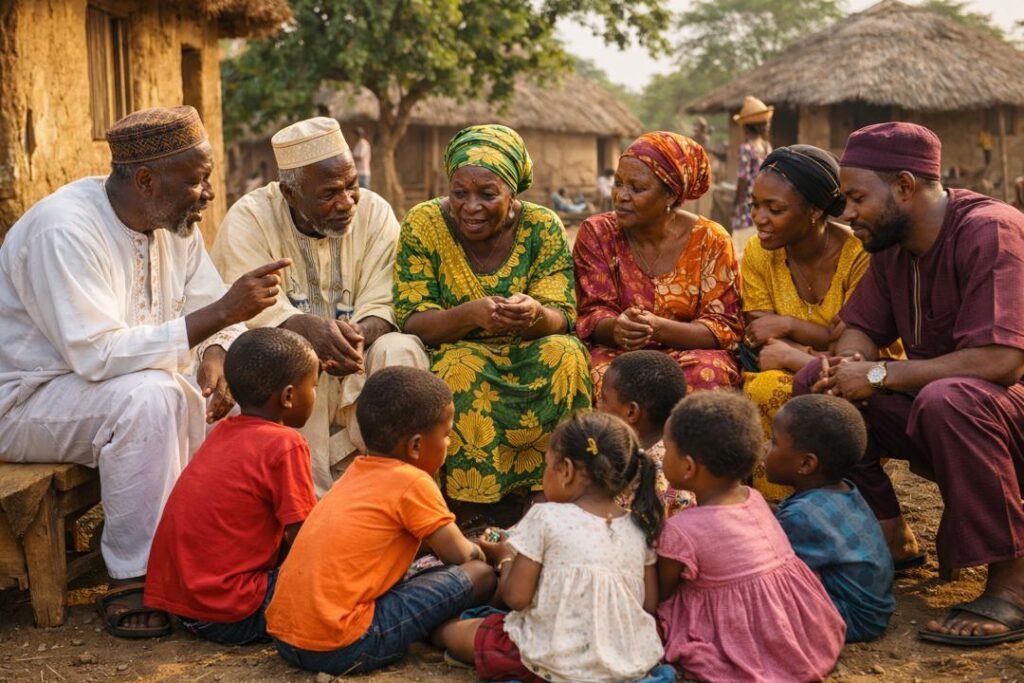
The Nigerian society is a collective one far as child upbringing is concerned. The common adage, it takes a village to raise a child, is true to the Nigerian cultural values. Authority figures in the life of a child do not necessarily include parents alone; other people such as elders, relatives, neighbors, and community leaders have a contribution towards shaping the character of children.
Socialization and Moral Education
Cultural values that are instilled in children include respect to the elders, obedience, honesty, hospitality and responsibility among others at an early age. Any responsible adult in the community is likely to administer corrective discipline as opposed to the biological parents. Although some of the practices have been transformed by modern day child-rights view, the premise of shared responsibility is still strong.
The lessons on moral codes and the history of the community are taught through storytelling, proverbs, folktales, and communal activities. These ways make children be aware of how to behave and what they can do in society.
Advantages of Collective Upbringing
Collective upbringing has a number of benefits:
- Children are reared with more than one role model.
- Childcare and supervision support are offered to the parents.
- The cultural values are maintained and transmitted.
- Children become well socialized and feel belonging.
The system also contributes towards the creation of socially responsible individuals who know how to cooperate and respect each other.
The Influence of Family and Community on Personal Conduct
The family and community set up significantly contribute to the development of individual behavior in the Nigerian society. Due to the view of individuals being representatives of family, social pressure is great towards acting in the right way.
The activities of an individual may either be a source of pride or disgrace to the family and society. This awareness encourages:
- Respectful communication
- Adherence to cultural norms
- Individual responsibility
An instance is that, when there is community misdemeanor, it can lead to family intervention, elderly counseling or communal penalties. This is an informal social control system that tends to stop the antisocial behavior and foster harmony.
Social Support System and Welfare
Family and community networks play an informal role in the social safety nets in the absence of more comprehensive government welfare systems. These support networks assist one to deal with life related issues like poverty, sickness, joblessness and displacement.
Extended families often:
- Meal school fees on younger members
- Care for elderly members
- Support widows and orphans
- Help members in time of crisis
There are also community groups, religious associations and unions of hometowns which support (financially, emotionally, and conflict resolving) in the community. These systems make societies less vulnerable and make them more resilient.
Conflict Management and Traditional Justice
The problem of conflict resolution in Nigeria is highly dependent on family and community structure. Most of the disputes are solved using traditional and communal systems as opposed to formal legal systems.
Position of Elders and Family Heads
Heads of families, elders and traditional rulers in the community are instrumental in conflict resolution. Their power stems on wisdom, experience and cultural legitimacy. A divorce, inheritance, land, land disputes, marriage, or interpersonal disputes are usually resolved by a conversation and mediation. Traditional conflict resolution is aimed at reconciliation and not punishment. Focus is put on reversing relationships, ensuring peace and avoiding future conflicts.
The benefits of Communal Conflict Resolution
More economical and quicker compared to formal courts.
- Culturally responsive and available.
- Promotes forgiveness and reconciliation.
- Maintains social relations.
Despite the growing popularity of modern legal systems, the traditional conflict resolution is still very strong, particularly in the rural setting.
Diversity in the Nigerian Societies
Although the fundamental principles of family and community are common to Nigeria, they are not expressed in the same manner across ethnic lines.
- The Yoruba cultures focus on respecting older adults and bloodline, as well as celebrating communal events.
- Igbo kinship, age grade, and town unions are found in the Igbo society.
- Hausa-Fulani culture is a combination of family structure, religious and traditional authority.
- Minorities throughout the Niger Delta and the Middle Belt have strong group identities which are related to land and ancestry.
In spite of these variations, the basic ideas of cooperation, kinship and mutual responsibility are the same.
Contemporary challenges in the Nigerian Society
Family and community life in Nigeria has been changed due to modernization, urbanization, migration and globalization. Nuclear families are also on the increase particularly in urban areas. The traditional practices have been changed by economic pressures, shifting gender roles and the influence of the Western culture.
But instead of dying, extended family and communal values are changing. Social media, digital communication, and Diasporas networks currently assist the family relationships over the distances. Demands of support and responsibility are still strong in the cultural aspects, even in the contemporary settings.
Conclusion
The Nigerian culture still relies on the family and community. The communal responsibility, shared upbringing, and the extended family structures equip the Nigerian society with a well-developed social relationship, collective values and mutual support. These institutions shape behavior, offer social welfare as well as offer effective conflict resolution mechanisms.
This is because the relevance of kinship and community has persistently influenced the life of the Nigerians despite the modern times. These cultural roots can be used to understand how social processes interact, how social problems are resilient, and how ancient values may still be relevant in modern Nigeria.
Get more well researched information about Family, Community and the influence in Nigerian Culture here