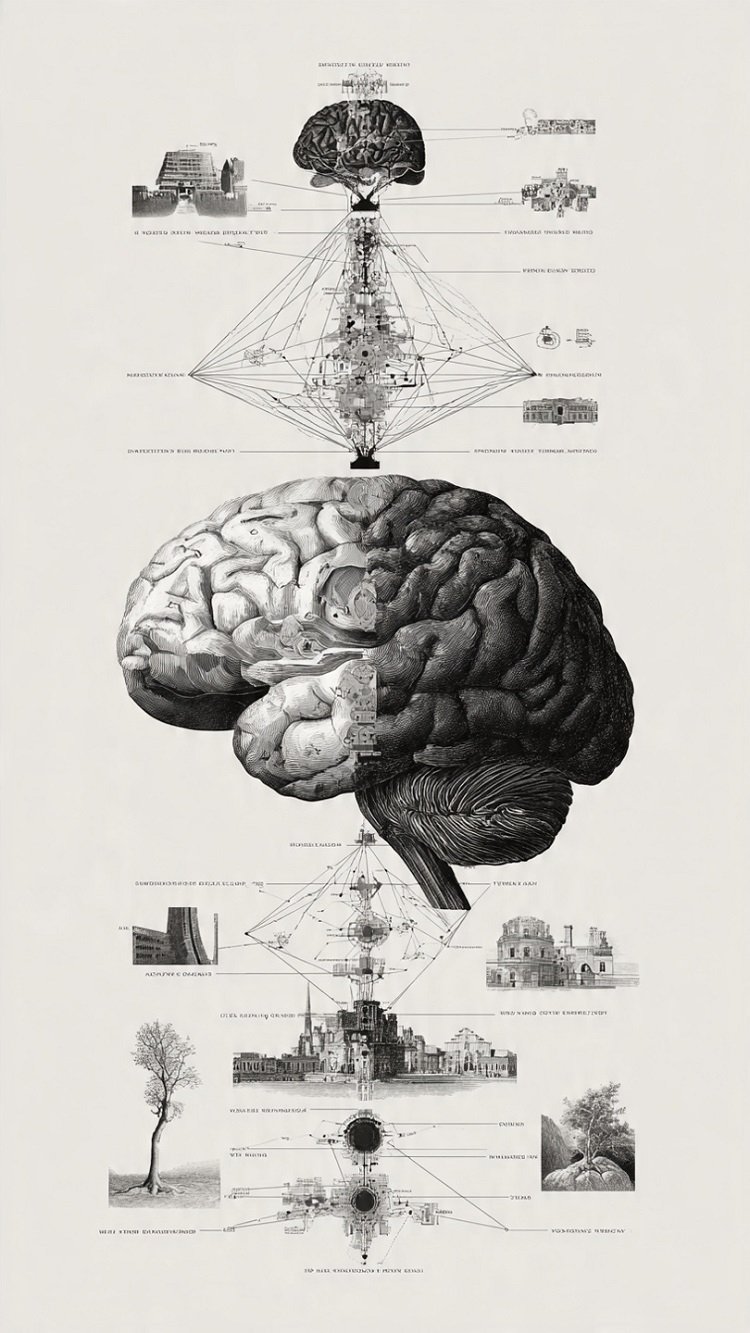
Human brain has been referred to as the most complex structure in the known universe. With almost 86 billion neurons, an infinite number of neural circuitries and highly elaborate communication systems in it, it coordinates the simplest survival activities to the most extreme human experiences. The coordinated activity of various parts of the brain is what brings about thought, memory, creativity, movement, emotion and decision-making. The knowledge about how these big structures operate gets us a bit nearer to the realisation of the incredible power of the brain, and how the processes that make human behaviour occurred.
This article examines the significant components of the brain the cerebrum, the cerebellum, and the brain stem and why these components have been interwoven to become a diverse arena of human thought and movement.
This article will attempt to, by debunking the mystery surrounding brain anatomy and linking structure to the functioning, demonstrate how, as well as why, these processes are so crucial to learning, decision-making, and emotional life of each human being.
The Architecture of the Human Brain
The brain is subdivided into three major parts:
- The Cerebrum: the largest reserve in dealing with higher thought.
- The Cerebellum: the organ of movement and equilibrium.
- The Brainstem: automatic and life sustaining functions controller.
These constructions compose a system. They interact at all times via neural pathways that transmit electrical and chemical messages within the body though the roles they executing are different. Knowing them individually would assist in making sense of how all our actions are governed by their joint action.
The Cerebrum: The Centre of Thought, Memory, and Consciousness
The cerebrum takes up 80 per cent of the total mass in the brain. When we think of a brain, we think of its wrinkling face on the cerebrum. These folds are known as gyri and sulci since they enlarge the surface area and enable more neurons to be contained in the skull which directly contributes to the high level of cognitive capabilities.
Structure of the Cerebrum
The cerebrum has been split into two portions left and right parts bonded by a thick band of fibres called corpus callosum. The hemispheres are also subdivided into four lobes each:
- Frontal Lobe
- Parietal Lobe
- Temporal Lobe
- Occipital Lobe
All the lobes perform distinct functions, yet they work in accordance to achieve harmonious perceptions, memories and actions.
Frontal Lobe: Executive Control and Making of Decision
There is the prefrontal cortex which is a part of the frontal lobe and is commonly referred to as the command centre of the brain. It deals with judgment, planning, reasoning and the control of impulses. This region is activated when individuals weigh alternatives, come up with objectives or consider the outcomes.
It also contains the primary motor cortex, which transmits a signal which results in voluntary movement. Without the frontal lobe, a person would not be able to intentional act, either speaking, walking or writing.
Parietal Lobe: Sensory Integration and Spatial Awareness
The parietal lobe perceives sensory information, including touch, temperature, and pressure as well as pain. It also assists in combining sensory perception and spatial knowledge. Your parietal lobe is busy when you have your eyes shut and do not know where your hand is.
This area is critical to activities that involve coordination of both visual perception and movement like in catching a ball or moving in a crowded room.
Temporal Lobe: Memory, Hearing, and Language
The hippocampus is located in the temporal lobe, which is the key to the formation of new memories and the recall of events. It also interprets auditory data and helps in understanding languages. Individuals whose brain has suffered damage on this region might have difficulties in comprehending speech or in holding new information.
Occipital Lobe: Vision and Visual Interpretation
The occipital lobe, which is found in the back part of the brain is devoted to vision. It processes the information that is sent to us through the eyes and enables us to identify shapes, colours, movement and objects. Without it the world will be meaningless to the eye, though the eyes might be in perfect condition.
How the Cerebrum Shapes Human Behavior
The cerebrum generates:
- Conscious thought
- Making of memories and recalling them.
- Emotional responses
- Logical thinking and decision making.
- Voluntary movement
It is a key factor in our human experience our capacity to learn, adapt, imagine and socialize with others. All the decisions, including what to eat have to work the complex networks of the cerebrum, and so do decisions on goals in life.
The Cerebellum: The Brain’s Master Coordinator
Though it is smaller than the cerebrum, the cerebellum is not any less important. It is situated at the back of the brain beneath the cerebral hemispheres having more neurons than the cerebrum even though it is very small.
Key Functions of the Cerebellum
The cerebellum performs the following functions:
- Fine-tuning movement
- Holding balance and position.
- Organizing voluntary behaviours.
- Supporting motor learning
The cerebellum is engaged when you ride a bicycle, play an instrument or acquire a new sport. It continuously matches the planned moves on the cerebrum with real performance and corrects the moves in real time.
That is why any damage to the cerebellum will create clumsiness, tremors, or inability to control fine motor tasks.
Motor Learning and Skill Development
The cerebellum is not simply a motor coordination centre; it assists in making the movement finer through the process of repetition. With time, things get easier and automatic to do. This is the way, that individuals learn complicated skills, such as typing fast, throwing a ball into the right spot, or dance a routine to perfection.
The cerebellum is also involved in other aspects of the human mind like attention, timing and emotion regulation and this also demonstrates its extensive impact on human behaviour.
The Brainstem: Life Sustaining Control Centre
The brainstem is located at the bottom of the brain and it connects the brain and the spinal cord. Small as it is, it controls the most vital human functions the ones that we cannot consider without a second thought.
Regions of the Brainstem
The brainstem includes:
- Midbrain
- Pons
- Medulla Oblongata
There are certain functions of each structure to control life-support systems.
Midbrain
Midbrain is involved in sensory reflexes, processing, visual processing, auditory processing and movement control. It allows automatic responses like the movement of the head to a sudden sound.
Pons
The pons bridges as a relay of signals between cerebrum and cerebellum. It controls breathing, sleep patterns and face sensations as well.
Medulla Oblongata
The medulla is the control centre of the essential functions such as:
- Heart rate
- Breathing
- Blood pressure
- Swallowing
- Digestion
Injuries in this region are life threatening as they interfere with the normal physiology.
The Brainstem’s Role In Behavior and Survival
Although the brainstem is not the part of the brain that regulates conscious thought, it forms the basis of existence itself. It ensures that the cerebrum and cerebellum are able to do higher-level tasks by maintaining internal balance and keeping the body functioning.
The absence of the brainstem would not be important as the movement, emotion, and memory would not be possible to continue.
Interaction and communication between the Brain and other parts
Despite the differences in the functions of the cerebrum, cerebellum, and brainstem, their functions are closely related.
Neural Pathways and Communication
The neurons interact by means of electrical impulses and chemical substances called neurotransmitters. Through these pathways information travels very fast through the brain, and thus co-ordinated action is executed.
- The cerebrum develops intentions (e.g. the decision to stand up).
- The movement (e.g., providing balance) is perfected by the cerebellum.
- The rise of the heart rate and breathing is controlled by the brainstem.
This uninterrupted communication forms adaptive behaviour that is smooth.
Emotion and Making of Decisions
The limbic system which is commonly regarded as a section of the cerebrum is very important in the fields of emotion and motivation. Brains such as the amygdala and the hippocampus connect emotion and memory, which influences behaviour and preferences.
There is no such thing as a pure logical decision. Interaction between the frontal lobe and the limbic system on reasoning and emotional assessment respectively affects decisions made on any daily basis, whether in personal or professional relationships.
The Brain’s Amazing Capabilities
The Plasticity of the Brain: Neuroplasticity
Neuroplasticity is one of the most impressive brain capacities, which is the capacity to restructure neural pathways in response to experience. This means:
- New skills help in strengthening some relationships.
- Memories are shaped out of recurrent patterns of activation.
- There are instances where brain regions can compensate after being damaged.
Neuroplasticity enables individuals to develop, evolve and heal in a manner that was never believed to be possible.
Memory Formation and Storage
The storage of memory is not centralized but dispersed on networks. The hippocampus and the prefrontal cortex, together with other areas, are all involved in the coordinated activity of short-term, long-term, emotional, and procedural memories.
Memory is resilient and complex due to this distribution.
Creativity and Imagination
Creative thinking is a result of the unforeseen workings of the brain. The brain creates new knowledge and inventions when connecting all irrelevant concepts or experiences. The brain is able to synthesize logic and imagination whether one is writing music, working on technology or everyday challenges, this leads to creativity.
Understanding the Brain to Understand Ourselves
The investigation of the brain shows the principles of what it means to be a human being. These two large sections of the brain combine to form perception, thinking, emotion, memory and movement. Through the knowledge of these systems we can learn:
- How learning occurs
- Why habits form
- What drives behaviour
- Influence of emotion in decisions.
- The way the brain evolves and matures.
With the ongoing development of neuroscience, the complex processes in the brain will be discovered and this will provide us with fresh insight into health, education, psychology and human potential.
Conclusion
The brain of man is a wonderful organ, a complex, but beautifully organized organ. The cerebrum manages thought and memory, the cerebellum helps to fine tune movement and coordination, and the brainstem is the part that keeps the body alive with the necessary automatic processes. We are able to think, feel, move, learn, and make meaningful decisions only through the collaboration of each of them, though their functions are different.
The understanding of the structure and the functionality of the major parts of the brain allows us to know ourselves better and appreciate the impressive biological machinery that brings any experience to life.