
Are you ready to take that exciting first step into homeownership but unsure where to start with financing? For many first-time buyers, navigating the world of home loans can feel overwhelming, especially with so many options all with different requirements and benefits. Understanding which financing choice aligns with your budget and goals is essential to setting a solid foundation for your new home journey.
In this blog, we’ll break down the most popular home financing options and share insights to help you make an informed, confident choice. Let’s dive into the essentials and get you closer to opening the door to your dream home!
Why Home Financing Matters?
Home financing makes owning a home easier because you pay for the house over time with manageable down payments and monthly installments. Each monthly payment will build equity, and ownership into that home. This is valuable later when getting a home equity loan for renovation purposes. Owning a home is one of the smartest investments and the value will surely grow over time. Home financing helps you gain financial stability and a secure place to call home, making it a step toward personal and financial security.
The Rise of Home Financing in Metropolitan Areas
As home prices rise nationwide, the demand for financing in urban areas like New York, Los Angeles, Austin, and Denver has surged, with young professionals and families increasingly seeking homeownership. However, high property values and varying loan terms make financing unique to each region.
In Idaho, cities like Boise and Caldwell also experience growing demand, with rising property costs challenging first-time buyers. Partnering with an idaho credit union caldwell allows residents access to competitive home equity loan rates and personalized options, providing vital support to help buyers achieve homeownership in a high-demand market.
Understanding Your Home Financing Goals
Setting financial goals is equivalent to aligning your budget with your long-term plans and embarking toward homeownership. Here’s how you can begin:
- Set Financial Priorities:
Define your budget, ideal monthly payments, and interest rates. According to the National Association of Realtors, a significant amount of first-time buyers, and for these people keeping costs affordable is the main priority. These priorities will help you select financing options that support financial stability.
- Check Your Credit Score:
Your credit score impacts loan eligibility, including the availability and interest rates. According to Experian, the average score for first-time buyers is around 700. Knowing your score and working on it, help you get better loan terms.
- Understand Down Payments:
First-time buyers often assume they need to bring 20% down to close on a home, but some loans, like FHA, require only 3.5%. Most first-time buyers finance their home with a mortgage.
- Focus on Long-Term Stability:
The Federal Housing Administration (FHA) recommends buyers focus on building equity and securing payments they can afford in the long term. Planning for financial stability helps you avoid strain because you make future payments.
Top Home Financing Options for First-Time Buyers
There are various types of loans for first-time buyers, each having different requirements and benefits. Below is a rundown of the best ones:
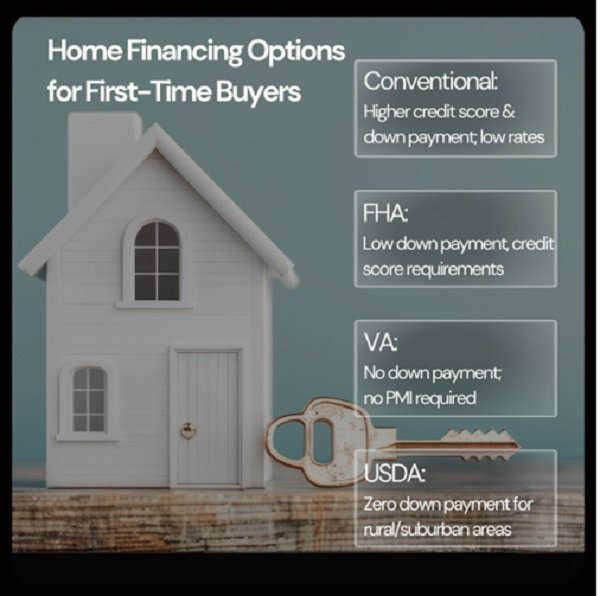
| Loan Type | Highlights | Best For | Equity Options |
| Conventional | Higher credit score & down payment; low rates | Buyers with good credit and stable income | Supports future home equity loans |
| FHA | Low down payment & credit score requirements | Buyers with a low initial cost | Allows access to home equity mortgages |
| VA | No down payment; no PMI required | Military personnel | Good for future home equity loans |
| USDA | Zero down payment for rural/suburban areas | Buyers in rural areas with low upfront costs | Access to home equity loan rates in rural areas |
- Conventional Loans
Conventional loans have a better credit score and more down payment but have competitive interest rates. They are suitable for buyers with a stable income and strong credit who can afford a larger upfront payment. As you pay down your loan and build home equity, these loans support home equity loan options in the future, allowing you to use your home’s value when needed.
- FHA Loans
The FHA loan is backed by the Federal Housing Administration. The qualification is easy because the down payments start at 3.5% and credit score requirements. It’s great for first-time buyers who wish to have an inexpensive start. Time allows you to build equity and exercise home equity mortgage options in FHA loans.
- VA Loans
Available to eligible veterans and military members, VA loans require no down payment or private mortgage insurance (PMI), making them an affordable option. VA loans are perfect for military personnel and support the best home equity loans as you build value in your home, offering future flexibility.
- USDA Loans
USDA loans are made for rural and suburban buyers, offering a zero-down payment option and competitive interest rates. It is ideal for buyers in rural Idaho and avoids high upfront costs while offering access to home equity loan rates as you build value in your property.
Exploring Local and State-Run Assistance Programs
Many state and local housing agencies have programs that assist with the financial burden of purchasing a home for a first-time homebuyer. Many states, such as California and New York, offer first-time buyer assistance programs. It’s worth checking with your state or local housing authority to see what support is available in your area.
The California-based CalHFA and the Texas Department of Housing offer specific assistance for income-eligible buyers. Buyers must qualify under such requirements as income limits, location criteria of the property, and completion of a homebuyer education program.
The down payment assistance program also lowers the cost of homeownership because some of the up-front costs are covered. For instance, the New York State of Opportunity offers down payment and closing cost assistance to eligible buyers, enabling home equity building with lower initial investment. These are suitable for limited-fund buyers who seek to start owning a home without any up-front costs.
How to Choose the Right Home Financing Option?
Compare the following for each loan to fit your budget, monthly payments, and plans:
- Loan Costs and Terms:
Compare APR (annual percentage rate), loan term length, and monthly payments. A lower APR will reduce total loan costs while shorter terms have higher monthly payments but less overall interest. Longer terms lower monthly costs but increase total interest.
- Adjustable vs. Fixed-Rate Mortgages:
An adjustable-rate mortgage (ARM) has a low rate at the start, which increases with time and is most suitable for short-term ownership plans. A fixed-rate mortgage pays the same each month with no variation. It is best suited for a long-term predictable cost plan.
- Future Flexibility:
Look for refinancing or home equity loan options sometime down the road. Of these, those that allow refinancing or building equity create an opportunity for future flexibility as you can adjust your house value or borrow based on need.
Preparing for the Loan Application Process
To make the loan application process easier, start gathering all the required documentation and move ahead with the steps below in a quite smooth manner.
- Gather Financial Documentation: It comprises bringing critical papers such as W-2, tax returns, income proofs, and credit reports. Once all these are well prepared in hand, things go smoothly, and the application becomes robust.
- Pre-Approval Tips: Get pre-approval early as it increases your buying power and assures you the readiness to show potential sellers. It thereby improves your status and increases your chances of having a clear approach toward becoming a homeowner.
FAQs
- What credit score is required for first-time homebuyer loans?
While the requirements for credit scores differ from loan to loan, an FHA loan can sometimes be had with a score as low as 580. Conventional loans require at least a 620.
- How much should I save for a down payment as a first-time buyer?
A down payment varies between 3.5% to 20%, depending on the type of loan. The lowest down payment for FHA loans is 3.5%. It is usually 10-20% for conventional loans.
- Are there financing options specifically for low-income buyers?
Yes, USDA loans and several state-specific programs are tailored for low-earning buyers, especially in areas eligible for rural regions.