Cassava cultivation is one of the most sustainable and resilient farming practices among small farmers, being highly adaptable and demand-driven for a variety of reasons. It is a vegetable crop that is grown and eaten in numerous homes across Africa, and therefore there are regular income opportunities even for the poorest and smallest of farmers with limited resources. Anyone wanting to start their own cassava production needs to be aware of the basic knowledge of how cassavas are produced as this will enable them to ensure they get a profitable business in the future. If properly planned, it is possible to grow cassava without heavy machinery; also without large farm land and with less costly inputs. The aim of this guide is to examine practical ways of launching into cassava farming successfully, yet maintaining good yields and profitability, even for the nascent farmers with low capital.
If one wants to take the step to a more solid knowledge of the cassava production, it is important to know that cassava is very punctilious but very responsive to good agronomic practices. Cultivating the right set of varieties, preparing stems properly, and maximising each and every square foot of land will still help “farmers” produce pouchfuls of impressive results even with limited area available for planting. While cassava farming is a budget-friendly option, this article delves into some forward-thinking and effective methods for cultivating cassava without breaking the bank, even as it minimizes costs and boosts productivity to deliver sustainable harvests from fresh tubers and processed goods, such as garri and flour.
- Selection of Suitable Land
Expertise in choosing the right land is the main and important basis of successful cassava production, particularly for those with limited funds. Cassava does not respond well to very fertile soils, but grows best in a well drained sandy loam soil that does not become water-logged. Small farm land owned but not used, fallow or leased from farmers with good intentions can serve as a starting point for low budget farmers. The important part is not to soil giving too much compaction and to leave it untouched for a while so that it can regenerate natural nutrients. Soil indices of low swampiness and clay content lead to avoidance of special soil disposition techniques which are expensive.
Also, the short distance to home or local markets should be taken into account because it helps to minimize transportation costs and labor costs. In addition, new growers need to evaluate the soil on their own by measuring the flow-through and gauge root growth after rain with easily SOURCED tools such as sticks or cutlasses. The proper selection of land decreases the future expenses on the maintenance of the land, fertilization, irrigation, and pest control. One of the key initial decisions in low input cassava production is whether the farm will require significant investment in the future or can continue to operate with low inputs, as this will determine whether a heavy investment is required later or not.
- Make use of better quality TMS cassava
Planting of improved high yielding varieties (such as TMS (Tropical Manihot Species) is one of the smartest steps that can be taken to produce best cassava farming even with limited investment). These varieties are scientifically developed against disease such as cassava mosaic virus and larger tuber size than the local varieties. This means greater yield from a smaller acreage of land for small farmers, avoiding expansion or excessive capital investment. Improved varieties also ripen earlier, usually in 9-12 months, thus enabling farmers to make up their investment faster.
Although it is important to obtain good planting materials, nearby agricultural extension centres or reliable farmers may also be used. Better stems will cost a little bit more but will save much from loss due to pests and diseases. This allows them to save money in the long run. Unhealthy or mixed varieties should not be planted by farmers as it can decrease yield and market value. Beginners, who wish to see harvest gains for all their efforts and small investments, can ensure this by adopting good planting materials.
- Proper Stem Cutting and Treatment
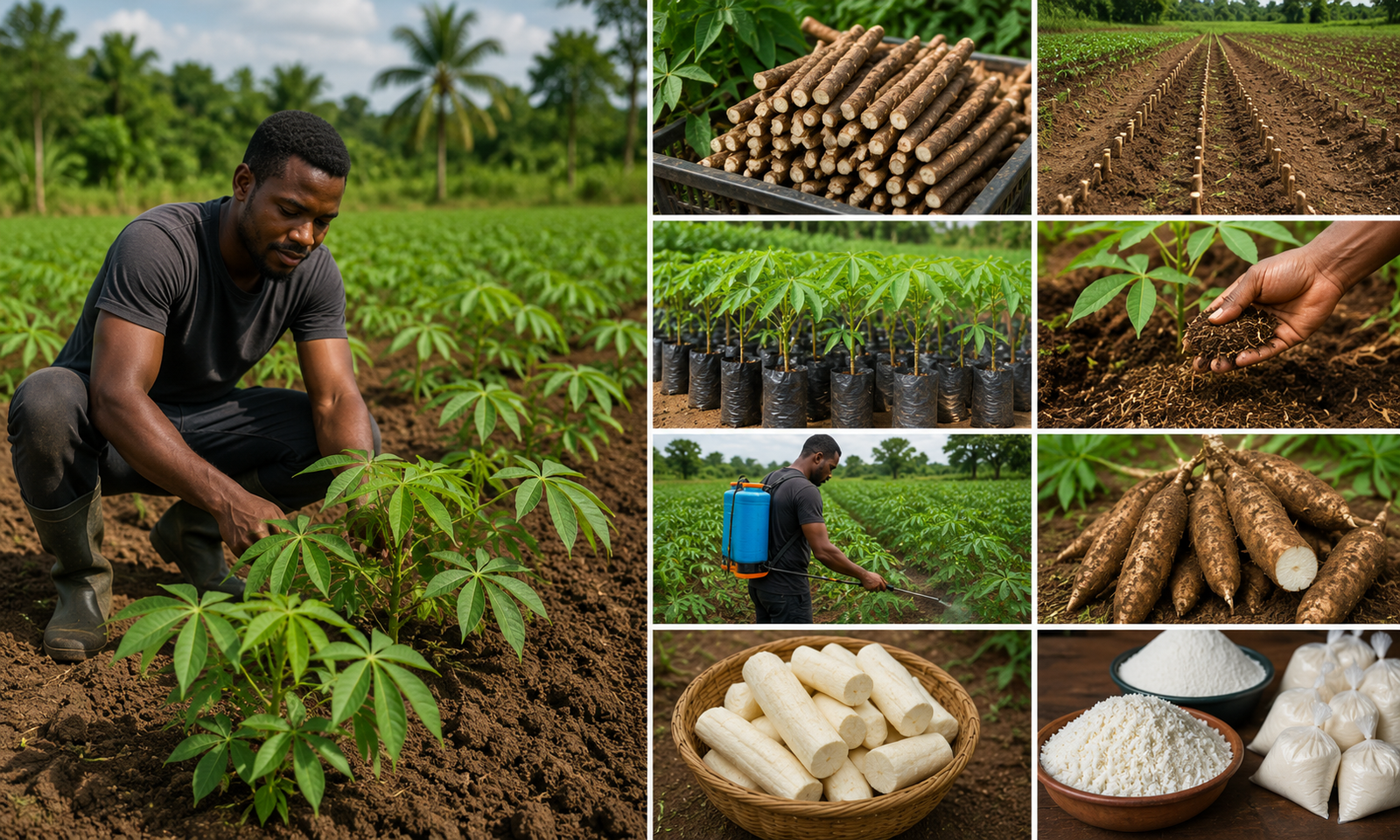
Preparing stem cutting is very critical in cultivating cassava at a relatively low cost. Stems which are healthy should be separated into sections of approximately 20-25 cm each; with each section containing at least 5-7 nodes. The importance of these nodes is that roots and shoots grow in them. For beginners, it is important to buy well-established (mature), stable stems from disease-free, healthy mother plants. Refuse to use damaged or very young stems which can germinate poorly or make low crop yields.
Stem cuttings benefit from simple organic and mild chemical treatment prior to planting to minimize soil-borne pathogens and pests. To increase cutting survival, some farmers dip the cuttings for a short time in wood ash solution or allow fungicides. This process is not equipment dependent and improves establishment success greatly. Suitable transport and storage are also essential, to avoid drying out or damage. Proper stem treatment reduces the chance of replanting, which due to proper and proper stem care will save both cost and time for the farmers and will ensure uniformity and productivity on their cassava farm.
- Plan out a proper plant spacing
Spacing is one of the main requirements in the cultivation of cassava and more particularly this is important for farmers who cannot wait to have a large size of land. Good spacing of the plants allows sufficient nutrients, sunlight and space for large tubers. The commonly recommended spacing for cassava is 1 x 1 meter, however, the spacing can be slightly modified based on soil fertility and the nature of the intercropping on a test plot by the beginners. Keeping it spaced ensures that no overcrowding occurs and animals compete with each other which lowers the yield.
In the case of low capital farmers, the advantage of efficiency of spacing is that the farmer is able to get the maximum number of productive plants in the same piece of land. This also allows for improved farm management, such as weed pulling and harvesting. Another alternative to reducing the extent of land is for farmers to consider optimizing their plant density, thereby boosting output per hectare. Worse spacing, however, results in reduced land values and disease transmission opportunities. Using basic measurement tools such as ropes or sticks, landowners can measure planting buffers accurately, increasing the farm’s overall efficiency and productivity without having to use extra equipment.
- Plan out adequate methods of controlling weeds
Weed control is one of the greatest difficulties encountered in cassava farming and need not be costly. Manual weeding techniques like hoeing and cutlassing are still the most cost-effective for small-scale farmers. Weeding is generally carried out first 3-4 weeks after planting and, depending on weed growth, on a regular basis of 6-8 weeks. Regular care prevents competition for nutrition and promotes good growth of cassava.
A second low cost approach to mulching involves weeding occurring while at the same time preventing the loss of soil moisture. The dried leaves, grass or crop residues can be used as ground cover over the soil surface. This helps control weeds and enhances soil quality with time. Managing herbicides at sensitive levels lowers costs and environmental footprint. Using manual work to control weeds, farmers can keep a clean farm and avoid heavy chemical and equipment costs to cultivate cassava, making cassava farming more sustainable and affordable.
- Integrating Cassava with Maize to generate more income.
Rotating crops is a good plan to profitably utilize limited land area. Maize is suitable and promising intercrop with cassava as it can also be grown at the beginning when cassava has not yet spread. Maize grows rapidly with harvest coming within a few months, thus giving farmers another source of income during the wait for cassava to mature. That system will ease the pain of farmers waiting a maximum of a year for the harvest of cassava.
Both crops must be spaced out and have different planting and harvest schedules to prevent competition. It is recommended to shorten the planting time of maize to balance the crops to plant shortly after cassava. Intercropping is also more productive in land utilization efficiency and affords ground cover which helps to control weed growth. Moreover, it provides a measure of diversification of risk, in that if one type doesn’t do well, the other might. It is one of the best strategies in cassava production, for those who have less capital, and without the need for other land or input such as fertilizers and other supplies.
- Get information on easy Processing Methods of Garri and Cassava Flour
Cassava value prior addition is applied which can be a powerful addition that will increase the profits gained from cassava farming. Rather than being sold as raw tubers, farmers can process their cassava and sell it as products such as garri and flour which have higher market value and have a longer shelf life. Simple processing does not require an industrial machine, a simple machine like graters, sacks, presses or frying pans can be used on a small scale. This makes it accessible even when there is a lack of funds from farmers.
In the garri processing, cassava has to be peeled, washed, grated, fermented, dewatered, sieved and fried. However, cassava flour needs to be dried and milled. These processes can be carried out step by step, enabling farmers to take a baby step and pursue further expansion, as soon as profits are realized. Value added products also provide opportunities to get into broader markets like bakeries, restaurants and retail shops. The production of the cassava is a very good approach to sustainable growth because it processes the cassava and thus helps the farmers to earn more as compared to selling the raw tubers, which help to minimize loss after harvesting.
- Use of low cost tools and gradual expansion strategy
To start farming cassava with little capital, does not need to buy expensive machinery, but simply clever using small equipment. A small cassava farm can be managed efficiently by using simple farming tools like hoes, cutlasses, wheelbarrows, and locally made sacks to hold cassava. Before the consideration of mechanization farmers should narrow their attention to mastering the manual techniques. This helps to ease the financial strain and enables slow learning and adaptation for farming conditions.
Another important factor for sustainability is the gradual expansion. Rather than “chasing” the big profits, farmers should allocate the profits generated from the harvests over the season into the additional land being purchased, more inputs being used, or upgraded processing equipment. They take action very slowly and will take time to make a successful profit. In this way, many cassava farmers began with small plots of only a few plants and gradually expanded their cassava production. If one has a proper scheme of expanding the business and a set of inexpensive equipment, then even a beginner can create a profitable business of cassava farming without overburdening him financially.
Conclusion
There is no need to invest huge capital or advanced equipments when venturing into cassava farming. A successful farming enterprise on small parcels of land, within access to better farming techniques, varieties and land, can be accomplished by all farmers even those with minimal landholding if they organise their fields efficiently.
Starts by emphasizing marketable cropping plans to be implemented using smart land selection, appropriate spacing, better stem cutting, diversification, and simple processing, which would allow minimising the risk while maximising the returns to be gained by the operators. Cassava continues to be a very reliable staple crop for local market demand and food processing potential.
If well managed and done with continuous effort, cassava cultivation can be a permanent source of smallholder farmers’ income and long-term food security.