Have you ever considered how plants make their food and survive on their own? The answer is simple: just like every living being, plants also depend on the world around them. However, they don’t move and hunt like animals; instead, they produce their own food when the environment supports them.
The place where plants grow, where they get light, water, temperature, and even soil, all these factors shape their life and growth. The air we exhale is useful to plants, and the oxygen they release is essential to us. It’s the beautiful cycle where both sides keep each other alive.
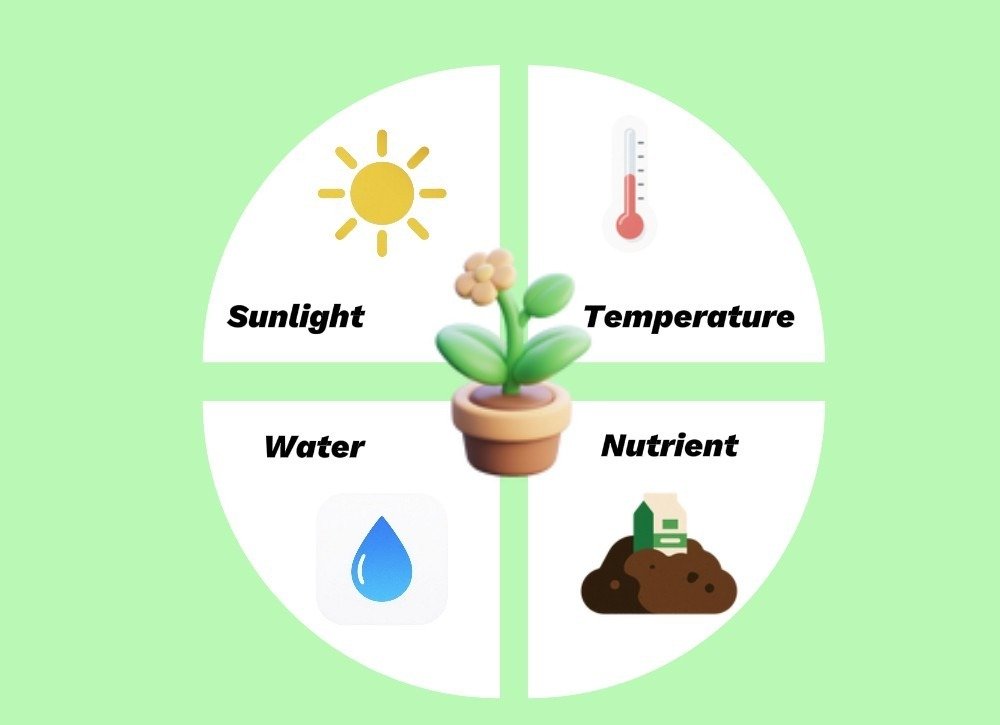
In this cycle, four environmental conditions become the foundation of plant life. By understanding these conditions, we can better support the plants and help them grow stronger and healthier. But what are the four environmental conditions needed for plant growth, and how do they play a significant role in photosynthesis and the respiration process? This is exactly what we will learn in this content!
How Do Plants Grow Every Day? The Role of Photosynthesis and Respiration
It is true that every single leaf you see growing is connected to the environment around it. But these environmental factors don’t produce food directly. Instead, there are two processes operating inside the plant: photosynthesis and respiration. Here’s where natural magic happens.
Both of these processes (photosynthesis and respiration) are deeply influenced by four essential environmental conditions, including sunlight, temperature, water, and nutrients. All these factors play a crucial role in the efficiency of photosynthesis and respiration.
When these conditions are favorable, the plant can produce enough energy through photosynthesis and use it effectively through respiration, which directly supports its growth. You can understand like;
Photosynthesis: The process by which plant prepare their food
Respiration: The process by which a plant uses the food to live, grow, and thrive.
Day and Night Processes in Plants: Photosynthesis vs. Respiration
Photosynthesis occurs during the day, when sunlight is available. But there is still a need for water, the right temperature, and nutrients, because all these work together. As a result, plants produce food and release oxygen.
On the other hand, respiration happens day and night, and its rate doesn’t change. During the day, photosynthesis is active, so the plant produces a lot of oxygen, which is why oxygen is released faster than carbon dioxide.
At night, when there is no sunlight, photosynthesis stops, so only carbon dioxide is released as the plant continues respiration using stored energy. It clearly shows that photosynthesis depends directly on sunlight, while respiration depends on the food already produced and occurs continuously.
What are the 4 Environmental Conditions Needed for Plant Growth?
Sunlight, temperature, water, and nutrients are the four environmental conditions needed for plant growth. These environmental factors directly influence both photosynthesis and respiration. During photosynthesis, all four conditions provide the foundation for plants to produce food. In contrast, respiration depends on the food created through photosynthesis. It means that photosynthesis itself is necessary for respiration.
By the way, several other environmental factors can influence plant growth, such as mountains, snow, wind, and air pressure. However, these factors do not directly control the plant’s internal processes for making food and using energy.
The following four main conditions, from sunlight to nutrients, are the only ones that consistently affect both photosynthesis and respiration. That’s exactly what makes them essential for every plant’s growth and survival.
1) Sunlight As A Primary Energy Source, Especially for Photosynthesis
Sunlight plays a central role in photosynthesis, and without it, the process cannot occur. Plants use a green pigment called chlorophyll to capture light energy. This captured energy is then used to convert water and carbon dioxide into glucose (the plant’s food) and oxygen. The rate of photosynthesis is directly influenced by light intensity.
- Bright light: The brighter the light (up to an optimal level), the faster the plant can produce food.
- Low light or darkness: In dim light, photosynthesis slows; in complete darkness, it stops entirely.
The more hours of sunlight a plant receives, the more food it can produce each day. This is why plants grow faster during summer when days are longer and sunlight is stronger.
Since respiration continues day and night, it uses stored glucose and oxygen inside. So, sunlight indirectly supports respiration. When sunlight increases, temperature also rises, which slightly speeds up photosynthesis, helping glucose production. As a result, it becomes the fuel for respiration.
2) Temperature Controls the Speed of Chemical Reactions
As we have already discussed, sunlight is the energy source for both photosynthesis and respiration. The role of temperature is the speed of these chemical reactions.
Both chemical reactions, photosynthesis and respiration, are catalyzed by enzymes. And temperature affects these enzymes. It means that any change in temperature alters the speed of these enzymes, thereby affecting the plant’s growth.
Every plant species has its own optimal temperature range in which it performs best. Since photosynthesis is an enzymatic process, temperature directly affects how quickly or slowly the plant can make food.
- Within an optimal temperature range, an increase in temperature increases the rate of photosynthesis.
- Very low temperature slows down enzyme activity and can stop the process altogether.
- Extremely high temperatures (around 40–45°C) can damage or denature enzymes, leading to a sharp drop in photosynthesis.
Light and Temperature Connection and Their Effect on Respiration
Stronger sunlight means higher temperatures, which indirectly affects the photosynthetic rate. Respiration, which also depends entirely on enzymes, is highly sensitive to temperature. As the temperature rises, the rate of respiration increases, often more quickly than photosynthesis.
It creates an energy imbalance: the plant begins to use food faster than it can produce it. When respiration becomes too high and photosynthesis cannot keep up, the plant’s growth slows down and may even reverse.
Why does the Same Plant not Grow Everywhere? (Temperature Varies Across Regions)
Each plant has its own specific temperature preference because different plants thrive in different temperature ranges. And, obviously, this temperature varies across regions; some areas are very hot, such as Florida and Texas, while others are extremely cold, such as Alaska.
This is why the same plant can not grow everywhere, and not all plants grow in the same location. The plant’s overall growth depends heavily on environmental conditions. It clearly shows that gardening tips should be tailored to the regional climate.
3) Water as a Chemical Component and Regulator in Photosynthesis
Water has two main roles in photosynthesis. It is one of the two main raw materials plants need, along with carbon dioxide. Plants use water (H₂O) in chemical reactions to make glucose (food) and oxygen. Water also helps control tiny pores on leaves called stomata.
When the plant has enough water, these pores remain open, allowing carbon dioxide from the air to enter for photosynthesis. When water is limited, the plant closes its stomata to conserve water. It stops carbon dioxide from entering and slows down or stops photosynthesis.
In respiration, water does not directly participate in the chemical reactions, but it plays a crucial role in many ways. Water provides a medium for reactions to occur within cells. It also helps move glucose (food) and oxygen to the cells where respiration happens, and carries waste products like carbon dioxide out of the cells.
Does water play a role alone in Plant Growth?
No, water does not play a single role. Plant growth is a complex process in which all environmental factors work together:
Water + Sunlight → Especially these two environmental conditions work together in the photosynthetic process.
- Light and Water: As light intensity increases, the plant uses (or loses) water more quickly. Therefore, more water is needed in bright sunlight.
- Temperature and Water: In hot temperatures, water evaporates more quickly (from the plant and the soil), so the need for water increases.
But wait! Don’t stop here; there is still one more environmental condition needed for plant growth.
3) Nutrient is a Power Behind Plant Photosynthesis and Respiration
Nutrients are the chemical elements needed for plant growth. In simple words, nutrients are a part of food that plants get from the soil. However, they are not directly part of photosynthesis and respiration, but they help build the “machinery” (enzymes and structures) needed for them.
Plants need 18 essential nutrients for proper growth. These nutrients are helpful for plant structure and enzyme formation. Soil is the biggest and most important source of nutrients. Plants absorb nutrients through their roots in a dissolved form.
Additionally, gardeners and farmers add extra nutrients through natural or artificial fertilizers, such as urea, DAP, or organic manure. The nutrients needed for plant growth can be divided into two main groups;
- Macronutrients: Needed in large amounts (Nitrogen, Phosphorus, Potassium, Sulfur, Calcium, Magnesium)
- Micronutrients: Needed in small amounts (Iron, Manganese, Zinc, Boron, Copper, etc.)
The role of nutrients in photosynthesis.
- Chlorophyll formation: Nitrogen and magnesium are essential to build chlorophyll. Without chlorophyll, a plant cannot absorb light, so photosynthesis decreases.
- Enzyme formation: Many micronutrients (like iron and manganese) are needed for enzymes that carry out photosynthesis.
- Structure support: Nutrients like calcium strengthen cell walls, helping leaves maintain structure for proper light absorption.
Respiration produces ATP with the help of phosphorus, which makes and stores ATP (energy). Potassium, magnesium, and other nutrients activate the enzymes used during respiration.
How do Environmental Conditions Needed for Plant Growth Operate Together?
Plant growth is an integrated system where these four factors (light, water, temperature, and nutrients) work together to form a complete cycle. As water and nutrients move up through the roots, light triggers photosynthesis, and temperature controls its rate, the plant continues to grow by gaining energy through respiration.
All of these processes occur repeatedly every day: photosynthesis during the day, respiration during the day and night. If any one of these four elements is weakened, the entire cycle is affected and the plant’s growth may slow or stop.