Tackling the WAEC, NECO and JAMB exam in a short period of time is stressful when students do not know how to organize their reading in a structured and an effective manner. But, getting good grades on these exams isn’t just about studying. It’s about management and strategic planning of studying time – and about studying the high-yield topics. This article provides a clear and practical 30-day study timetable guide to revision that helps candidates to make best use of the time. It brings a system that focuses on revision, practice tests and subjects prioritizing to enhance performance in exam situations. If you are in need of a more thorough planning guide, a detailed 30-day study planner can help you determine how to schedule study time efficiently and how to prevent last minute chaos.
The Significance of a Structured 30-Day Revision Strategy
It is extremely critical that there is a structured 30-day revision strategy, as it turns random reading into meaningful learning. A common problem of a lot of students awaiting the WAEC, NECO and JAMB exams is that they often read out of order without focusing on the topics that they think will be difficult or frequently appear in the exams. This results in time wasters and inadequate retention. Having a structure helps students determine what important topics are in the video, divide it into parts, and set aside particular days to revise and practise. It also helps with anxiety because it will make it easier to follow a certain routine when exams are close at hand. Students should be encouraged to learn the key concepts, to practise past papers and to work on the areas that they are not as strong in as systematically as possible, rather than trying to go through everything all at once. This way pupils will develop confidence and revision will be deep and effective, enabling them to remember, and use, the information correctly in exams.
The 30-Day Study Framework
The study framework is broken down into 4 clearly defined phases for 30 days to build knowledge, reinforce understanding and strengthen exam readiness. The first phase is on content revision and students will revisit all the key concepts of each content area in Mathematics, English, Biology, Physics, Chemistry, Government, and Economics. During the second phase, the students are put into practice and application mode, and start solving previous year’s papers under timed conditions. The third phase is targeted improvement that targets weak areas revealed in practice tests. The last stage is revision and mock tests to develop speed, accuracy and confidence. A structured analysis helps the student not get lost, but learn at his own pace and from learning to mastery. It also ensures that no important topic is left out and also provides enough time for the repetition which is important for long term memory before WAEC, NECO and JAMB exams.
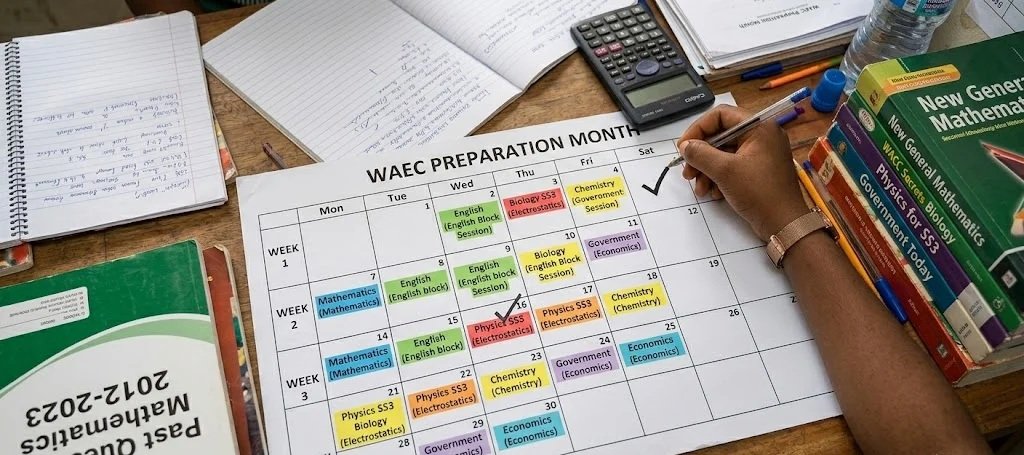
Week 1: Laying the Groundwork and Completing Subject Coverage
The first week of the 30 day study plan concentrates on developing a solid academic foundation and all key topics across selected subjects are reviewed again. Students should try to read two major subjects each day during this time, and to master important definitions, formulas, and concepts, but not to memorize material. Every day subjects such as Mathematics and English should be high-priority subjects as they are the essential parts of all three exams. Students should also start to take notes of summary which will help them in revision phases later on. This week isn’t about speed, it is about clarity and comprehension – so that students can re-build their understanding of previously taught units. Also, it will be beneficial to start light practice at the end of each study session to reinforce learning. At the end of Week 1 students should have run through most of the syllabus broadly and should have identified a few areas of the syllabus which need to be explored further in the remaining weeks.
Week 2: Practice and Application
Week 2 focuses on applying knowledge and not just on passive reading and includes consistent practice of past examination questions. Students should start practicing their WAEC, NECO, and JAMB past questions with time limits at this stage to build speed and accuracy. This will give the students an understanding of the pattern of exams, common questions and paper marking. Care should be taken in the rotation of subjects in order to prevent the subject from getting burnt out and giving science as well as arts subjects equal importance. Pupils should also start to look at their mistakes from their practice and practice sessions and correct them off the spot to prevent repetition. This week will be important as it will put students under genuine pressure and will enable them to learn problem-solving skills. Learners have now been able to apply what they have learnt rather than just read notes and this is making a difference to retention. At the end of Week 2, students should feel more at ease with exam-style questions and feel more confident in doing so under time constraints.
Week 3: Improvement in Weak Areas and Targeted Revision
The third week of the study plan will focus on targeting and building weak points that were found in previous practice sessions. This is a point at which students should be acquainted with the majority of the topics by heart, and not just memorize them, but rather master them. Every pupil reviews previous questions to see what subjects/topic he/she has lost marks on regularly. These areas should be targeted when they are identified and then spent extra time practicing and ensuring they are revised each day with intensive practice. This could include re-reading books or texts, watching educational explanations, or more practice questions. Individuals should also be encouraged to keep on testing in mixed subjects so as to achieve balanced preparation. This week’s aim is to remove any repeated errors and develop accuracy in all subjects. At the end of Week 3, students should be more confident in their understanding, and should be able to answer a greater number of questions without confusion and hesitation.
Week 4: Last Revision and Exam Simulation
The last week of the 30-day study plan will be dedicated to complete revision and examination simulation. At this point students should not be introduced to new topics but should be re-learning and reinforcing the material they’ve been learning these last three weeks. Past copies of WAEC, NECO and JAMB papers must be used for daily mock exams under time constraint to simulate real exams. This will help them become faster, less anxious at exams and help provide endurance for long exams. Students should go through their answers of each mock test, and check for any errors. It also is important to “edit” summary notes, formulas and key concepts as often as possible to improve retention. This week will be busy but well organized so that the students will stay focused but not overloaded. Candidates should be completely ready, confident and mentally equipped by the end of Week 4 to take their examinations with clearness and discipline.

Daily Study Routine for Maximum Productivity
It is crucial to have a well-planned study schedule for the 30-day revision period. Students should start early in the day with a brief review session to remember what they have learned and then cover new topics. Hard subjects like Maths or Physics should be in the morning hours as the mind is fresh and alert. Following a break, pupils may move on to theoretical-based subjects, such as Government or Literature or Biology. Evening sessions should be used to revise the points made and to summarise key points learned during the day, whilst afternoon sessions should be used for practice questions and past papers. Also, it is essential to take short breaks between each study session to avoid fatigue and focus. Consistency is more important than length of time spent in irregular studying and students should make it a habit of studying this way daily throughout the 30 days for optimal performance in WAEC, NECO and JAMB exams.
To Summarize: Remain Consistent and Focused Until Exam Day
Achieving success in WAEC, NECO and JAMB in 30 days is possible with a disciplined and structured method of study. The important thing to remember is not to panic, or try to tackle everything at once, but build understanding, practice and confidence slowly within a clear plan. Students can benefit greatly from breaking the month into manageable parts, writing on their weaknesses and revisiting old exams. In the exams discipline, consistency and clever revision skills are the key to success. When exams are drawing near, it’s as crucial to have a positive frame of mind and believe in the preparation process as it is to study. By working hard and following proper examination strategy, students are ready to sit the examination and are confident that they can do well.