By Mir Naqibul Islam
I didn’t plan to start school.
For most of my life, I identified primarily as a performer. Teaching happened naturally, one student at a time. But something shifted when a small group of students began showing up consistently, deeply committed. I realized I was repeating the same foundations privately while students felt unsure of their progress and disconnected from one another.
When I introduced group classes, everything changed.
Students learned faster. They listened more carefully. They felt accountable not just to me, but to each other. No one felt left behind. That was the moment NYC Tabla began taking shape—not just as a tabla program, but as a platform for meaningful rhythm training for musicians.
My training comes from a long lineage, starting when I was seven, through formal education in Bangladesh, and under my gurus in the Farrukhabad tradition. But living in New York reshaped me. I had to learn Western notation, understand jazz form, play in odd meters, and find ways for tabla to coexist with instruments like duff, drum set, or chamber ensembles.
NYC Tabla reflects that reality.
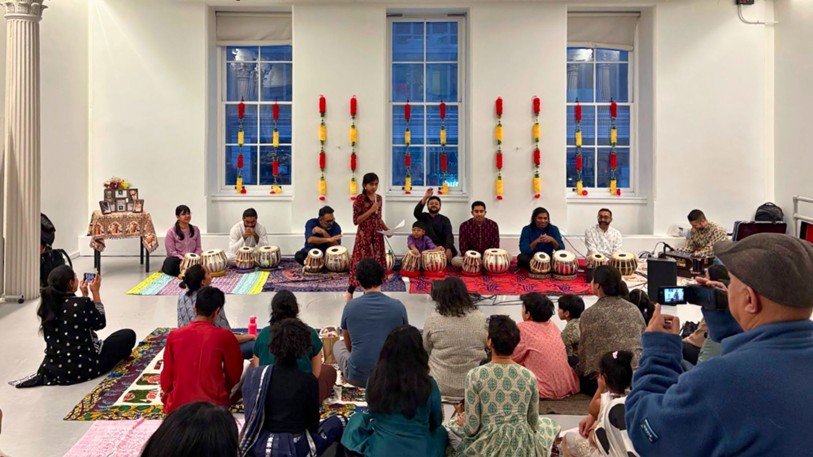
We focus on performance, not abstract ideas. We prioritize community over isolation. We bring students together across boroughs, ages, and instruments. Our recitals are not showcases of perfection, but celebrations of progress.
We are growing slowly, intentionally. We are building curriculum, improving our online learning quality, and developing rhythm programs for musicians who may never touch a tabla but want to understand rhythm deeply.
Spring 2026 registration is now open, and the next phase of this journey is already taking shape. NYC Tabla is my way of giving structure to something that should never feel lonely: learning music.
More information is available at www.nyctabla.com, and updates can be found on Instagram at @nyctabla.
INTERVIEW
Interview: Mir Naqibul Islam on NYC Tabla and the Future of Rhythm
Q: What is NYC Tabla?
NYC Tabla is a rhythm and tabla school built around group learning, performance, and community. While rooted in Hindustani rhythm education, our approach serves broader rhythm training for musicians across genres. We operate across Brooklyn, Manhattan, Long Island, and Westchester, with everyone coming together weekly online.
Q: What inspired you to start it?
I noticed students learning in isolation. Group learning created motivation, clarity, and accountability. Once that worked, formalizing the school felt natural.
Q: How does your background shape the school?
I come from the Farrukhabad lineage and have studied under my gurus for decades. At the same time, living in New York forced me to adapt tabla to many musical contexts. NYC Tabla lives at that intersection.
Q: What makes NYC Tabla different from traditional models?
Performance is central. Students perform what they learn, regularly. We don’t over-intellectualize. We play.
Q: Why is community so important?
Music doesn’t grow in isolation. Our recitals are collaborative and community-funded. Students meet their peers, their guru-bhais and guru-bons, and musicians from other traditions.
Q: What is your vision for NYC Tabla?
Slow, intentional growth. Strong rhythm thinkers. Expanding rhythm education beyond tabla players. Spring 2026 registration is currently open, and we’re focused on strengthening the learning experience rather than scaling too fast.
Q: Where can people learn more?
All information is available at www.nyctabla.com, and we share ongoing updates and performances on Instagram at @nyctabla.