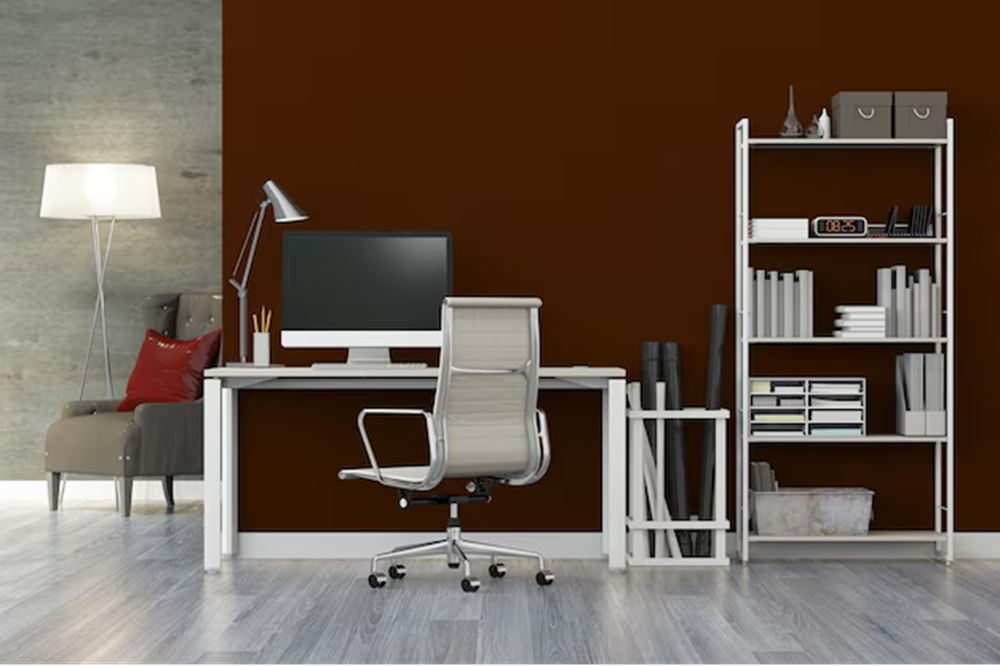
Walk into any corporate office and regardless of the company, the walls speak up, whether they want them to or not. Those framed bridge prints. That cute rock formation near the office bathroom. The sans serif fonts for motivational sayings. The same abstract paintings that could adorn any office, anywhere. They’re all saying something. Usually, they’re saying, “We didn’t put much effort into this,” or, “We opted for the cheapest filler.”
But people look. Employees look. Clients look. Therefore, what is around the employees gives signals about company ethos, attention to detail, appreciation for its own identity or lack thereof and whether it values itself like every other business or it something more personal and intentional. Yet companies skip over this all day, every day, spending thousands on office decor with furniture but paying little regard to the potential for what exists on the walls.
The Generic Office
There’s a one-size-fits-all approach to professional decor. Neutral colored walls potentially accented by a surprising color for somebody daring enough. Mass produced artwork of business-casual cityscapes and nature-related prints in washed out hues. A massive selection of options boasts best sellers in itemized categories, millions of businesses in need of the same uninspired office space went the risk-averse route. Who doesn’t love a newly painted wall as opposed to an unattractive hole? Or a larger-than-life company mission statement? Appeal to the masses to make things easier on everyone.
It’s understandable. Nobody wants to offend. Nobody wants to walk the line of interpretation and have more symbolic than realistic products come back to haunt them. But at what cost? Offices with uninspired details confirm loyalties do not run deep. Offices with uninspired details tell the world that this company thinks the same as other companies, has no real vision or creativity.
People spend hours, literally, every day in these offices. Therefore if they assume that the companies believes in temporary environments without intrigue or earnestness, that reflects poorly on motivation, morale and productivity.
Thus, how people feel about their offices is reflective of how they feel about their company if their company doesn’t even bother creating a space for employees to enjoy.
What Thoughtful Choices Communicate
Companies that go beyond generic filler and those that include works of art with significant meaning communicate a different story entirely. This communication comes less frequently from the mouth of the employees or clients but from their minds regarding how logical this all feels. Therefore this small communication isn’t so small.
Companies that prioritize detail in such pieces actively acknowledge these traits: effort towards cohesion, effort towards quality, effort towards knowing good work when seeing it and questioning anything with legitimate backgrounds.
Aboriginal artwork, for example, possesses a weight mere corporate print cannot capture. Galleries such as aboriginal-art-australia.com provide authenticated pieces by notable artists; having such artistic choices suggests respect for cultural interpretation/aesthetic as well as attention to authenticity instead of convenient attempts to make things pretty.
Perception matters in intangible ways, positive and negative, about what’s in an office create impressions about attention to detail. If there’s nothing but generic filler, how can any client expect an honest approach to its needs? If there’s critical thinking behind aesthetic preferences, and moreover, actual worth, how can any client expect anything else but detailed engagement on its case?
The Employee Perspective
Cubicles matter, break rooms matter, lighting matters, these are all elements that people care about when spending 40 hours per week at an office. But what often goes unconsidered is what’s hanging on walls.
Dreary blandness becomes exhausting looking at for eight hours daily over the course of days, weeks and months. Interesting or representative works provide opportunities for eyes to wander and wonder, breaks for better mental focus and engagement through purpose.
Office spaces don’t have to be crassly casual in order to be successful; they merely have to recognize that people appreciate environments better curated than a catalog by a third party with no stake in their success.
Even considerations of what define those offices bring merit, motivational sayings seem trite when they mean nothing more than meant to be motivation; these become easy targets in parody. But original art is appreciated from each responsible element from artists through its process.
What’s Important To Clients and Office First Impressions
Who knows what the first comment will be? Will it be within seconds before someone walks in? Most likely not, as soon as one enters a reception area then sits waiting. Before anyone speaks or shakes hands, what’s projected is competence.
Generic filler suggests a company going through the motions, generic people doing generic activities that have now become devalued and uninspired through machinations of their own existence.
Thoughtful pieces suggest quality companies doing quality things with time and sustained effort that champions little things into larger, cumulative contributions making clients feel good about choosing to work with them.
If a company has gone out of its way to approach competitors for creative endeavors here, why wouldn’t they care about how compensation is approached?
This more intimate understanding is especially true for creative endeavors, and consulting/professional services, where images stand unique because the office is what sells a client just as much as the interaction does; their first impression is an impression of how this company would tackle their needs.
Therefore it’s clear when pieces are printed versus actually artsy; it’s clear when furniture is appreciated versus tacky. It’s even clear when lobbies are thoughtfully completed versus barely furnished.
Well-Furnished Spaces versus One-Size-Fits-All
A company that gets a catalog seeks its one-size-fits-all apprised agenda; companies that appreciate paying attention to detail in furniture and frills appreciate natural materials (wood instead of plastic), warm accommodations vs cold intentions, and vibrant offerings instead of neutral alternatives.
Wood, stone, wool and cotton have more presence than particleboard over paper bags masquerading as interesting foliage.
Additionally lighting matters; stark fluorescents kill mood which kills projects; layering opportunities create interesting spaces along zones more functional with such type including task friendly elements.
Plants fill spaces better than anything artificial ever could; they create noise distractions reducing decibel levels and create interest without consistent maintenance. Nothing beats an exciting natural phenomenon day after day.
Making Changes in Established Spaces
Change over time offers no concern that a practical adjustment makes. For established spaces without detail, furniture and additional elements it makes no sense to evaluate until improvements make sense over time through research and chosen dedication.
It’s clear starting with common areas where clients will engage prove adequate from an impactful point of view. Reception areas, meeting rooms, conference spaces where business gets conducted, these are the priority zones that deserve attention first.
Even small changes signal shifting priorities to both employees and visitors. Replacing a few generic prints with quality pieces starts transforming how a space feels overall. Adding plants, improving lighting in key areas, upgrading seating in common spaces, these create noticeable impact without requiring complete renovation.
The key is approaching it as an ongoing process rather than a one-time project. Spaces can improve gradually as budget allows, with each addition chosen thoughtfully rather than just filling space with whatever’s available or convenient at the moment.
What It All Means
Office walls communicate whether companies realize it or not. Generic corporate decor sends one message about priorities and values. Thoughtful, quality choices send another entirely different message. The question is which message companies want to send and whether their current environment actually supports it.
Moving beyond generic office aesthetics requires more initial thought and investment than ordering from a catalog. But it creates environments that better serve both employees and business objectives in meaningful ways. The physical space either reinforces company culture and values or undermines them through neglect and generic choices.
In professional settings where every detail contributes to overall impression, where client relationships matter and employee satisfaction affects retention and productivity, the walls matter more than most companies acknowledge. They’re speaking constantly, telling stories about what the company values and how it operates. The only question is whether those stories are intentional or accidental, considered or careless.