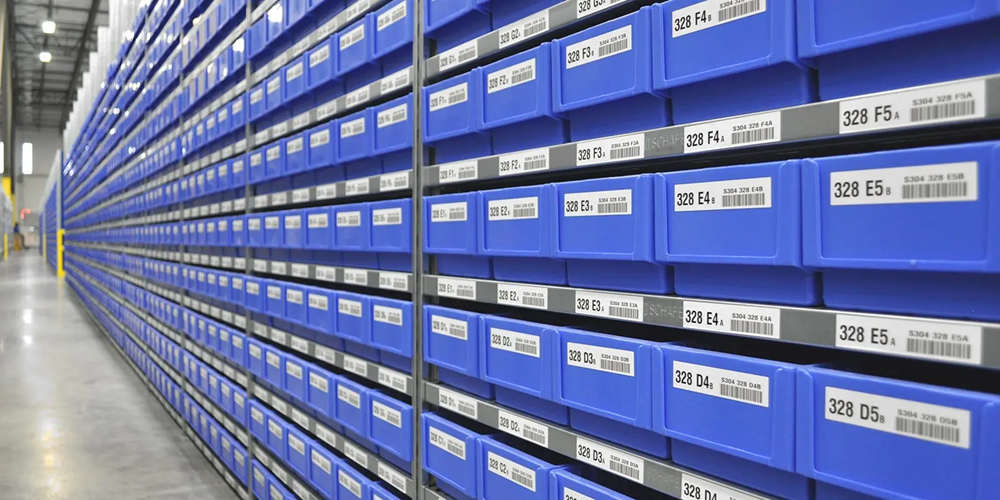
Most people running a warehouse facility ignore the labels until they start to fall off. Then you have mislabelled product, people searching for items in the wrong place, and the tedious task of relabelling everything while trying to keep the warehouse operational. The fact is that warehouse labels come in various qualities and the difference between a cheap sticker and a proper industrial label can run into thousands of dollars in mistakes and hours of labor.
What Actually Destroys Warehouse Labels
Temperature variations destroy warehouse labels first and foremost. A warehouse that gets cold at night and heats back up during the day puts a constant strain on the adhesive. The label looks fine, but the adhesive is succumbing over time. Cold storage facilities are even worse. The air changes temperature often enough to allow moisture to slip under the edges every single time. In a few months, the corners start to lift and after that, the entire label is done for.
Forklift activity destroys labels when you least expect it. Obvious bumps and collisions with equipment and product take their toll on labels but its also the constant vibration from pallets and product moving through a busy facility. This weakens bonds over time. Dust is another factor. All that activity churns the dust up, and it settles on exposed adhesive edges around partially lifted labels, hastening the peeling process.
Chemical exposure is the silent killer of warehouse labels. Cleaning chemicals, hydraulic fluid drips, and even fumes from equipment slowly degrade certain materials. A label that works perfectly in a grocery warehouse will complete fail in a warehouse that handles industrial chemicals or one that has to be pressure washed regularly.
The Materials That Hold Up (And the Ones That Don’t)
Paper labels are cheap and that’s about it. They hold up in climate controlled offices but not in real warehouses. Moisture makes them curl and tear. Abrasion from boxes rubbing against them cause wear and tear over time. Use them if you need a throwaway label that is only supposed to last a few months. If you expect longevity you will be sorely disappointed.
Most warehouses can probably get away with using polyester labels. They don’t tear easily, they survive temperature variations better than most other materials, and they don’t fade as quickly under fluorescent lights. The material is tough enough that you can’t rip it by hand. If you are looking to move beyond a basic paper labeling system, it might be worth considering tailored warehouse labeling solutions designed for industrial applications. The price difference over a sticker that doesn’t last anyway pays for itself with all the time you will save by not having to replace them constantly.
Vinyl labels have flex. That counts for something in certain applications. They hold up better in situations where you have a curve to deal with such as pipes or even column sections of your facility. The material has good chemical resistance. It even holds up in facilities where there are outdoor sections (docks) or storage areas exposed to the elements.
Adhesives are Usually Stupidly Strong
The stickiest glue isn’t always the best for a facility label. An adhesive with permanent stickiness causes headaches when location systems change or when a facility goes through a rack layout change. It also ruins the surface where it gets applied when you eventually peel it off after too long.
The strong tendencies of removable adhesives sounds good but it’s not designed to be everlasting. It’s great for temporary applications such as marking items for inventories or seasonal storage but leave it too long and it starts to bond like a permanent adhesive.
Then there’s cold temperature adhesive. This one is essential for freezer applications but overkill for regular warehouses. Regular adhesive doesn’t bond below 50 degrees F. Cold temperatures make it hard for adhesive to flow into micro irregularities in the surfaces it’s applied to.
Print Quality and Barcode Scanning
Thermal transfer print quality produces durable labels. During this process resin based ink gets essentially “melted” onto the label. The ink becomes an integral part of the label, not just something that sits on top of it and this makes it durable to fade from exposure to UV lights, smudging from people handling items and even chemicals. Barcode scanners can read these things long after they are applied.
Direct thermal printing is cheaper because it doesn’t require ribbon cartridges. However, labels fade and darken after a while. Heat makes this process go even faster. A label that looks fine when first applied and is readable today might not be so in a year from now if stored in a heated location. This printing process works well when you need temporary identification marks on items but not when you want to mark permanent storage locations in your facility.
Resolution also plays a bigger role in barcode scanning than most people think. A barcode with no clear definition between the bars of the code can probably be read by a person but not by a scanning device. This is especially true if there is dust buildup and minor wear on the label after it’s been around for a while.
Using higher print resolution (600 DPI versus 300 DPI) will give you better scanning results even deep into a label’s lifespan.
Plan Long Term
Think realistically about replacement costs before you select a label option for your facility. A cheap label that costs you an additional 1000 a year isn’t worth it over one that costs 3x more and lasts five years.
Think about how much replacing a label will cost including:
- Your labor cost of relabelling everything
- The productivity cost of people who can’t find items because they can’t read labels
- Inventory mistakes made by staff trying to locate items stored in the wrong locations.
In most cases, it’s advisable to apply different grades of labels around one facility. High traffic areas that get handled often such as picking zones will probably need more resilient labels than racks that don’t get used as often.
Dock areas need climate resistant labels but climate-controlled areas around the same dock don’t need the same treatment.
Before you dive headfirst into making a purchase of thousands of labels from your chosen supplier, it’s advisable to test the labels out first. Purchase a small batch or even individual samples. Use them. See how they hold up after a few months. Certain conditions related to traffic loading docks temperature variations etc might not align with the supplier’s test results.
Don’t feel like you have to change everything all at once. Change your labeling system in phases and focus on areas where labels fail most often first. You are likely to see improved results starting with high-traffic areas or cold storage areas first.
Proper warehouse labels might not be amazing but they are one of those not cool but necessary infrastructure investments that save you money when you least expect it down the road. When people don’t have to wonder whether they will find proper labels on their crates when they show up for work every day, operations in warehouse facilities keep running at breakneck speeds. Pay attention to what ends up on your racks.