One of the most famous programming languages nowadays, Python is a simple and versatile programming language. Regardless of your level of expertise or experience in the field of development, one of the most crucial tasks in writing constructive Python code is the knowledge of the basics of the programming environment, including variables and datatype. This article presents you to the fundamentals of variables and data types and allows you to be familiar with how Python stores and manipulates data. We shall discuss the use of the various types of data in computation and how they will affect the functionality of your programs.
What Are Variables in Python?
Every programming language has variables as a fundamental component. A variable in Python is a symbolic name which is used to hold a reference to a value. They can be any values, such as numbers, text or even complicated data structures. Creating a variable in Python means instructing the program to remember some information to be used later on.
Python Variable Declarations
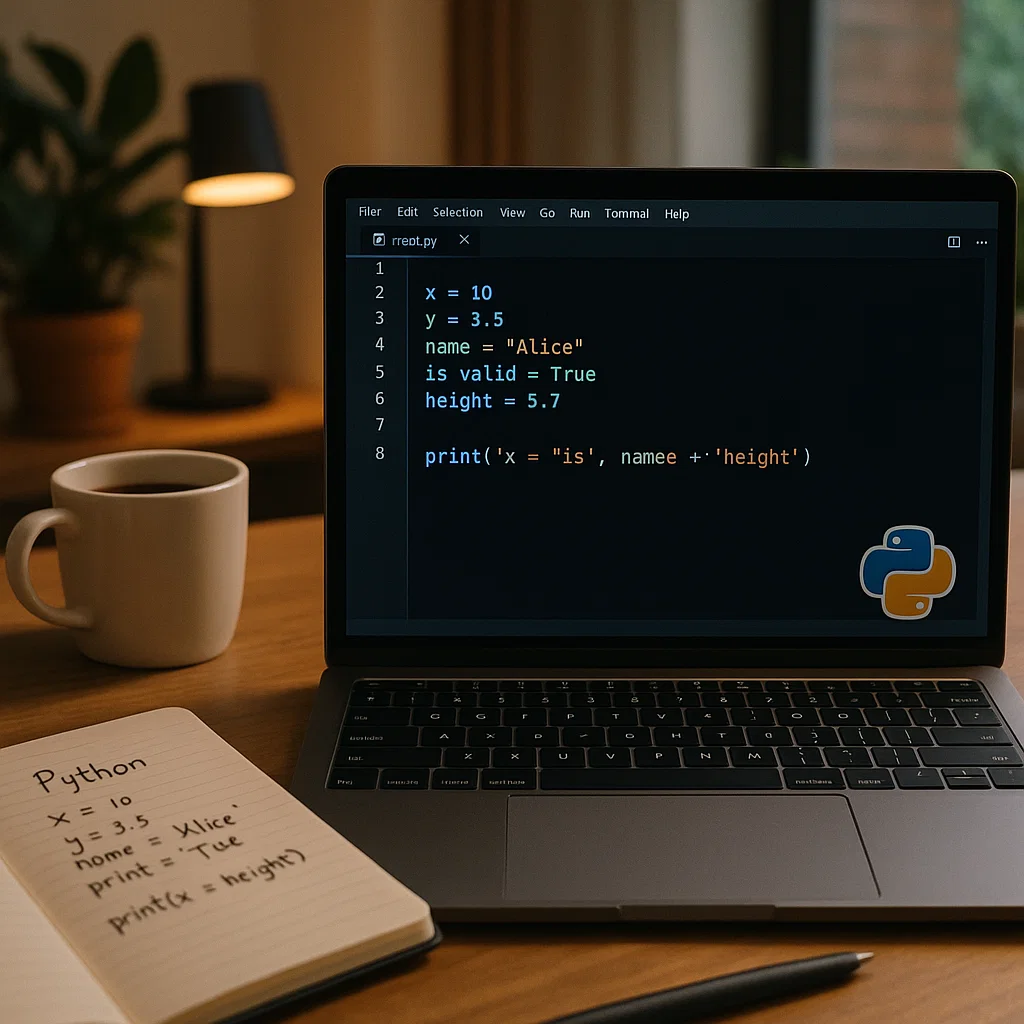
It is easy to declare a variable in Python. You do not need to declare the type of the variable explicitly, Python can tell the type of the variable according to what you assign to it.
x = 10 # Integer
name = “Alice” # String
height = 5.7 # Float
isactive = True # Boolean
The above example is x with an integer value, name with a string, height with a floating point value and isactive with a boolean value. Python is dynamically typed which does not require the declaration of the type of a variable. The inference of the type is made out of the value.
The Fundamental Constituents of Programming: Data Types
Data items change into categories known as data types. Python has a number of data types, which could be generally classified into built-in types. These data types are essential to work with Python. Let us see the commonest types of data in Python.
Integers (int)
An integer is a complete whole number, either positive or negative and does not contain a decimal point. It is among the most prevalent data types that are used in programming to describe numeric values.
x = 10 # A positive integer
y = -5 # A negative integer
z = 0 # Zero is also an integer
The application of integers can be in different mathematical operations like addition, subtraction, multiplication, and division.
Floating Point Numbers (float)
The floating-point number (also known as float) is a representation of real numbers and is used to store values which require a decimal point. The type of data is essential to a representation of continuous data including measurements, prices, and other values that do not occupy entire numbers.
pi = 3.14 # A float representing the value of pi
temperature = 22.5 # A float which is the temperature
Python uses floating-point numbers in more accurate computations, particularly scientific, engineering, and financial computations.
Strings (str)
Texts are represented in strings and consist of sequences of characters. Python has strings surrounded either by single quotes (‘, for example, ‘said’) or by double quotes (, such as “said”). You can store any kind of text (names, messages and description) in strings.
name = “Alice”
greeting = ‘Hello, world!’
There are many useful string functions, including upper, lower, strip, replace etc that may be used to manipulate strings. Alternatively, concatenation of strings is possible as well as formatting to produce more complex output.
Booleans (bool)
A data type of a Boolean type can only have two values; True or False. Computer programming is often considered to use Booleans to make decisions and control flow (e.g., in an if-else statement).
issunny = True
israining = False
The basis of logic in programming is Booleans. Logical operators such as and, or, and not can be used to combine two or more logic expressions.
Lists (list)
A list simply is a set of ordered items, they may be of any type of data. Lists are dynamic i.e. once they have been created, they can be changed. Array Lists are frequently employed to hold sets of data, e.g. objects in a shopping cart or the items in a dataset.
fruits = [“apple”, “banana”, “cherry”]
numbers = [1, 2, 3, 4]
With the help of the indices and the in-built techniques, you can add, delete, or update the elements of a list.
Tuples (tuple)
A tuple is the same as a list except that it is immutable, i.e. its contents cannot be modified after assignment. Tuples can be used to hold related data that is not to be changed.
coordinates = (10, 20)
person = (“Alice”, 25, “Engineer”)
Tuples can be of great help in cases where you are interested in the fact that data would not be changed in the course of your program.
Dictionaries (dict)
A dictionary consists of a non-ordered set of key-value pairs. The keys are also distinctive and are applied to the respective values. Dictionaries are, simply put, very handy when it is necessary to store and access data, with particular identifiers, i.e., user profiles or product catalogs.
person = {“name”: “Alice”, “age”: 25, “occupation”: “Engineer”}
To get values in a dictionary, you can make reference to their keys.
The Data Storage and Manipulation in Python
The data handling of Python is easy and effective. Python has a memory that holds the value that you have assigned to a variable and links it to the name of the variable. In case the value is changed, the memory location is automatically updated to hold the new data in Python.
Memory Management in Python
The Python language incorporates a built-in memory system and can therefore manage the specification and release of memory without a programmer controlling this explicitly. Python includes an inbuilt garbage collector that frees up memory when it is not required and therefore developers do not have to worry about memory management but write code.
Type Conversion
Occasionally, it might be necessary to transform one type of data into another. Python has a couple of functions that can be used in type conversion, which include:
- int(): Changes a value into an integer.
- float(): Casts to a float.
- str(): Changes a value into a string.
- bool(): Represents a variable to a Boolean.
Example:
x = “10”
y = int(x) # String to integer
z = float(x) # Changes string to float
The Significance of Learning to Compare and Contrast Variables and Data Types
It is crucial to know the functionality of variables and types of data to develop effective and bug-free Python programs. Selecting an appropriate data type to be used in a task may affect the manner in which your program performs. To provide an example, when one intends to use integer numbers, the use of floating-point numbers can lead to unexpected results or errors.
Also, the type of data affects the extent of memory utilization and the speed at which operations could be carried out. With knowledge of Python data storage and manipulation, you are able to provide faster and more optimized code.
Conclusion
Python is based on the variables and data types. Learning how variables store data and the manner in which various data types are used during computation will enable you to write more effective and efficient code. Python offers various forms of data such as integers, complex data models such as dictionaries to support various programming tasks.
These are the basic concepts that one needs to understand before proceeding to the more sophisticated concepts of programming. Once you have understood the basic constructs of programming (variables, data types etc.), you would be well on your way to becoming a good Python developer.