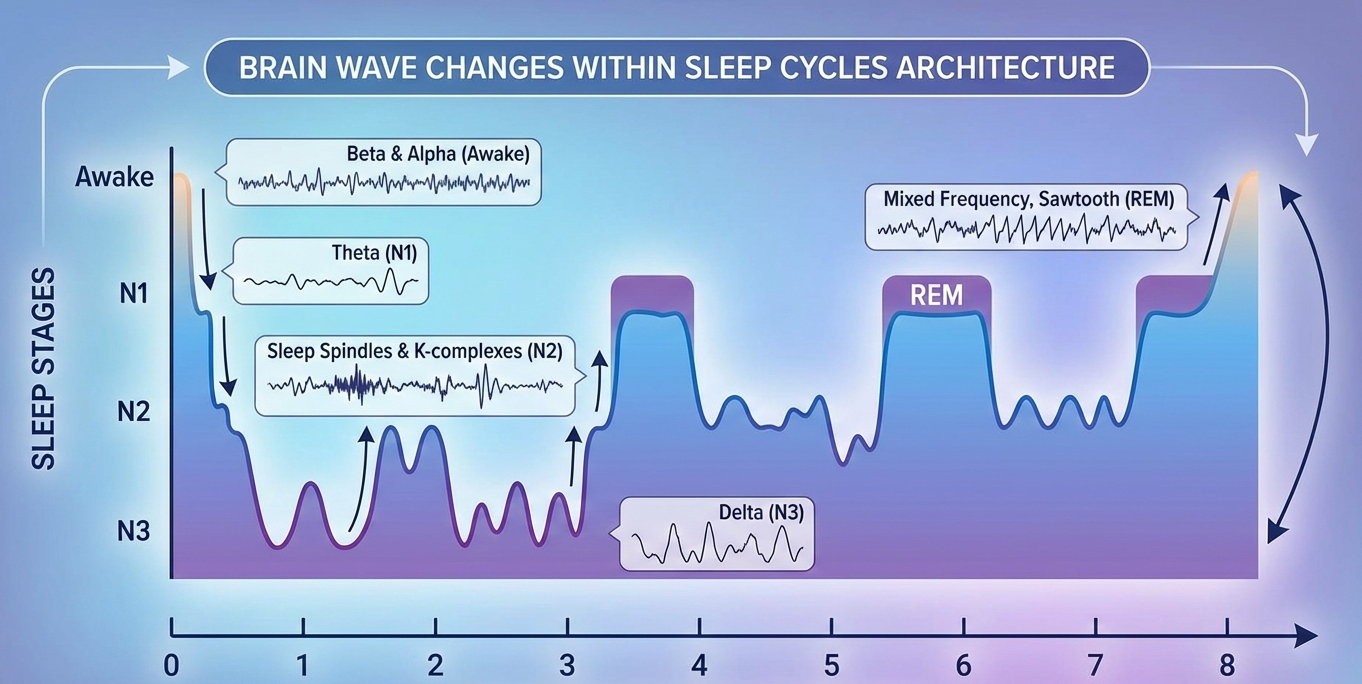
Sleep is the organized biological process, which consists of repetitive cycles, which occur during the evening. Instead of being a homogeneous state, sleep is composed of several phases that are specialized to carry out specific functions to aid physical and cognitive well being. The insight into the structure of sleep cycles helps to understand the mechanism of body and brain of recovering the demands of everyday life.
Sleep pattern is an alternation of non-rapid eye movement (NREM) and rapid eye movement (REM) sleep. These rhythms are repeated approximately after every 90 minutes, with the light sleep gradually changing to deep and, finally, to the REM. The stages play different roles in the detoxification process, emotional processing, cell regeneration and neurological organization.
When one understands the role of every stage, one can see the importance of the duration of sleep and the quality of sleep in order to perform at the best.
The Organization of a Sleep Cycle
The average night sleep has four to six cycles. Each cycle includes:
- Light sleep ( NREM Stage 1 and Stage 2)
- Deep sleep (NREM Stage 3)
REM sleep
The initial stages of the night have higher durations of deep sleep whereas the later iterations have increased periods of REM sleep. This movement is indicative of the changing priorities of the body, which are first to be physically restored at the beginning of the night and then to cognitive and emotional process near the morning.
These stages are arranged according to a predictable pattern that is critical in complete recovery.
Light Sleep: The Entrance to Repose
Light sleep incorporates Stage 1 and Stage 2 of NREM sleep. These stages though disregarded get the body ready to undergo more profound restorative functions.
Stage 1: Wakefulness to Sleep
The stage 1 takes just a few minutes. The brain waves start to become slower, the muscle activity becomes slower, and the awareness about the surrounding world becomes less. People can have their minds wander or twitch momentarily.
This phase is the transition of active involvement to inner healing.
Stage 2: Stabilization and Neural Coordination
The proportion of the total sleep time that is spent at Stage 2 is largest. There is a decrease in heart rate, a decrease in body temperature and the breathing process becomes more regular. Sleep spindles are bursts of electrical events associated with learning and memory consolidation that are displayed on the brain activity.
Stage 2 assists in stabilising sleep and making an individual less responsive to outside activity, which guarantees continuous growth to deeper stages.
Deep Sleep: Physical Repair and Cell regeneration
Deep sleep or slow-wave or Stage 3 NREM is slow brain wave accompanied by enormous slow brain waves. This phase is necessary in physical restoration
Cellular Regeneration
When one is in deep sleep, they also release growth hormone which helps in repairing tissues and muscle restoration. Synthesis of proteins also improves and the cells can rebuild and regenerate.
This is a stage of addressing daily wear and tear of tissues and hence deep sleep is essential in physical resilience.
Immune System Support
Deep sleep increases the activity of immune cells. Cytokine production assists in the control of immune responses and fighting with infection.
Sleep deprivation over time may impact the immune system, which is why one should get sufficient deep sleep.
Brain Detoxification
Deep sleep is also beneficial to the glymphatic system of the brain, which consists of a waste-clearing system, which removes the results of metabolism that accumulate when one is awake. This process of detoxifying the body is best achieved when in the slow-wave sleep.
Proper cleansing of the brain leads to the neurological health in the long run.
REM Sleep: Cognitive and Emotional Cohesion
The REM sleep is characterized by fast eye-blinking, lively dreaming, and an increase in the activity of the brain. In spite of the fact that body is paralysed temporarily, brain is very active.
Emotional Processing
REM sleeps enable the brain to process emotional experiences under controlled conditions. Hypothetical memories are incorporated and restructured, and it decreases the psychological stress.
The loss of REM sleep has been linked to emotional instability and the lack of emotional resilience.
Memory Consolidation
The information that one acquires throughout the day is rearranged and encoded during the REM sleep. The neural connections of significant knowledge are reinforced and the unnecessary connections are eliminated.
Such selective reinforcing improves the efficiency in learning and cognitive clarity.
Creative Problem-Solving
REM sleep promotes the creative thought and flexibility. The brain develops new associations that help in innovation and complicated thinking.
The Recurrence of Cycles during the Night
Sleep is not a linear process. The body instead passes through light sleep, deep sleep and REM stages repeatedly.
Early cycles are based on the deep sleep, on emphasis on restoring the body. Subsequent cycles are more focused on REM sleep that boosts cognitive and emotional processing.
Alterations that interrupt cycles can lead to inability to complete key reparative stages. Insofar as the total time spent asleep seems sufficient, disrupted sleep can diminish quality and minimize the recovery.
Sleep Duration and Sleep Quality
The best operation is based on the adequate time span and well-organized stages.
Sleep Duration
The average adult needs seven or nine hours of sleep. It might be necessary to have shorter durations to minimize the amount of deep and REM exposure.
Sleep Quality
Sleep quality is where there is no disruption of the stages. The frequent awakening disturbs the cycle architecture and lowers the effectiveness of restoring the efficacy.
The two aspects should be balanced in order to ensure stability of cognition, emotion, and physical well-being.
Regulation of Hormones throughout Sleep
The stages of sleep determine the pattern of release of hormones.
The highest level of growth hormone is during deep sleep.
There is a drop in cortisol during early sleep and an increase to the morning.
Melatonin controls the sleep-wakefulness
Disturbances in sleep architecture have the capability of changing these rhythms, which influences metabolism and responses to stress.
Meditative State of Being and Re-Energizing
Deep sleep helps in the regulation of glucose and insulin sensitivity. Poor sleep can limit the efficiency of metabolism.
Regular sleep routines aid in energy rejuvenation and appetite control, which enhance the general metabolic condition.
Effects of Waking up at Abnormal Times
Persistent sleep cycle disturbance can lead to fatigue, lack of concentration, low immunity and emotional instability.
Poor full sleep does not allow cellular regeneration. Lack of REM sleep impairs the memory consolidation and emotional processing.
By knowing about these effects, the significance of organized sleep will be cemented.
Scheduling Healthy Sleep Patterns
The encouragement of regular sleep patterns includes:
- Having consistent sleep patterns
- Building a nocturnal silent sleep environment.
- Reducing the amount of stimulants taken at bedtime.
- Involving in physical exercise.
Such habits promote the natural development in stages and improve the quality as a whole.
Conclusion
The architecture of sleep cycles is an indication of an advanced biological design that maintains even a balance between physical rest and mental renewal. The body gets ready to undergo even deeper processes with the help of light sleep. Deep sleep allows the cellular regeneration, the reinforcement of immunity, and the detoxification of the brain. REM sleep assists in memory consolidation and processing of emotions.
The length of sleep and the quality of sleep are necessary. It is important to complete several consecutive sessions every night to be fully restored.
Taking into consideration that sleep is a dynamic process with a structure promotes the emphasis on the importance of healthy behaviour that ensures the safety of well-being.