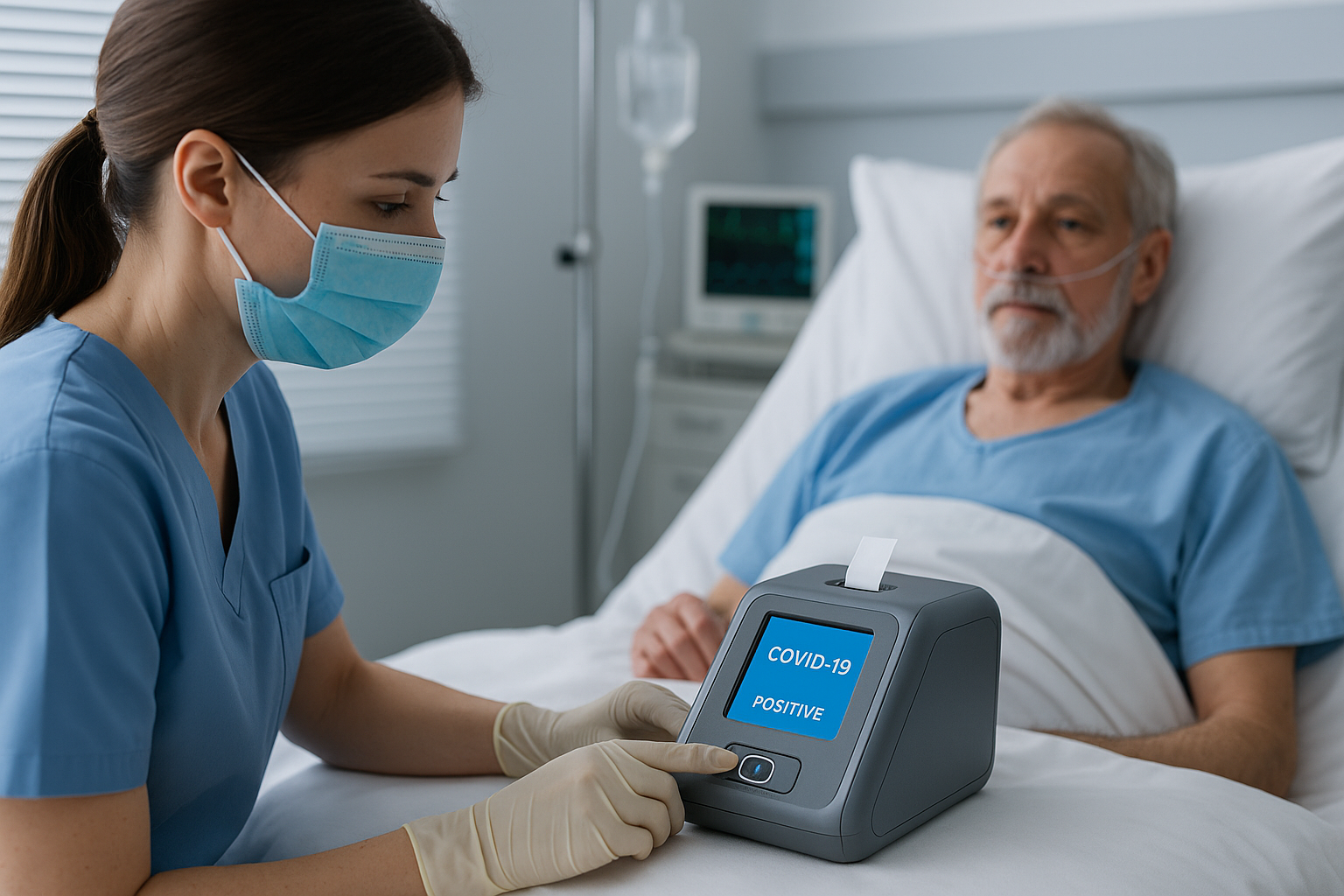
The use of molecular testing in a point-of-care (POC) format is revolutionizing the world of diagnostics to date by providing the highest level of molecular detection capability in bedside, clinic, and even remote locations. As compared to conventional laboratory testing, which commonly entails centralized facilities, expert workforce and longer turnaround times, POC molecular diagnostics are immediate, portable and straightforward methods of testing with the capability of yielding outcomes in few minutes to hours. These innovations in the management of infectious diseases are especially crucial since a timely diagnosis can significantly increase the outcome of the patients and assist in curbing outbreaks.
The article addresses some of the fundamental concepts in science and technological advances towards key molecular technologies, novel engineering behind POC devices that are transforming diagnostic processes across the world.
Irreducible Problems of Molecular Diagnostics
Molecular diagnostics are methods to identify particular sequence in DNA or RNA that could or could not be linked with disease causing organisms. Molecular diagnostics gives a strategy to identify pathogens, genetic mutation and even cancer markers with high sensitivity and specificity; they concentrate on nucleic acids.
The main processes in the molecular diagnostics testing entail:
- Sample Preparation: Nucleic acids extraction of the sample (e.g. blood, saliva or swab).
- Amplification: Multiplier actions in order to raise the instructions of the target nucleic acid to levels that can be measured.
- Detection: the target that is amplified identifies by fluorescence or colorimetric signal.
Historically, such processes took complicated equipment and laboratory facilities. Technological innovations, however, have made such processes smaller and by integration, small in size and portable, thus favored to be used in points of care..
The POC Testing is Driven by Nucleic Acid Amplification Tests
Nucleic acid amplification is the essence of molecular diagnostics by allowing identification even of extremely minute concentrations of pathological or human cellular genetic material. A number of amplification procedures have been modified to POC molecular testing, which include:
1. Polymerase Chain Reaction ( PCR )
Molecular diagnostics is a gold standard because of its high sensitivity and specificity, i.e. PCR. It is thermally cycled using three stages which are:
- Separation of strands of DNA aka denaturation
- Annealing (primer-Molecule pairing)
- Extension (new DNA strands synthesis)
Minimized PCR: PCR based POC devices can take less than one hour to deliver the results and this has been made possible by the improvement in microfluidics and thermal cycling. The systems have automated sample preparation or sample amplification within a one-time use cartridge to minimize operator training requirements.
2. LAMP or the Loop-Mediated Isothermal Amplification
LAMP is a replacement of PCR that carries out such amplifications at a pronounced temperature; thus, avoiding complex thermal cyclers. It can also be run on a variety of primers and a strand displacement activity DNA polymerase allowing fast and strong amplification.
LAMP in POC Latest News
LAMP is especially adapted to the POC environment having the advantage of simplicity, speed and capacity to withstand sample contamination.
• It is friendly with the non-specialist operators because colorimetric methods of detection can only be carried out with visible color changes, meaning positive and negative results.
3. CRISPR-Based Detection
Recent CRISPR-based innovations have used the CRISPR-Cas system, which was invented to edit genes, to do something much different: detect nucleic acids highly specifically and rapidly. CRISPR-based diagnostic such as SHERLOCK and DETECTR can:
• Identify particular DNA or RNA sequence
• Give a fluorescent signal, or colorimetric signal, on target detection
Benefits with POC:
• Ultra high specificity
• A quick response (in 30 minutes)
Possibility of Disposable devices at low prices
CRISPR diagnostics is under developmental process to become handheld, going beyond the limit of what can really be done with POC molecular testing.
Major tenets of Molecular diagnostics
The pathogens are classified on molecular diagnosis levels of their genetic markers. The main steps of it usually are:
1. Sampling and sample preparation
A biological specimen (i.e. saliva, nasal swab, or blood) is taken and bioprocessed to obtain nucleic acids. This is usually accomplished in POC devices by automating it in the cartridge / device itself and minimizing chances of handling errors.
2. NucleicAcid Amplification
Namely, to identify the genetic material of a pathogen, DNA/RNA samples should be amplified to large-enough quantities to be measured. Such techniques as PCR, LAMP, as well as CRISPR-based techniques are decisive in this case.
3. Detection
The presence of a target genetic material is detected with fluorescence or colorimetry signal after the amplification and stored as positive or negative.
Core Principles of Molecular Diagnostics
Molecular diagnostics identify pathogens by targeting their genetic signatures. The core steps generally include:
1. Sample Collection and Preparation
A biological sample (like saliva, nasal swab, or blood) is collected and processed to extract nucleic acids. In POC devices, this step is often automated within the cartridge or device, reducing handling errors.
2. Nucleic Acid Amplification
To detect a pathogen’s genetic material, small amounts of DNA or RNA must be amplified to measurable levels. Techniques like PCR, LAMP, and CRISPR-based methods are pivotal here.
3. Detection
After amplification, the presence of the target genetic material is identified through fluorescence or colorimetric signals, indicating a positive or negative result.
Comparing POC Molecular Testing to Conventional Laboratories Diagnostics
| Feature | The conventional Lab Diagnostics | POC Devices |
| Time to Results: | Hours to days | Minutes to hour |
| Portability | Fixed, lab-type | Portable, usually handheld |
| Skill level | Highly trained technicians | Little training is necessary |
| Sample Handling | Manual, multi stage procedures | Robotic, in-built equipment |
| Use Case | Central labs | Bedside, clinics, far away places |
POC molecular diagnostics are more accessible and faster than high-throughput systems and in cases where rapid clinical decision must be made, as in emergency rooms, rural clinics, and during disease outbreaks, it is decidedly needed.
The Uses of POC Molecular Testing
The flexibility of the POC molecular diagnostics transcends all the related medical series, which include:
Prevention of Infections and Detection Infectious Diseases
POC molecular devices were critical in the management of the COVID-19, where quick detection of SARS-CoV-2 was facilitated in the community, at the airports, and the workplaces. Among the crucial targets, there is:
- Tuberculosis (TB): Easy detection and profiling of drug resistance can be done with the help of rapid molecular tests.
- HIV: POC testing is used in assisting in same-day diagnosis and immediate launch of therapy.
- Sexually Transmitted infection (STI): Rapid testing, and error-free face better patient compliance and transmission rates.
Antimicrobial resistances (AMR) Tracking
Precise detection of the genes associated with resistance to antibiotics as a POC molecular test can assist in eliminating development in the most effective mechanism of using antibiotics in combating the AMR crisis worldwide.
Oncology and genetic Screening
At its relatively early stage of development, POC platforms are developed along the following lines:
• The genetic test during pregnancy
• Detection of cancer biomarkers as the basis of individual therapy
POC Molecular Testing Complications
Although POC molecular diagnostics have many advantages, they have a number of challenges:
Price and Availability
On average, POC molecular tests are more costly on average per test than conventional procedures. There is an endeavor to continue to reduce the manufacturing prices and make it easier to afford particularly in low-income areas.
Sensitivity Vs Simplicity Trade-Off
Realizing the laboratory level of sensitivity in small instruments without compromise on ease of use is an engineering challenge.
Quality Control
It is vital to make all test performances consistent across different environments and operators. The effective internal controls and friendly interface are necessary to ensure the diagnostic reliability.
Regulatory Hurdles
Although POC molecular devices have to survive high regulatory hurdles in order to be safe and effective, the process can delay market penetration of groundbreaking platforms.
Point-of-Care Molecular Diagnostic in the Future
The molecular testing POC sector is developing fast due to the merge of:
- Microfluidics: Facilitating a lab-on-a-chip miniaturization Microfluidics is the science of the manipulation of fluids in very small spaces, very small volumes, and with very small feature sizes.
- Improving sensitivity and speed Nanotechnology: Minimizing the sensitivity and speed
- Artificial intelligence (AI): Boosting interpretation of data and decision-useful support
- Connectivity: The possibility of linking to digital health systems to enable smooth care delivery to the patients
In the future, they are to increase even in affordability, speed, and multiplexing, or that is the detection of more than one pathogen or genetic mark in a single test.
Global Health Partnership with the Global Health Strategies
World Health Organization (WHO) underlines that decentralization of diagnostics is important to enhance equity in health. POC molecular technologies are just the right technologies to support this vision with scalable solutions in those resource-limited localities.
Personalized Medicine In Point of Care
With the momentum of precision medicine, the future of POC molecular testing is bound to be used as a continuous form of monitoring genetic conditions, in-real-time treatment modifications, and even diagnostic platforms administered at home, and will help deliver a new age of individualized healthcare.
Conclusion
Point-of-care molecular testing is at the frontier of the evolution of diagnostics, and quick, precise, and available testing became a reality throughout the world. POC devices are closing the gap between the precision of laboratories and the acclaim of the clinical situation through the miniaturization of methods such as complex nucleic acid amplification procedures such as PCR, LAMP, CRISPR-based, and more.
Although some obstacles in the form of cost, regulatory clearance, and technical optimization still exist, there are still numerous advantages that are bound to outweigh the obstacles. With the ongoing evolution of technology, POC molecular diagnostics are becoming an essential part in the management of infectious diseases and antimicrobial stewardship and the general movement of decentralized and patient-centered healthcare.
After all, the knowledge of the principles and the technologies of POC molecular testing allows both healthcare professionals, policymakers, and patients to do their very best using the power of these tools and making life-saving decisions in a timely fashion.