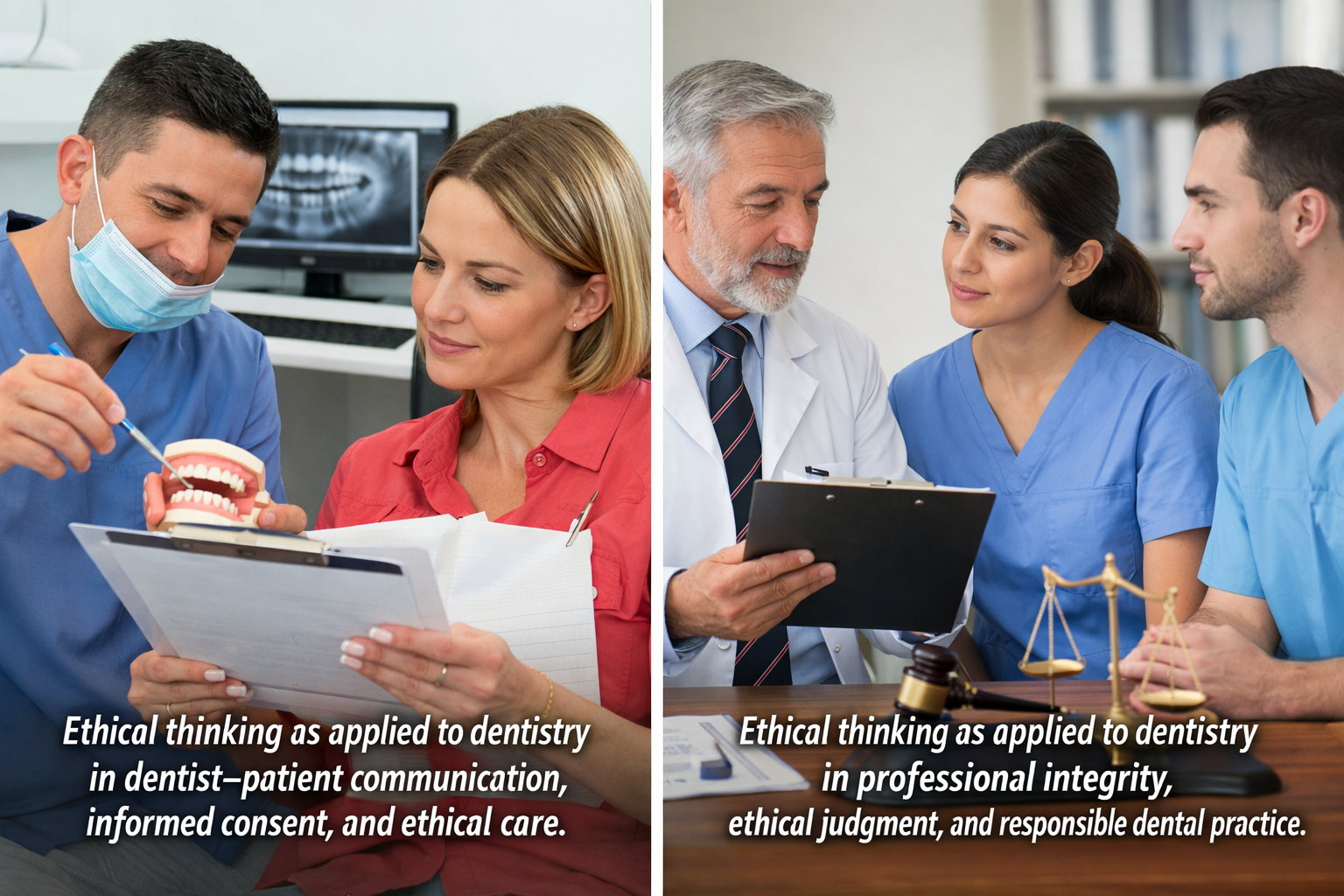
Ethics is at the center of healthcare, as it helps professionals perform the actions that would protect the patients, human dignity, and ensure the confidence of the people. Dentistry presents the ethical dilemma in everyday life- choices of treatment and informed consent, professional limits, and equitable access to the care. To dental students and junior practitioners, learning how to think ethically in relation to dentistry is not only a course requirement, but a practical knowledge that influences clinical judgment and professional self.
The paper presents the philosophical basics of ethics in contemporary dentistry. It defines the term ethics as applied to dental context, reasons why ethical decisions are vital in the course of a dental career and how ethical awareness enhances patient trust, clinical results, and professional integrity.
What is Ethical Thinking in Dentistry?
Ethical thinking is a process of considering actions, choices and behaviors with reference to moral values and professional values. In the dentistry field, it means balancing science, clinical expertise, patient needs, and social expectations with performing the right thing even in a complicated or ambiguous situation.
Ethics is concerned with values like honesty, fairness, respect and responsibility unlike technical skills which can be measured in an objective manner. The application of ethical thinking in the field of dentistry assists the practitioners to make decisions that are not only based on what can be done clinically, but on what they believe to be the best interest of the patient and the profession.
The ethics in dentistry is affected by:
- General moral philosophy
- The professional codes of conduct.
- Legal regulations
- Cultural and social values
The combination of these factors helps dentists to make defensible judgments in practice.
Relevance of Ethics in Dental Practice Today
The modern day dental practice is characterized by the high rate of technological changes, patient consciousness and increasing commercial demands. Though these changes present opportunities, they have presented ethical risks like overtreatment, conflicts of interest and inequity in care access.
Ethical reasoning is vital since dentistry is a profession that is founded on trust. Dentists would be able to use patients to conduct invasive procedures, pain management, and health outcomes over long periods. This trust is soon destroyed when there is lack of ethical conduct.
Ethics is an issue in dentistry since it:
- Preserves the well-being and freedom of the patient.
- Improves professionalism.
- Minimizes legislative and malpractice risks.
- Believes in equitable and humane care.
- Enhances the confidence of the dental profession.
Because of these reasons, ethical decision making is not an option, rather a necessity at all levels of dental career.
Essential Ethical Standards in Dentistry
The majority of commonly used dental ethical frameworks have their foundations on a set of principles. By being aware of these principles, one gets a basis of thinking morally and making effective decisions.
Self-determination: Honoring Patient Choice
Patient autonomy is the right of the individuals to make a decision concerning their healthcare. This in dentistry implies that the dentists should respect the values, preferences, and choices of patients following the presentation of clear and accurate information.
To respect autonomy, it is necessary:
- Ethical disclosure of diagnoses and treatment alternatives.
- Risk, benefit and alternative disclosure.
- The time and manner of respecting the choice of the patients, regardless of their refusal to receive treatment.
Ethical dental practice includes intelligible consent as one of its pillars and autonomy.
Beneficence: The Best Interest of the Patient
Beneficence is a requirement that makes dentists act in the best interest of their patients. The focus of this principle is on the promotion of oral health and the elimination of pain and diseases and enhancing the quality of life.
Ethical beneficence means:
- Suggesting evidence-based interventions.
- Eschewing unneeded or purely profit-seeking processes.
- Always revising clinical knowledge.
A dentist with beneficence will care more about the welfare of the patient than his own or the profit.
Non-Maleficence: Do No Harm
Non-maleficence, which is closely connected with beneficence, demands that dentists do no harm. This involves bodily injuries, mental agony, and financial misrepresentation.
In practice, non-maleficence is concerned with:
- Retaining clinical competence.
- Personal limitations and making relevant referrals.
- Eschewing the procedures which involve unreasonable risk.
Good intentions are always dangerous without reflection on ethics.
Justice: Equity and Fairness during Care
Justice in dentistry is aimed at fairness, equality, and non-discrimination. It deals with the distribution of dental services and treatment of patients.
Ethical justice includes:
- Attending to patients regardless of their race, gender, age, or socioeconomic status.
- Opening up to charges and treatment expenses.
- Promoting care access as feasible.
Justice is one of the most difficult ethical principles to observe in a world where not all people have equal access to oral healthcare.
Professional Codes and Ethical Guidelines
Professional codes assist in supporting ethical thinking in the field of dentistry by providing the expected standards of conduct. These codes are considered as handy guidelines to ethical conduct and to bring the profession together in common values.
The FDI World Dental Federation is one of the international organizations that can offer ethical guidance that is based on international standards and professional responsibilities. The official guidelines on ethics in dentistry could be used by dentists and students to learn more about these principles.
These rules are designed to focus on the ideals of professionalism, patient-centered care, honesty and accountability in various cultural and clinical contexts.
Clinical Practice Ethical Decision-Making
There are few easy solutions to ethical issues in dentistry. Nurses are often subjected to the dilemma of conflicting values, scant resources and patient demands. The use of ethical thinking gives an orderly way of tackling such dilemmas.
Ethical Dilemmas in Dentistry
The dentists can encounter problems of ethics like:
- Addressing the demands of patients to use unnecessary treatments.
- Management of confidentiality in group clinical settings.
- Treatment of children or patients with low decision-making capacity.
- Striking a balance between business and professional ethics.
- Being open and amenable to correcting mistakes or negative consequences.
Being aware of these obstacles beforehand will enable practitioners to be reactive instead of being reactive.
An Ethical Decision Making Practical Approach
Resolving ethical issues might be directed by a step-wise approach:
- Identify the ethical issue
- Observe pertinent clinical and contextual data.
- Take into consideration relevant ethical standards.
- Consider other possible courses of action and outcomes.
- Take a choice and act in accordance with the professional values.
- Reflect on the outcome
Such a way reinforces ethical thinking and facilitates sound and defensible decision making.
Patient Trust, Ethics, and Communication
The basis of the dentist-patient relationship is trust and ethical behavior is vital in establishing and sustaining the relationship. When treated with respect and educated, patients tend to adhere to treatment programs, revisit care, and refer patients to others.
Ethical communication entails:
- Good explanations without ambiguous language.
- Active listening to patient issues.
- Candidacy regarding unknown risks and constraints.
- Receptive management of complaints or dissatisfaction.
By feeling that the patients are being honest and empathetic, trust develops- even in challenging clinical scenarios.
Ethical Thinking through a Dental Career
Ethical responsibility is a growing phenomenon in the career of a dental professional. What starts as classroom education is practice experience in the clinical setting.
Ethics in Dental Education
In the case of students, ethical thought is developed by:
- Case-based learning
- Clinical supervision
- Professional responsibility Reflection.
The exposure to ethical situations at an early stage makes students ready to face the challenges in the real world and strengthen professional standards.
Ethics in New and More Senior Practice
Ethical issues that arise in the career of dentists tend to be complicated as they advance them professionally. Ethical decision-making is further complicated by practice ownership, leadership functions and mentoring.
The continuous professional growth and moral reflection are indispensable to upholding integrity and keeping up with dynamic professional conditions.
Ethical Awareness in Professional Integrity
Professional integrity is uniformity of values, actions and responsibilities. Ethics consciousness enhances integrity as it prompts dentists to be responsible even when nobody is looking.
The dentists who have solid ethical foundations can be more likely to:
- Confess and develop by experience.
- Resist unethical pressures
- Being able to maintain standards in a competitive environment.
- Citizen role models of the profession.
Ethical integrity, when used in the long run, leads to personal fulfillment and professional respect.
Conclusion
The concept of ethical thinking in relation to dentistry is critical to every practitioner or newcomer in the field of dentistry. Ethics helps in clinical judgment, patient protection and maintenance of trustworthiness of dentistry as a healthcare profession in the eyes of people. Building decisions around the ethical principles of autonomy, beneficence, non-maleficence, and justice, dental professionals will be able to navigate the complicated situations and make informed choices.
To dental students and practitioners who are in early-career stages, ethical thinking does not merely represent a topic to be studied–it is a lifelong commitment that informs every encounter, choice and result in practice. With the ever-changing development in dentistry, it is the ethical awareness that will always serve as the constant guide within the profession so that technical excellence will always be accompanied with moral responsibility.