INTRODUCTION
The traditional African communication systems illustrate elaborate indigenous systems that African communities used to pass information, uphold social morals, sustain leadership, and ensure continuity of cultural way before the advent of the modern mass media. These systems were not naive and spontaneous, but they were philosophical, collective, and organized social orders. Within these indigenous media lay communal ethics, spiritual views, and moral demands which governed the relationship of individuals and the society across generations (Ugboajah, 1985).
The traditional African societies could not communicate without culture. It was based on identity, common experiences, and social requirements. Communities created resilient knowledge transmission systems, conflict management systems, and harmony maintenance systems through communal discourse, symbolic articulation, oral tradition, and ritual practices.
However, it is important to note that before one can admire the complexity of African societies before their colonialization, they need to learn about these media systems and principles guiding them (Ansu-Kyeremeh, 2005).
Indigenous African Communication Philosophical Foundations
Collective Consciousness and Communalism
The African traditional communication is premised on the communalism philosophy. The African worldview sees the individual as an entity that belongs to a group, other than a subject in isolation. Communication, here, functions as a collective cultural responsibility to maintain social, and not merely transmitting personal expression (Mbiti, 1969). Unity, shared responsibility, and respect for authority were strengthened with the aid of public communication.
The Power of the Spoken Word
African cultures consider speech to be spiritual, as well as socially binding. Spoken word had an emotional, moral, and even sacred charge. Through the use of proverbs, folktales, chants, praise poetry, and narratives, the traditional society preserved history, passed moral wisdom, and strengthened collective memory (Finnegan, 2012). The wisdom of elders and traditional narrators rested on integrity and experience.
Traditional Communication Channels and Forms of Indigenous Communication
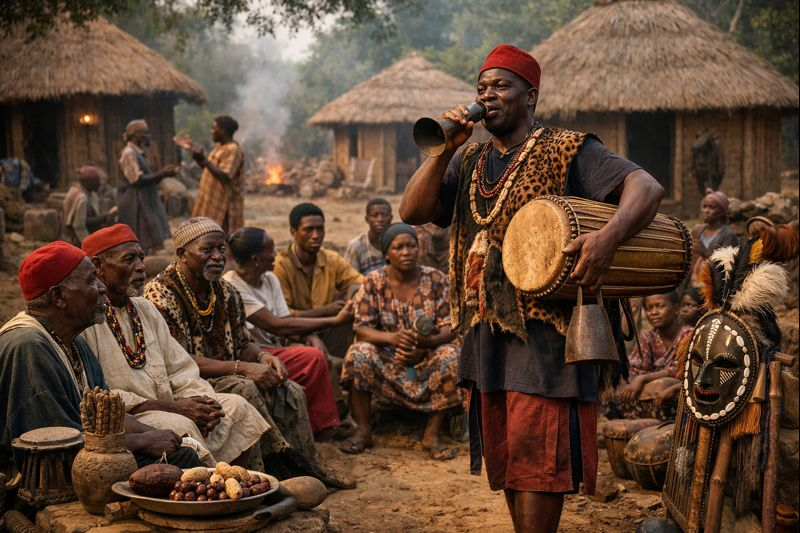
The traditional African communication systems included systematic forms of media whose regions of use were different, but with the same aim of social intent. These media were verbal communication, symbolic communication, ritual expression, musical instruments, and officially approved messengers.
Instruments of Music as Communication Media
The musical instruments such as drums, gongs, horns, and others were advanced communication technologies. In the case of West Africa, the coded linguistic information that was transmitted over long distances was expressed through the talking of drums. Certain rhythms marked an emergency, a community gathering, a celebration, or a lamentation. These instruments were also used as aesthetic and administrative instruments (Nketia, 1975).
Town Criers and Official Messengers
The communication in most African societies was formalized by the means of town criers or court heralds. Authoritative information about the governance, communal work, laws, or social events was propagated by the appointed people called chiefs or councils. Their communications could be relied on, as they were the representation of the legitimacy and accountability of the leaders.
Non-Verbal and Symbolic Communication
The African societies often used symbols and objects to represent structured meanings. Palm leaves, kola nuts, carved sticks, beads, feathers, and ritual items frequently conveyed the message of peace, threat, command, grieving, or divine forbiddenness. These symbolic codes were interpreted everywhere in their cultural backgrounds and served the purpose of binding communication.
Rituals, Festivals, and Ceremonial Communication
Ritual communication became a very important aspect of native African media. Initiation rites, harvest festivals, coronations, and ancestral celebrations served as ceremonies to pass cultural values, reassert identity, and enhance the intergenerational relationship. These happenings were mass educational ones, during which the society re-evaluated moral standards and societal duties.
Indigenous Media and Social Relevance and Cultural Values
Governance and Leadership
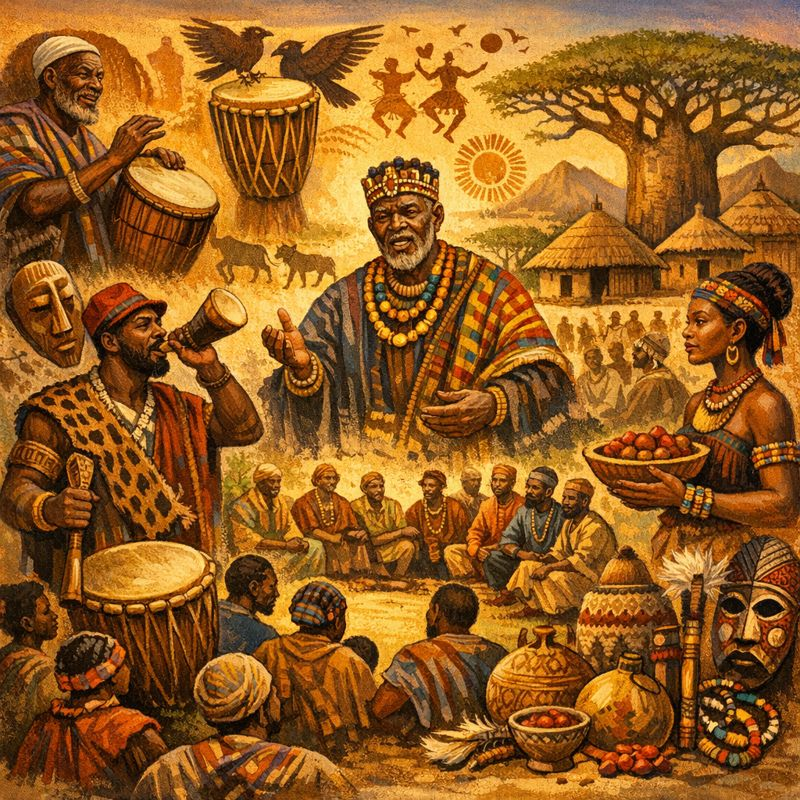
Political administration was based on traditional African systems of communication. The chiefs, elders, and the council institutions relied on the establishment of communication networks to rule efficiently. Leadership decisions were presented or communicated in the village assemblies, palaces, and communal squares, and consensus was made there (Skjerdal, 2012). This involvement was facilitated, which is why indigenous political communications were incredibly consultative.
Resolution of Conflict and Social Peace
The traditional African societies depended on dialogue-based communication as a means of resolving conflicts. The mediation by the elders was done by community hearings, storytelling, calls to the cultural values, and public reproach. The main aim was to restore sanity, but not to engage in punitive retribution. Communication was thus a reconciliatory, healing, and reintegration tool which was ethical.
Socialization and Ethical Education
Aboriginal communication systems played a key role in socialization of younger generations. Discipline, respect, honesty, bravery, and communal duty were acquired by the children through folktales, songs, mentorship, and communal teaching. This guaranteed cultural survival and moral development within community.
Cohesion and Identity of the Community
Conventional communication encouraged togetherness and unity. African societies created emotions of unity and social responsibility through communal meetings, communal rites, stories, and through interactive communication. Communication has been a carrier of culture that united communities.
Local Differences Within the Continent
Although there were basic similarities in the traditional African communication systems, their manifestations differed depending on the region:
West Africa
There were griots, talking drums, court communication systems, and town criers.
East Africa
There are strong traditions of clan meetings, narrative, pastoral forms of communication, and ritual narration.
Central Africa
Different applications of masks, ritual symbolism, musical communication, and community rituals.
Southern Africa
Underlined the council meetings (indabas), praise poetry, symbolic leadership tools, and collective discourse.
Regardless of these differences, the logic behind these differences was that people could communicate to maintain community life.
Still Relevance in Modern Africa
The traditional African system of communication is still very powerful even in the digital age. In Africa, in many rural and semi-urban settings, the elders, chiefs, town criers, and community meetings are still valid sources of information. Indigenous communication structures are adopted by government and development agencies in the public enlightenment campaigns because they command trust, legitimacy, and participation. (Servaes, 2008).
These systems do not disappear, but rather coexist with the modern media. They offer culturally based options that will be inclusive, authentic, and locally owned information processes.
Summary/ Conclusion
This article has delved into the ancient African communication systems and pointed out how the ancient societies managed to pass information in a very sophisticated manner, which preserved their culture and ensured social unity even before the emergence of the modern-day mass media.
The analysis showed that these systems were not spontaneous or primitive, but were well designed to have both practical and philosophical applications. African societies incorporated communication in the cultural practices, spiritual beliefs, and moral responsibility, based on the perception of the world in which the individual lives, mostly in a group context. Communities, through these systems, ensured that social order, morality, and community accountability were upheld between generations.
Channels and Forms of Indigenous Media
The analysis revealed that indigenous media used various channels and forms to fulfil the needs of the society. Knowledge preservation, moral education, and socialization of younger generations involved verbal communication via oral tradition of storytelling, proverbs, and praise poetry. Musical instruments such as talking drums, gongs, and horns helped in sending messages over long distances, making announcements, and during ceremonies.
The use of objects, ritual items, and visual codes was employed to communicate authority, warnings, and shared values in the community. Town criers and official messengers helped to disseminate vital information to all members of society. Rituals, festivals, and ceremonial performances also contributed to social cohesion, the passing of cultural knowledge, and provided a chance to reflect and impart morals as a community.
Social Relevance and Ethical Function
The paper has also highlighted the social relevance of indigenous communication. These systems constituted a part of governance, settlement of conflicts, and leadership as they provided tools for consultation, consensus-making, and mediation of disputes. They were also significant in socialization, ethical behavior, community roles, and cultural identity. In the various parts of Africa such as West, East, Central, and Southern Africa, the communication patterns and rhythms varied, yet the foundational understanding of community, participation, and social harmony was always consistent.
Continued Relevance in Modern Settings
Lastly, the study indicated how traditional African communication systems remain relevant in modern settings. Although the use of modern media has increased, elders, community meetings, symbolic rituals, and oral traditions are still dominant in rural and semi-urban settings. These systems present culturally grounded alternatives to the spread of information, the preservation of trust, and enhancement of social cohesiveness. On the whole, the example of African traditional forms of communication can be seen as an art of ingenuity, survival, and morality of indigenous African societies that also teaches timeless lessons about the importance of community-focused and culturally rooted ways of communication.
In conclusion, the traditional African communication systems depict that African communities had highly organised, philosophical, and socially effective media well before the advent of modern communication technology. The role of these indigenous systems was essential in the system of governance, conflict resolution, socialization, and unity of communities. They remain useful for the provision of insights into the culturally held communication practices that can reinforce participation and togetherness in contemporary African settings.
Knowing these systems is necessary, hence not only to understand African history, but also to develop culturally responsive ways of communicating currently.
References
Ansu-Kyeremeh, K. (2005). Indigenous communication in Africa: Concept, applications and prospects. Accra: Ghana University Press.
Finnegan, R. (2012). Oral literature in Africa. Cambridge, UK: Open Book Publishers. https://doi.org/10.11647/OBP.0025
Mbiti, J. S. (1969). African religions and philosophy. London: Heinemann.
Nketia, J. H. K. (1974). The music of Africa. New York, NY: W. W. Norton.
Servaes, J. (Ed.). (2008). Communication for development and social change. Thousand Oaks, CA: SAGE Publications.
Skjerdal, T. S. (2012). The three alternative journalisms of Africa. International Communication Gazette, 74(7), 636–654. https://doi.org/10.1177/1748048512458559
Ugboajah, F. O. (1985). Mass communication, culture and society in West Africa. London: Hans Zell Publishers.