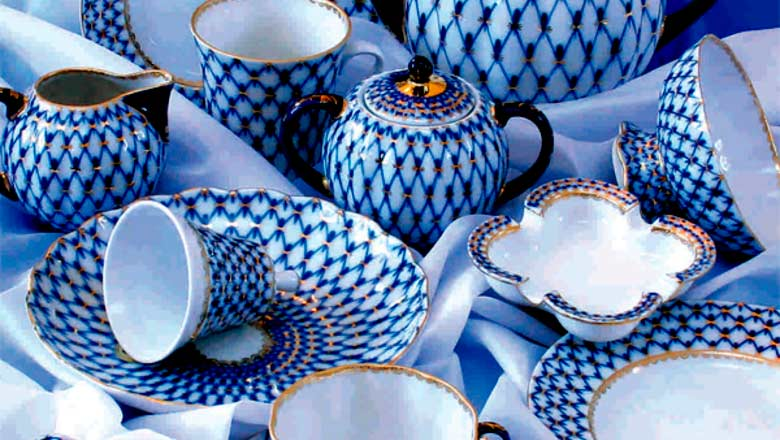
History and Artistic Significance of the cobalt net Pattern
The origin of the iconic Lomonosov porcelain cobalt net pattern dates back to the 18th century, when the Imperial Porcelain Manufactory in Saint Petersburg began experimenting with deep blue decoration on fine white porcelain. Influenced by earlier European and Asian blue-and-white traditions, the cobalt net developed into a uniquely Russian aesthetic: a delicate, geometric lattice of hand-painted cobalt lines that forms a textured, almost textile-like surface across cups, plates, and vases. Collectors and historians alike value the pattern for its synthesis of technical skill and visual restraint.
Artistically, the cobalt net embodies a marriage of precision and spontaneity. Each piece begins as pure white porcelain, the canvas for a highly controlled underglaze technique. The cobalt pigment, finely ground and mixed, is applied by skilled painters who trace meticulous lines to create the netting. Slight variations in spacing and brushstroke produce a lively surface that reads as both pattern and handwork. Because of those subtle irregularities, authentic pieces celebrate the human touch rather than machine uniformity.
Over time, the pattern moved beyond mere utility and became a symbol of prestige and refined taste in Russia and abroad. Emperors, aristocrats, and diplomatic houses commissioned services decorated with the net, using them at state dinners and important ceremonies. The cobalt net’s restrained color palette—intense blue against pure white porcelain—allowed it to complement a wide range of table settings and interiors, which has helped sustain its popularity through changing design trends. Museums and private collections now highlight the pattern not only for its beauty but for its representation of Russian cultural heritage and porcelain craftsmanship.
Craftsmanship, Materials, and Production Techniques
Creating true Lomonosov porcelain cobalt net requires mastery across multiple stages: formulation of the porcelain body, preparation of the cobalt underglaze, application, glazing, and high-temperature firing. The porcelain body itself is formulated to achieve pristine whiteness and fine translucency, a technical achievement that allows the cobalt blue to appear luminous and pure. Cobalt oxide, prized for its durable and vivid blue, is mixed into a finely controlled medium so that it flows predictably from the brush while maintaining intensity after firing.
Application of the cobalt net is performed by painters trained in a disciplined, traditional method. Using a steady hand and a fine brush, they draw intersecting lines to form the lattice, often varying line thickness intentionally to create depth and rhythm. This stage is critical: once applied, adjustments are limited because the underglaze pigment bonds with the porcelain body during firing. After decoration, a clear glaze is applied to protect the surface and to enhance the contrast between the white ground and the deep blue network. The piece is then fired at high temperatures where the glaze vitrifies and the cobalt develops its characteristic hue.
Authenticity and quality can be gauged through a few telltale signs: the translucency and whiteness of the body, the depth and consistency of the blue, and the natural, slightly irregular brush marks that indicate handwork. Modern reproductions sometimes mimic the look but often lack the porcelain’s fine grain or the pigment’s depth achieved through traditional firing. For discerning buyers and interior designers, recognizing these differences matters not only for aesthetic reasons but also for value and longevity. Workshops associated with the Imperial Porcelain Manufactory still produce pieces using many of these historic techniques, ensuring continuity of quality for collectors and interiors that favor artisanal detail.
Collecting, Styling Interiors, and Real-World Examples
As an element of interior décor and a collectible, Lomonosov porcelain cobalt net lends a refined, timeless note to settings ranging from classic dining rooms to modern minimalist kitchens. The pattern’s crisp contrast and rhythmic geometry make it versatile: a full service creates a statement on a formal table, while a few accent pieces—tea cups, a sugar bowl, or a serving platter—introduce a touch of heritage and color without overwhelming contemporary interiors. Retailers and boutiques specializing in porcelain frequently advise mixing cobalt-net items with plain white linens, natural wood, and brass accents to balance tradition with current design trends.
PorzellanHaus, as a leading partner of the Imperial Porcelain Manufactory, curates selections that help customers integrate these pieces into distinctive interiors. Case studies from clients show how a single artefact can anchor a room: a cobalt net tea set placed on an oak sideboard, paired with linen napkins and a small flower arrangement, creates a cozy nook for leisurely afternoons; alternatively, a set of cobalt net dessert plates used as wall-hung décor introduces pattern and color in an entryway. The tactile quality of the hand-painted lattice invites close inspection and conversation, making these pieces both functional and sociable artworks.
Collectors often reference provenance and condition when evaluating pieces. Museum-quality examples or those with documented historical use command premium prices, while newer handcrafted services offer accessible entry points for enthusiasts. For those interested in purchasing authenticated items, viewing a curated selection online can be informative. One such resource is the collection presented by PorzellanHaus, where you can explore genuine pieces like the Lomonosov porcelain cobalt net and find detailed descriptions that help match items to personal style or interior schemes.