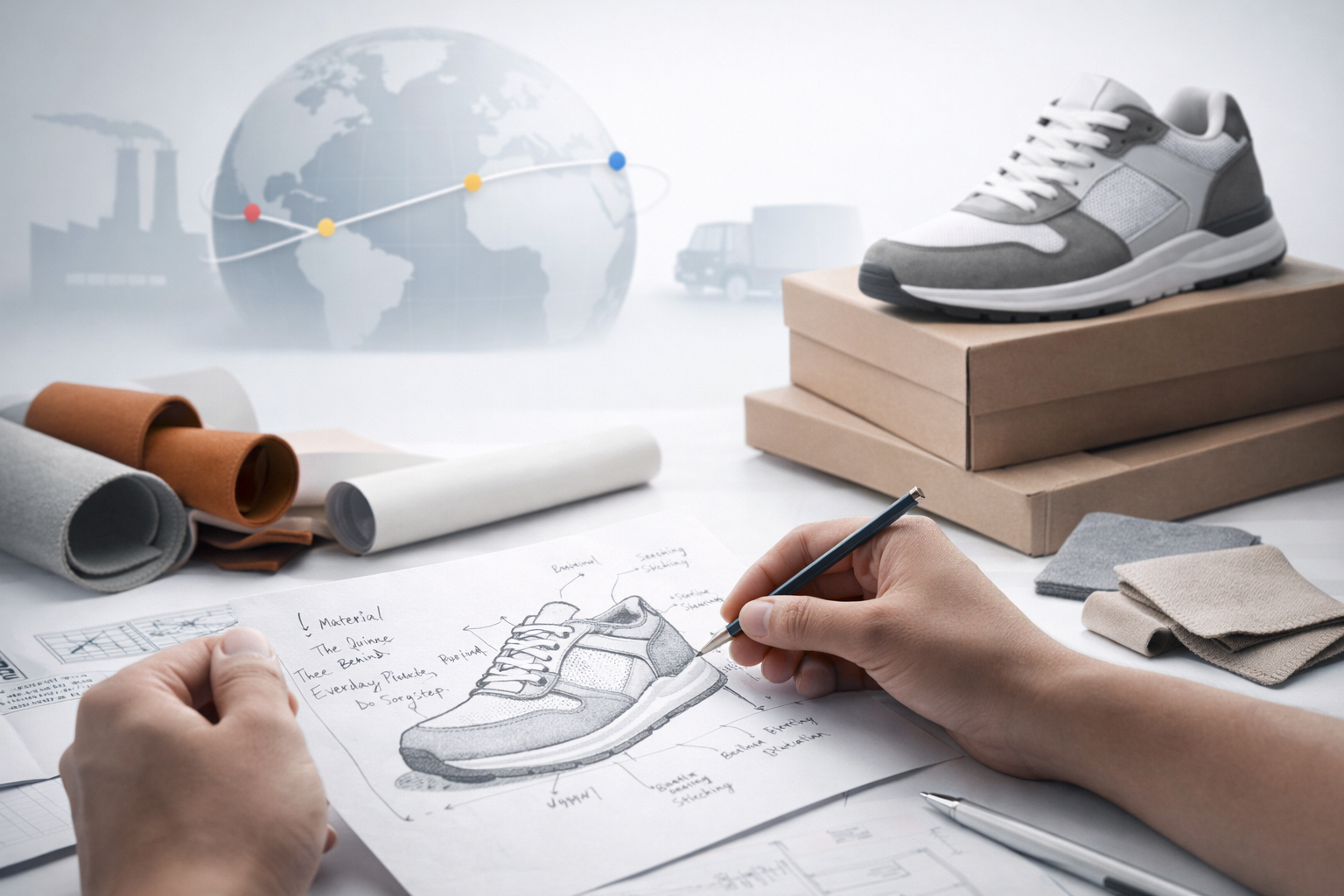
It’s easy to forget that most of what we buy started as someone’s rough idea—maybe a sketch, maybe a note on a phone, maybe a half-working prototype on a desk. By the time it shows up at your door, it feels “finished,” like it always existed that way.
But the truth is: a lot happens between “this would be cool” and “add to cart.” And once you see that behind-the-scenes path—materials, samples, factory runs, quality checks—you start to understand why two items that look almost identical can feel totally different in real life.
The basic path most products take (no insider knowledge needed)
Whether it’s a backpack, a water bottle, a phone case, or sneakers, the route is usually something like:
- An idea turns into a plan (what it’s made of, what it needs to do)
- A plan turns into samples (the first real version you can hold)
- Samples turn into production (hundreds or thousands of copies)
- Production turns into shipping (boxes, labels, warehouses, delivery trucks)
That sounds straightforward—until you realize how many tiny decisions live inside each step.
Where quality really starts: the “boring” details
When something feels solid—stitching that doesn’t snag, materials that don’t peel, a fit that stays comfortable—that usually traces back to the part nobody sees: the product “spec.”
A spec is basically the instruction sheet for what gets made. Not marketing (“premium,” “high quality”), but specifics:
- what material (and what grade)
- thickness or density targets
- how seams or joins should hold
- how it should fit or flex
- what the finish should look like after use
When those details are fuzzy, the final product is more likely to vary. And that’s where you get that frustrating experience of buying the “same” thing twice and wondering why the second one feels off.
Why samples matter more than people think
The first sample of a product is often a reality check.
Something that looked great in a design file might feel stiff. A color might look different in daylight. A seam might rub. A handle might feel awkward once it’s loaded. Shoes are especially notorious for this—fit, comfort, and materials all interact.
Brands that take quality seriously usually go through more than one sample round. Not because they’re perfectionists, but because the first version almost always reveals something you didn’t anticipate.
Mass production is where consistency gets tested
Once a product moves into a real production run, the big challenge isn’t “can we make it?” It’s “can we make it the same way every time?”
Even if the design stays the same, small things shift:
- a different batch of material behaves slightly differently
- a machine drifts and needs calibration
- different workers interpret steps slightly differently
- timelines tighten and finishing gets rushed
That’s why “quality control” matters—not as a buzzword, but as a simple idea: checking that what’s being produced matches what was supposed to be produced.
The hidden helpers that make small brands possible
A lot of people assume only huge brands can make decent physical products. But if you’ve ever bought something from a smaller online brand and been surprised it felt genuinely well-made, there’s often a reason: they didn’t try to figure everything out alone.
Many founders lean on partners who help with the unglamorous parts—finding suitable suppliers, coordinating samples, organizing inspections, and keeping communication clean so fewer things get lost in translation.
Footwear is a good example because it’s complicated in very normal ways (fit, comfort, materials, construction). If you’re curious how the process works, guides like fuleisourcing walk through a straightforward “here’s what people actually do” approach to importing shoes—useful even if you’re not importing anything, because it shows where mistakes and quality issues commonly start.
And if you’ve ever wondered what sourcing companies actually do (and how they differ), a simple overview like fuleisourcing breaks down common roles and services people compare—things like supplier vetting, sample coordination, and quality checks.
How to shop smarter without turning it into a hobby
You don’t need to learn manufacturing terms to make better calls as a buyer. A few small habits help:
1) Look for real details
If a product page can’t tell you what something is made from—or hides behind vague “premium” language—treat it like a warning sign.
2) Notice patterns in reviews
One bad review can be anything. But repeated comments like “inconsistent sizing,” “quality varies,” or “my second one was different” often point to consistency issues upstream.
3) Be cautious with extreme discounts
Sales are normal. But when pricing looks wildly lower than comparable items, it can be a clue that something was optimized mainly for cost—materials, construction, or consistency.
4) Buy for the job
A stylish sneaker might be perfect for errands and terrible for all-day walking. The product didn’t “fail”—it was just built for a different use.
The bigger idea: products are the result of choices
Most items we use every day aren’t “good” or “bad” by accident. They’re the outcome of priorities—speed, cost, consistency, durability—plus how carefully the boring steps were handled.
Once you notice that, shopping gets less mysterious. You start paying attention to specifics, not hype. And you get better at spotting the quiet signs that something was built thoughtfully—before you ever click “buy.”