Abstract
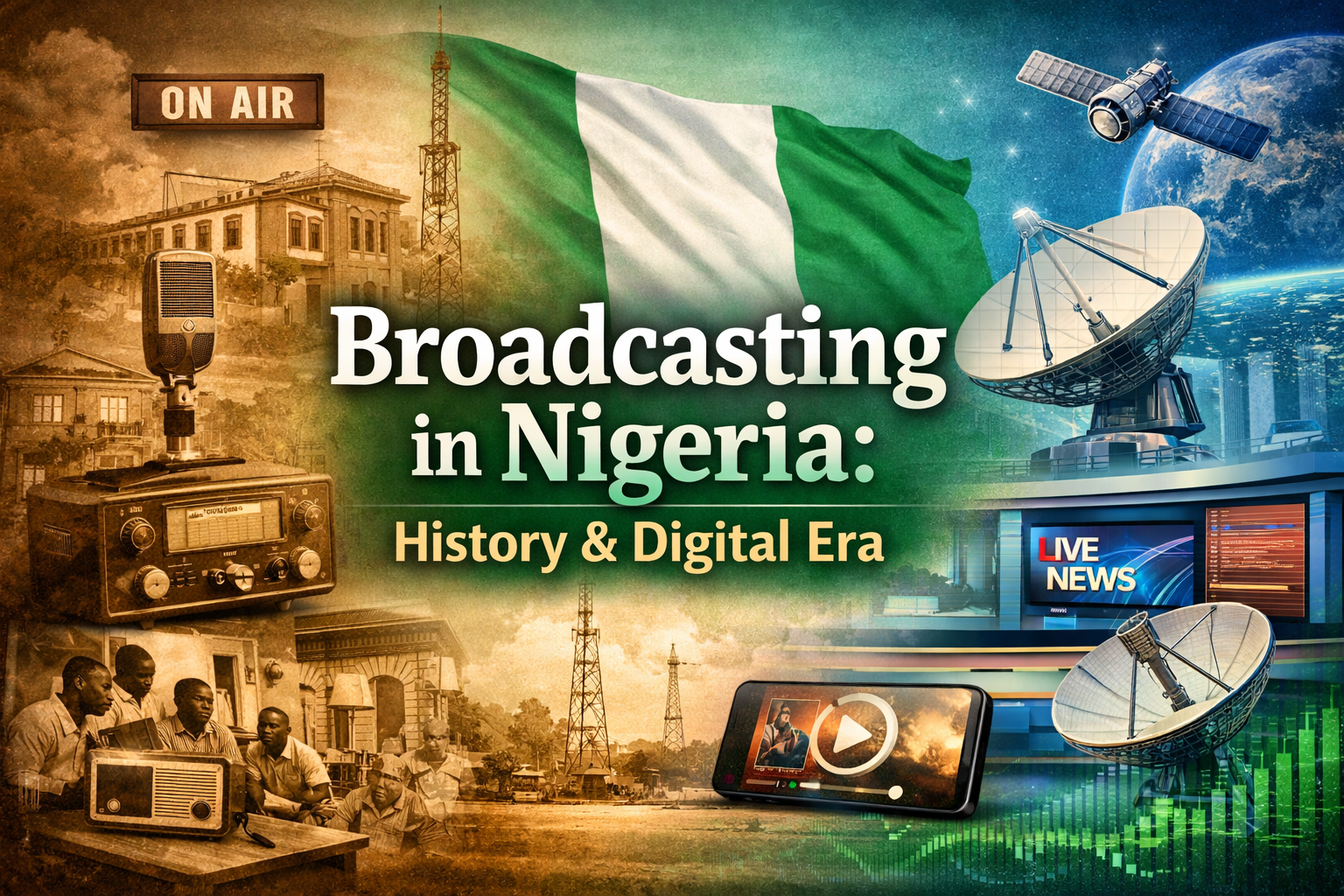
Broadcasting in Nigeria has experienced a radical change from being a colonial administrative communication experiment to one of the most vibrant media systems in Africa. This paper follows the historical path of broadcasting in Nigeria, starting with the initial relay services in the 1930s to the national development of broadcasting after independence, the military control of broadcasting, the liberalisation of broadcasting in the 1990s and the modern process of digitalisation of broadcasting. Contextualizing the experience of Nigeria in the context of world technological developments, the paper explores the way broadcasting has developed as a governance mechanism and as a mass communication tool, a cultural expression, and a democratic instrument. The article is an evaluation of the institutional development, policy reforms, adoption of technologies, and other socio-political factors that affect the sector using historical and qualitative analytical tools. Results indicate that Nigerian broadcasting is indicative of the general shifts in communication technology and political power; these changes indicate that the conflicts between state control, commercial interests, and ideals of the public service broadcasting remain unresolved.
Keywords: history of broadcasting, Nigerian media development, colonial communication media, digital broadcasting, media policy, public service broadcasting.
Introduction
Broadcasting is a key figure in the communication industry of Nigeria as it affects the politics, education, culture and national identity. Further elaboration of broadcasting in the country is inseparable from the colonial administrative agenda, technological advancement across the world, and the transformation of the government systems. Initially, the early broadcasting systems were meant to spread imperial messages, but these eventually became effective tools of national integration and democratic discussions.
The historical development of the Broadcasting Organisation of Nigeria and other related institutions explains why broadcasting in Nigeria shifted its centralized colonial dominance over the media to pluralistic and technologically advanced forms. The knowledge of this evolution will give an insight into how communication infrastructures influence change in society.
Broadcasting in the world grew alongside the radio transmission, electromagnetic theory and electrical engineering in the first half of the twentieth century. Nigeria has adopted these tendencies, but it was influenced by peculiarities of colonization, culture and politics. It is in this article that broadcasting is considered in terms of a technological process as well as a socio-political institution.
Literature Review
The literature on broadcasting in Nigeria highlights three hegemonic approaches to the subject, including the colonial communication theory, developmental media theory, and political economy approaches.
Early researchers like Uche (1989) make the argument that colonial broadcasting was more of a continuation of the British administrative power than a form of participation in communication. On the same note, Head (1974) noted that the broadcasting systems that were introduced in British colonies were focused on imperial messaging and social control.
Subsequent research was focused on post-independence growth. A study by Oso (2012) has indicated that broadcasting was also a means of nation-building, especially by regional stations, which enhanced the linguistic diversity but at the same time strengthened national consciousness. In the meantime, Salawu (2009) discussed the impact of deregulation on the media economy in Nigeria by introducing market competition and privatization.
The new literature is concerned with digitization and convergence. According to scholars, online streaming and digital broadcasting services have disrupted the nature of the engagement of the audience, undermining traditional monopolies and broadening access to the media (Adeyemi, 2020).
Taken together, these works indicate that the development of broadcasting in Nigeria is reflecting the changes in the worldwide trends, i.e. the change of the state monopoly to the mixed public-commerce frameworks, which are affected by technological innovation.
Conceptual Review
Communication System Broadcasting
Broadcasting is defined as the delivery of audio or audiovisual messages to widely scattered audiences through electromagnetic waves or digital lines. Historically, it consists of radio and television broadcasts using transmitters and receivers whose work falls within controlled frequency bands.
Public Service Broadcasting
Public service broadcasting focuses on education, cultural conservation and equitable information broadcasts. The initial national broadcasting institutions that arose in Nigeria were partly shaped by the ideology of the BBC that called on broadcasting to be a social duty as opposed to a business venture.
Media Liberalization
Media liberalization entails the opening of the broadcasting industries to private ownership at the expense of state monopoly and the infusion of competition in the industry and innovation. The transition in Nigeria in the 1990s gave a big conceptual turn towards pluralism.
Theoretical Framework
The paper relies on the Development Media Theory and Technological Determinism in the first place.
According to the Development Media Theory, the media systems in the developing countries tend to fulfill the national development objectives like education, modernization and unity (McQuail, 2010). This perspective is traditionally reflected in Nigerian broadcasting, especially when nation-building after independence.
In contrast, Technological Determinism argues that social and institutional change are caused by technological innovation. The emergence of FM transmission, satellite broadcasting and digital platforms fundamentally changed the Nigerian media structures and audience behavior.
These theories, as a combination, explain how the political goals and technological abilities influenced the evolution of broadcasting together.
Methodology
The present article has a qualitative approach to historical research based on:
- Archival Analysis – Research of historical data, policy and institutional reports.
- Literature Review – Literary analysis of scholarly works that discuss the history of the Nigerian media.
- Comparative Historical Analysis – Placing the broadcasting development in Nigeria in its global broadcasting trends.
The methodology permits an interpretive analysis approach instead of a statistical measurement focused, which highlights the institutional change and evolution of policies.
Findings
Broadcasting in Nigeria: a History (Colonial Beginnings (1930s-1950s)
In Nigeria, broadcasting started in 1932 with Radio Distribution System (RDS) being launched as a wired relay service where the broadcasting carried out in Britain transmitted these programs to select urban listeners. The system mainly retransferred the BBC content, making sure that the colonial administrators could easily spread information.
In 1951, the Nigerian Broadcasting Service (NBS) was formed, and it transitioned to localized productions. Nevertheless, the editorial direction was still closely related to the colonial governance goals.
Regionalization and Pre-Independence Expansion (1950s-1960)
In 1951 Macpherson Constitution brought about regional autonomy whereby regional governments were allowed to set up broadcasting stations. In 1959, Western Nigeria opened the first television station in Africa, which shows that it is fast adopting technology.
Broadcasting started moving towards the establishment of regional identity instead of colonial propaganda. Programmes were more and more in local languages, music, and local storytelling.
National Broadcasting (1960-1979) Post-Independence
The broadcasting became a strategic instrument of nation-building after the independence in 1960. The federal government formed the Nigerian Broadcasting Corporation that dealt with unifying broadcasting services and ensuring nation cohesion.
The Nigerian Civil War (1967-1970) demonstrated the important role of radio in forming public opinion and political discourse, and it is an example of the ability of broadcasting to influence the image.
In 1977, the television services were merged into the Nigerian Television Authority (NTA) forming one of the largest television in Africa. Educational broadcasting, agricultural broadcasting and cultural promotion programs were increased.
Centralization and Military Era Regulation (1979-1992)
Military regimes tightened state censorship on broadcasting and considered media as a political stability and management of information. As infrastructure was being developed around the country, there was little editorial autonomy.
Radio broadcasting was centralized under the federal control with the formation of the Federal Radio Corporation of Nigeria (FRCN). Although there were political barriers, advancement in technology enhanced the reach of the transmission in rural regions.
Liberalization and the Emergence of Private Broadcasting (1992- 2000s)
The breakthrough came in 1992, when the national broadcasting commission (NBC) was established by Decree No. 38. Through this reform, the radio and TV stations were privatized to enable the owners to own them.
The liberalization period brought in competition, demarcated content and provoked investment. The growth of the entertainment programmes, investigative journalism, and advertisement-driven model of broadcasting was witnessed in the private stations.
This was also during the time of the internet development of satellite television in the world and the Nigerian people began to see world media content and modernization took place.
Digital Transformation and Contemporary Broadcasting (2010-Present)
The process of digitalization of broadcasting in Nigeria is consistent with the international telecommunication unit (ITU) standards of migrations across the world. In digital broadcasting, there was an enhancement of the quality of the signal, increased capacity of channels and convergence of multimedia.
Mobile broadcasting, internet-based radio and streaming are now complementing the traditional terrestrial systems. Audience consumption is more smartphone and social media-driven, and it is challenging broadcasting boundaries.
In general, the paper finds some major trends in the development of the broadcasting situation in Nigeria:
- Colonial Foundations: Broadcasting was originally used to represent the administrative rather than the people.
- Nation-Building Role: The post-independent governments relied on broadcasting to foster unity and development.
- State Control vs. Media Freedom: Military governments focused on centralization, which influenced editorial designs.
- Liberalization of policy: Deregulation led to diversity and innovativeness and commercial sustainability.
- Technological Adaptation: Digital migration made broadcasting into a hybrid multimedia ecosystem.
These results prove that the development of broadcasting was closely dependent on the changes in politics and technological progress.
Discussion
History of broadcasting in Nigeria demonstrates a world trend of the development of communication technologies in line with governance systems. Colonial broadcasting followed imperial forms of communication at the time when post-independence growth was associated with the developmental ambitions.
The liberalization period was a turning point in the ideology of state monopoly to media pluralism. Nevertheless, the industry is encountering a number of threats such as the pressure of regulations, financing constraints of state media companies, and the threat of digital platforms.
Online broadcasting has erased the borderline dividing broadcasting and online media and has posed new challenges on regulation, ownership of content and measurement of the audience. The Nigerian young population and the large mobile penetration are indicators that further expansions in hybrid forms of broadcast-digital are likely to increase.
Conclusion
History and development of broadcasting in Nigeria is an indication of a vibrant interplay between technology, politics and society. Starting as a colonial relay system aimed to establish administrative communication practices, broadcasting had evolved to become a strong national institution that influences education, culture and democratic practices.
The most important changes within the sphere of institutions, technological introduction, and liberalization of the policies had facilitated the development of the sector into a multi-faced and competitive media landscape. Digital broadcasting is a continuation and a revolution today, preserving the mass communication aspect of broadcasting and incorporating the interactive and online capabilities.
Knowing this historical pattern offers critical understanding of the future of the Nigerian media where innovation has to be able to balance its duties to the people, regulatory factors and the sustainability of the media business.
References
Adeyemi, T. (2020). Digital broadcasting and media convergence in Nigeria. Lagos: University Press.
Head, S. W. (1974). Broadcasting in Africa: A continental survey. Temple University Press.
McQuail, D. (2010). McQuail’s mass communication theory (6th ed.). Sage Publications.
Oso, L. (2012). Press and politics in Nigeria: On whose side? Journal of African Media Studies, 4(1), 23–41.
Salawu, A. (2009). Media liberalization and democracy in Nigeria. Ecquid Novi: African Journalism Studies, 30(1), 85–99.
Uche, L. U. (1989). Mass media, people, and politics in Nigeria. Concept Publishing.
National Broadcasting Commission. (2018). Nigeria broadcasting code. Abuja: NBC Publications.