The human brain is the most complicated organ in the body which controls all the thoughts, movements, emotions, and behaviors. Though it is approximately three pounds, it contains billions of neurons and trillions of connections that determine the way we think, learn, act, and perceive the world. Knowing the anatomy of the brain enables us to appreciate the role or impact of the brain structures on personality, memory, coordination and overall neurological well being.
The list of the key parts of the human brain, such as cerebral cortex, cerebellum, and the brainstem, as well as the functions performed by each of the lobes, are examined below.
Introduction to Structural Organization of the Human Brain
The brain consists of three major sections:
- Cerebrum (Cerebral Cortex)- the part of the brain that deals with higher thinking, memory and voluntary movements.
- Cerebellum – coordinates, maintains the posture, and stability.
- Brainstem – regulates the crucial automatic processes like heart rate and breathing.
These areas liaise in ideal collaboration to ensure that the body operates and enables us to relate with our own surroundings.
Learning the Brain how it works
This study examines the meetings between a supply chain operations manager and the company’s general manager.<|human|>This paper analyses the interactions between a supply chain operations manager and the general manager of the company.
Cerebrum: The Biggest and the Topmost Division of the Human Brain
The cerebrum constitutes approximately 80 percent of the total mass of a brain and is the part of the brain that deals with advanced cognitive abilities like problem-solving, language, imagination, planning, voluntary movement as well as conscious perception. It is divided into:
- Left hemisphere: logical, language, analytical.
- RH: imagination, spatial judgment, emotional comprehension.
The two hemispheres are linked by a deep structure known as corpus callosum that allows communication and coordination between the two hemispheres.
Cerebral Cortex: Processing Exterior
The cerebral cortex is a grey matter layer that is thin and extensively folded. It holds neurons that process sensory data as well as allow complex thinking. The crevices (gyri) and gullies (sulci) augment the surface area with millions of neurons fitting on a small territory.
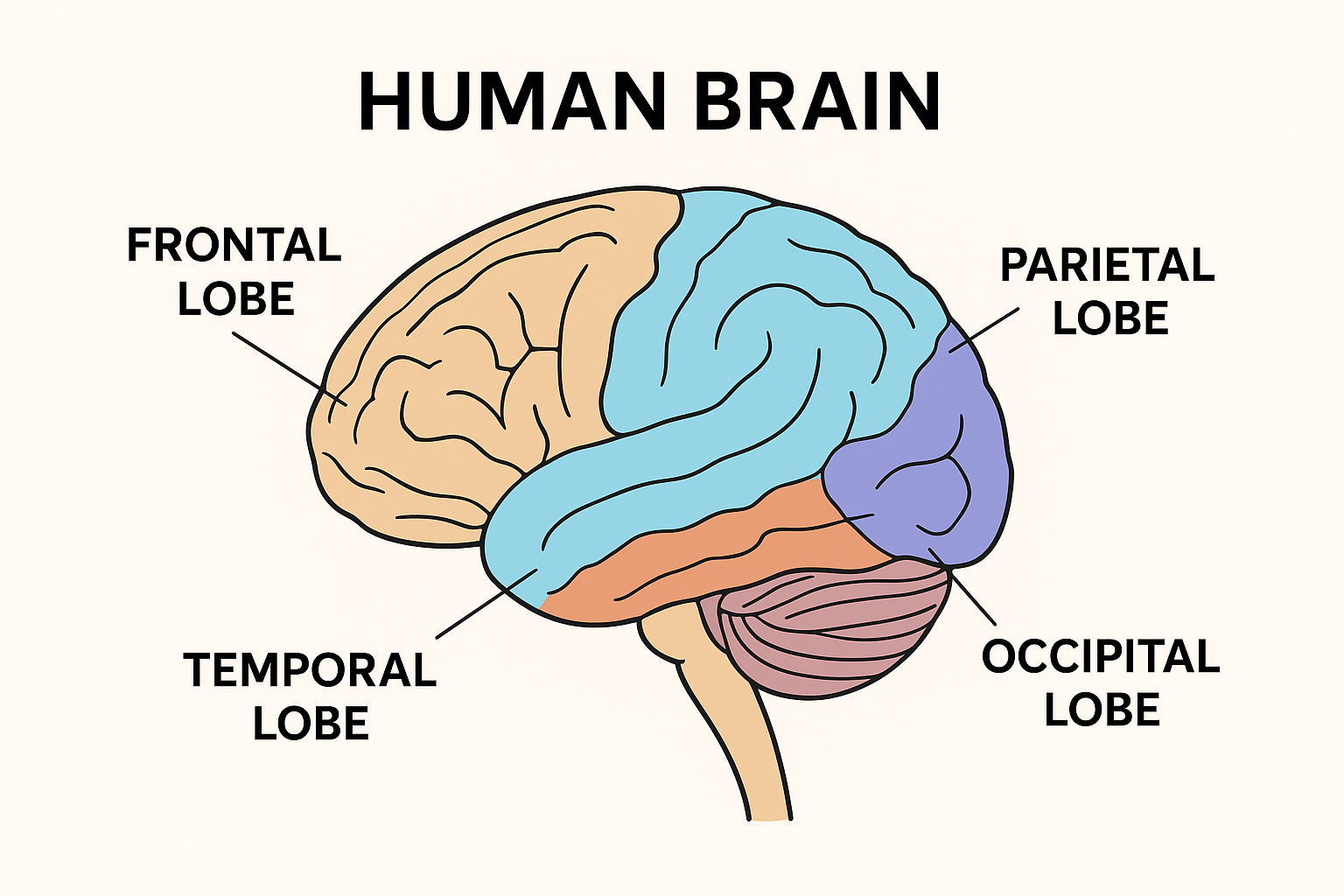
The cortex consists of four great lobes:
- Frontal Lobe
- Parietal Lobe
- Temporal Lobe
- Occipital Lobe
The lobes have their characteristic functions vital to daily life.
Human Brain Major Lobes and their functions
Frontal Lobe: The Brain Centre of Reasoning, Decision-Making, and Movement
The largest lobe is the frontal lobe located by the front of the brain. It supports:
- The voluntary movement (primary motor cortex) is the initial movement.
- Decision making and planning.
- Focus and problem analysis.
- Emotional regulation
- Social behavior and personality.
- Production of speech (area of Broca)
The frontal lobe has been termed as the control panel of the brain due to its contribution in personality and reasoning.
The Frontal Lobe has key structures that include the following
- Motor Cortex: It activates voluntary movements.
- Prefrontal Cortex: Prefrontal cortex allows making judgments, reasoning, controls impulses and plans ahead.
- Controlled speech production: Broca Area.
Injury to this region can impair behavior, motor control or speech.
Parietal Lobe: Interpreting Sense of touch, space and senses
The parietal lobe is found at the top and back of the head and assists the brain in the interpretation of the sensory input of the skin and body.
Main functions include:
- Touch, temperature, pain processing.
- Spatial identification and orientation.
- Perceiving creates, separates and links.
- Coordinating movements of hands and eyes.
- Combining information of the senses (e.g., to identify objects through touch).
The parietal lobe contains the somatosensory cortex that is important in the perception of textures, pressure, vibrations, and position of the body.
Temporal Lobe, memory, hearing and learning emotional things
One of the significant functions of the temporal lobe is found on the side of the brain close to the ears and this is the temporal lobe.
- Sound interpretation and hearing.
- Making of memory (long-term memory in particular)
- Language understanding (area of Wernecke)
- Affective learning and reactions (amygdala).
Multifunctional Structures of the Temporal Lobe
- Hippocampus: Transforms short-term memory into long-term storage.
- Amygdala: Fear, emotions, and emotion memory processing.
- Wernicke Area: Helps comprehend the spoken and written language.
Damage to the temporal lobe can impair interpretation of speech, creation of memories or emotions.
Occipital Lobe: Visual and Vision Interpretation
Occipital lobes are at the back of the brain and it is completely involved with visual perception.
Its functions include:
- Movement, color and light processing.
- Shapes and recognition of objects.
- Visual interpretation of information in the eyes.
- Controlling visual memory
The major visual cortex (V1) gets the direct input of the retinas and passes the visual information to other parts of the brain to form the total images.
An injury can result in the loss of visual ability, the inability to notice movement, or the inability to identify objects in the occipital lobe.
The Cerebellum: Center of Equilibrium and Co-ordination
The cerebellum is located below the cerebrum and it is located behind the brainstem. It is the smallest part of the brain but it has more neurons than the whole cerebral cortex.
Its major operations are:
- Balance and posture
- Organization of voluntary movements.
- Fine-tuning motor actions
- Learning to ride a bicycle (e.g. motor learning)
- Performing accuracy and timing.
The cerebellum does not trigger movements but enhances its precision and fluency. It guarantees smooth and controlled movements that are well coordinated.
The Brainstem: Window into the Brain and Body
The brainstem is the primal and the most essential of the human brain. It is what links the brain to the spinal cord and regulates the key automatic functions that are needed to survive.
The brainstem is subdivided into:
Midbrain
- Controls eye movements
- Audiological and visual reflexes.
- Helps control wakefulness and sleep.
Pons
- Precedes the movement between the left and right side of the body.
- Controls facial expression and feelings.
- Participates in the control of breathing.
Medulla Oblongata
- Controls heart rate
- Regulates blood pressure
- Maintains breathing rhythm
- Controls reflexes, i.e., swallowing, coughing and blinking.
The presence of even the minor injuries in the brainstem may be life-threatening since this part of the brain controls the processes that are of fundamental survival importance.
The Brain Anatomy and its effect on Behavior and Neurological Health
The behavior of all humans, speaking, learning, and even responding emotionally, is dictated by certain structures of the brain. In case of an injury or disease in any section of the brain, it is commonplace to show a correlation between the functions of that specific area with the symptoms.
Examples
- Damage to the frontal lobe can have an impact on personality or decision-making.
- Space awareness may be affected by injury to the parietal lobe.
- The disorders of the temporal lobes can refer to the memory or language.
- Visual disturbances may result when there are problems with the occipital lobe.
- Cerebellar diseases typically cause clumsy movement or co-ordination.
- Brain stem lesions impact on the lives functions such as breathing.
The knowledge of the areas that regulate which functions allow clinicians to diagnose stroke, epilepsy, dementia, and traumatic brain injury.
Conclusion
The human brain is an amazing organ that is the control center of all the thoughts, motions, and emotions. With its three large parts or its three major parts- the cerebrum, cerebellum and the brainstem, it is able to store memories, coordinate actions, control vital functions and mold our mental capabilities.
The brain has exclusive responsibilities that are performed by each lobe:
- Decision-making and movement are controlled by the frontal lobe.
- The parietal lobe handles the sense and space sense.
- Memory and sound interpretation is done in the temporal lobe.
- Visual processing is done in the occipital lobe.
Learners can also gain an insight into how these structures operate to understand the role of brain structure in determining behavior and serving to keep the brain healthy over a lifetime.