Introduction
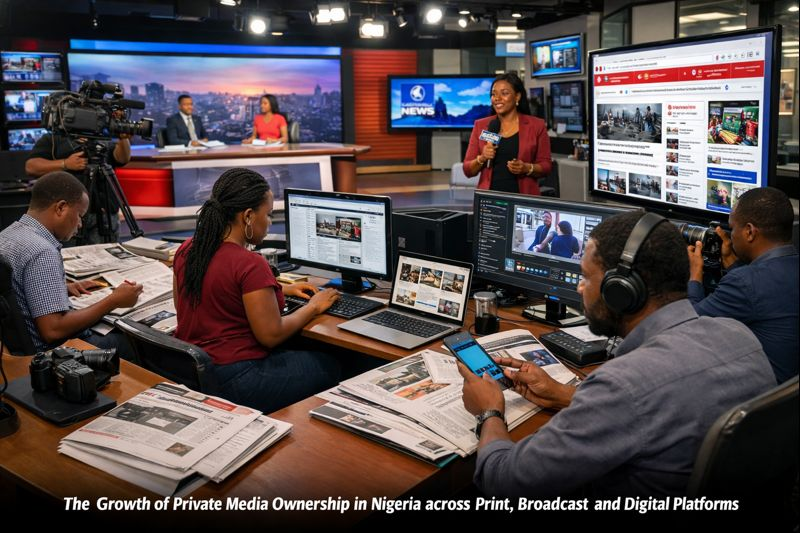
Nigerian media environment has been changing tremendously over the decades, transforming from a wide-ranging system dominated by the state to private media ownership, one where a mixture of individual investment, competition, and technology transforms the media landscape significantly. This development represents general political, economic and social shifts in the nation.
The development of the private media in Nigeria was a turning point from state media monopoly to greater pluralism in the media. This transformation has promoted opinion diversity, better content and innovation in all print, broadcast and digital media.
This article documents the emergence of private media houses like The Guardian, Punch, Channels Television and independent radio stations, the role of commercialization and participation by the private in the media content, competition and the involvement of the audience.
History of Media Ownership in Nigeria
Colonial and Early Post-Independence Media Structure
The initial media practice in Nigeria was marked by privately owned newspapers like Iwe Irohin in 1859. However, the press was heavily controlled during the colonial period. This still saw the newspapers agitate on nationalistic grounds. The acquisition of government ownership grew very fast after independence in 1960, with the regional and federal government setting up radio and television stations to encourage unification and development.
As the state media were dominating the airwaves, the private press still existed and, in most cases, acted as watchdogs and critics of the government policies. Their reach and influence were however curtailed by restrictive laws, military interventions and censorship.
Development of Commercial Media Consciousness
Late in the 1970s and 1980s, commercial media ventures were able to be established by economic liberals and urbanization. Media started to be regarded by the private investors as advocacy mechanisms as well as viable business opportunities. Income of advertisements, sales of circulation and audience rating developed to be essential survival instruments and professionalized journalism and competitive media practices were laid.
The Emergence of Privatized Print Media Organizations
The Intellectual Journalism and the Guardian Newspapers
The Guardian newspaper came into existence in the year 1983 and had an evident editorial philosophy that focused on intellectualism, investigative coverage and social responsibility. The Guardian has positioned itself as a policy paper among policymakers, scholars and professionals unlike sensational tabloids.
The editorial in the papers was privately owned and this gave the press freedom to criticize the policies of the government and the military regimes without the interference of the state. Investment in a pool of knowledgeable journalists, foreign correspondents, and editorial training went up, which increased the quality of content and improved credibility. The structure, use of language and topic of the paper have contributed to a new standard in print journalism in Nigeria.
Mass Appeal and Punch Newspapers
Punch was established in 1971 and followed a different approach that was equally influential. It was aimed at accessibility, the issues of everyday life, and popularity.
Punch’s commercial rivalry compelled the company to be innovative in the presentation of news and increase circulation across the country. The advertising-driven nature of the newspaper stimulated content that focused on the audience, creating high readership and creating long-term growth. Privacy of ownership therefore played a part in responsiveness to the interest of the people instead of the political directive.
The Opening of Broadcasting and the Birth of Private Television
Deregulation and the NBC Era
A big breakthrough was achieved in 1992 when the National Broadcasting Commission (NBC) was formed and legalized broadcasting in Nigeria. This policy change terminated the decades of state monopoly and liberalized the airwaves to private investors.
The deregulation saw the rise of privately owned radio and television stations which brought competition, professionalism and innovation to broadcasting.
The Channels Television and News Excellence
In 1995, Channels Television was founded, and it was a prime illustration of how investment by the private sectorcould be used to upgrade the standards of broadcasting. Channels also stood out in terms of accuracy of news, live coverage, and best practices around the world in comparison with the government-owned stations.
The privatization allowed the station to make huge investments in modern equipment, training of journalists, and international relations. Its editorial freedom contributed to improved trust of the people and competition made it take care of high levels of ethicality and professionalism. The success of channels proved that commercial viability and journalistic integrity might co-exist.
Independent Radio Station Growth
Further FM Radio and Local Involvement
The increase in the number of private radio stations occurred quite fast since the late 1990s. FM stations like the RayPower FM, Cool FM and other subsequent regional stations made radio a very interactive medium.
Contrary to the state radio, the private radio was more concerned with participation of the audience using the phone-in, music programming, local languages, and lifestyle programming. The programming models brought about by advertisements promoted customized programming favorable to the tastes of the listeners to make them more engaged and loyal.
Social Impact and Cultural Reflection
Radio stations also contributed to the promotion of local culture, music, and languages effectively, but they were independent. Competition in the business environment led to innovation, and privatization minimized bureaucracies. This pluralism made the media more plural and guaranteed the representation of various social groups.
Commercialization and Its Effect on the Content Quality
Advertising and Professional Standards
Commercialization created new sources of revenue, especially advertising and sponsorship. The media organizations were not only answerable to the regulators, but also to the audiences and advertisers. With this responsibility, the quality of production, methods of telling stories, and visual representation were advanced.
Newsroom technology, investigative units, and training programs were invested in by media houses that were privately owned. The field of competition was rewarding originality and credibility, which led organizations toward verifying facts, diversifying content, and practising ethics as a professional.
Issues of Business Competition
Commercialization which has some advantages also brought its set of problems. Patronage by politics, sensationalism and clicking headlines were at times a threat to editorial independence. But the credible media houses such as The Guardian, Punch, and Channels TV have been able to stay balanced to a large extent with institutional values and powerful editorial policies.
The Digital Transformation and The New Media Economy

Movement from Print and Broadcast to Digital Platforms
The Nigerian media ownership was redefined by the digital era. Newspapers and television went online, to publishing sites, social media, and mobile applications. Punch and The Guardian built strong digital platforms, and Channels Television emerged as an online video news leader.
This transition was made possible by the way of private investment and enabled organizations to embrace the use of data analytics, multimedia storytelling, and real-time reporting.
The Interactive Era of the Internet
The digital platforms changed the way people engage with the media to a more interactive form as opposed to a passive one. Live streams, commenting facilities and social media feedback allowed media organizations to communicate directly with the people.
Rivalry in the online arena fostered competition, quicker news cycles and wider content varieties. Credibility, speed and relevance became associated with audience loyalty.
Effects of Ownership of the Media by the Wealthy in Democratic Development
The private media outlets have the discourse of democracy through offering alternative opinions, investigations, and avenues of civic participation. This has enabled them to undermine authority, expose corruption, and amplify the voices of the citizens because they are not directly under the control of the government.
Despite these challenges, it is a fact that, through the private ownership of the media, freedom and accountability of the media in Nigeria have increased.
Outlook of the Future of the Private Media in Nigeria
Sustainability, digital innovation, and ethical journalism are the future of Nigeria private media ownership. With more and more people accessing the content via the Internet, the private media organizations are forced to juggle commercial and the responsibilities of serving the common good.
Long-term credibility will be established through investment in fact-checking, investigative reporting and media literacy. Under good control and professionalism, the private media will remain in the development of the social and political life of Nigeria.
Conclusion
One of the most important developments in communication history of Nigeria is the expansion of the private media ownership in the country. Since the early print shops such as The Guardian and Punch, as well as broadcast houses such as Channels Television and many independent radio stations, the media practice has been altering through the introduction of the privatization of investment.
The commercialization has led to competition, better content development and an increased involvement with the audience, and the digital technology has increased accessibility and interactivity. Although the economic and ethical factors pose a challenge to the operation of the private media entities, they continue to play the role of core to the democratic process of Nigeria, as well as expression and national awareness. Their further development will determine the ways of how the Nigerians will perceive, interpret, and engage in the field of the digital age.