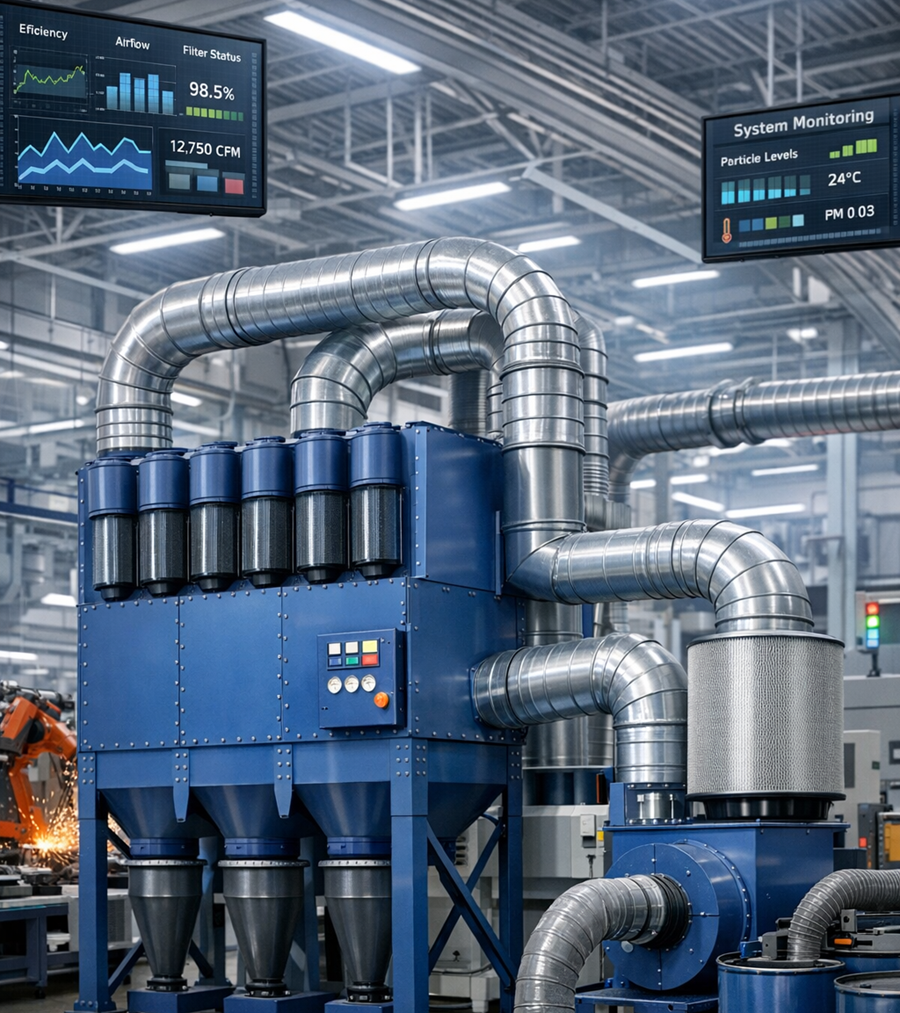
Smart factories are transforming the global manufacturing landscape through automation, robotics, and data-driven production systems. In these advanced facilities, maintaining clean air and controlling airborne particles has become a critical operational requirement rather than a secondary concern. A modern Dust Collector plays an essential role in protecting sensitive machinery, maintaining high product quality, and ensuring worker safety across high-tech sectors such as CNC machining, metal fabrication, EV component manufacturing, and electronics assembly.
Manufacturers investing in Industry 4.0 infrastructure increasingly buy or source advanced Dust Collector systems from global suppliers to maintain peak operational efficiency. Industrial buyers often compare Dust Collector sale price, installation cost, shipping time, and factory inventory availability before placing orders with international manufacturers or specialized suppliers. Without a robust dust management strategy, smart factories risk significant production downtime, premature equipment failure, and expensive regulatory compliance issues.
Core Functions of Dust Collector Technology in Automated Production Facilities
In a smart manufacturing environment, airborne particulates generated by high-speed machining, grinding, laser cutting, and material handling must be captured at the source. A high-performance Dust Collector system ensures stable production conditions and protects the massive capital investment represented by automated equipment.
Key functions of modern Dust Collector technology include:
- Airborne particle filtration from high-precision machining and fabrication processes.
- Protection of CNC machines, robotic arms, and automated sensors from abrasive dust.
- Improved worker health and safety compliance regarding OSHA and local air quality standards.
- Reduction of cross-contamination in precision electronics and medical device manufacturing.
- Efficient collection of metal dust, plastic particles, and volatile composite debris.
- Enhanced facility cleanliness, which is vital for the optical sensors used in automated production lines.
- Prevention of equipment overheating caused by dust buildup on cooling fans and heat sinks.
Strategic procurement teams typically order Dust Collector systems from industrial suppliers that maintain deep in-stock inventory and offer fast shipping options to minimize potential production bottlenecks.
Types of Dust Collector Systems Used in Smart Manufacturing
Selecting the correct filtration technology is a prerequisite for facility efficiency. Smart factories often source Dust Collector equipment directly from Chinese factory manufacturers or international industrial suppliers depending on their specific cost structure and required filtration capacity.
Common Dust Collector Technologies for Industrial Facilities
| Dust Collector Type | Best Application | Key Advantages | Typical Buyers |
| Cartridge Dust Collector | CNC machining and laser cutting | High filtration efficiency; compact footprint | Precision manufacturers |
| Baghouse Dust Collector | Heavy metal fabrication | Handles massive dust volumes and high temps | Steel mills and heavy industrial plants |
| Cyclone Dust Collector | Pre-filtering large particles | Low maintenance; no moving parts | Foundries and woodworking shops |
| Wet Dust Collector | Combustible metal dust | Improved explosion safety (NFPA compliant) | Aerospace and EV battery plants |
| Portable Dust Collector | Small workshops/Flexible lines | Mobility and quick plug-and-play setup | Prototype labs and SME factories |
Procurement managers usually request a quote from multiple Dust Collector manufacturers to compare the total cost of ownership, including the initial sale price, international shipping logistics, and system performance specifications.
Integration of Dust Collector Systems with Industry 4.0 Technologies
The shift toward Industry 4.0 has transformed the traditional Dust Collector from a passive “vacuum” into a connected piece of intelligent industrial infrastructure. Modern systems are no longer isolated; they integrate seamlessly with IoT sensors, predictive maintenance platforms, and factory-wide monitoring software. These smart systems track airflow performance, filter saturation, and energy consumption in real-time.
Manufacturers operating automated production facilities often buy Dust Collector units equipped with smart monitoring technology to reduce maintenance overhead and avoid unexpected “stop-page” events. Key Industry 4.0 capabilities found in premium units include:
- Real-time airflow monitoring to ensure consistent suction at the tool head.
- Predictive filter replacement alerts based on differential pressure data.
- Variable Frequency Drives (VFD) for energy consumption tracking and optimization.
- Remote performance diagnostics accessible via mobile or desktop dashboards.
- Automated system control integration with the central factory PLC.
Industrial buyers frequently evaluate Dust Collector manufacturer capabilities and the quality of supplier technical support before placing high-volume wholesale equipment orders.
Key Factors Manufacturing Buyers Should Evaluate When Sourcing
When selecting a Dust Collector for a smart manufacturing facility, procurement teams must look beyond the initial sale price. A comprehensive analysis of operational and logistical factors is required to ensure a high ROI.
Important sourcing considerations include:
- Required airflow capacity (CFM) tailored to the specific cubic footage of the production environment.
- Chemical properties of dust generated (e.g., oily mist vs. dry metallic dust).
- Compatibility with existing automated production lines and ductwork.
- Dust Collector sale price vs. the long-term energy and filter operating costs.
- Maintenance requirements, specifically the ease of access for filter changes.
- Supplier Inventory: Availability of in-stock systems to meet tight commissioning deadlines.
- Logistics: Factory lead times and reliable international shipping options.
- Safety Compliance: Ensuring the unit meets ATEX or NFPA standards for combustible dust.
- Manufacturer Support: Availability of a local or rapid-response spare parts inventory.
Industrial buyers frequently compare Chinese Dust Collector manufacturers, international specialty suppliers, and OEM providers to find the optimal balance of performance, delivery speed, and wholesale cost.

Cost Structure and Procurement Considerations
The “landed cost” of industrial filtration is multifaceted. Manufacturers often source Dust Collector equipment from Chinese factories due to highly competitive wholesale pricing and the ability to scale production for large-scale facility build-outs.
Industrial Dust Collector Procurement Cost Factors
| Cost Component | Description | Buyer Consideration |
| Equipment Sale Price | The base cost of the Dust Collector unit | Compare multiple supplier quotes |
| Installation Cost | Ductwork, electrical integration, and setup | Depends on factory footprint and layout |
| Filter Replacement | Ongoing consumable maintenance expense | Critical for long-term O&M budgeting |
| Energy Consumption | Daily operating power requirements | Smart VFD systems significantly reduce cost |
| Shipping & Logistics | International freight and customs duties | Evaluate supplier location and transit time |
| Spare Parts | Replacement motors, valves, and control units | Verify manufacturer after-sales support |
While the initial order price is important, procurement teams must also prioritize supplier reliability and the availability of technical documentation to ensure the system integrates with the smart factory’s digital twin.
Future Trends in Dust Collector Technology for Smart Factories
As smart manufacturing continues to expand globally, the sophistication of Dust Collector technology will scale accordingly. Future developments are already moving toward AI-driven predictive maintenance, where the system “self-cleans” based on particulate load, and energy-efficient filtration technologies that recirculate conditioned air to save on HVAC costs.
Manufacturing companies investing in these advanced environments increasingly order Dust Collector systems from specialized manufacturers and global suppliers that offer smart monitoring, competitive sale prices, and reliable shipping support. These innovations ensure that dust management remains a core component of a clean, safe, and highly profitable smart manufacturing facility.

very informative